
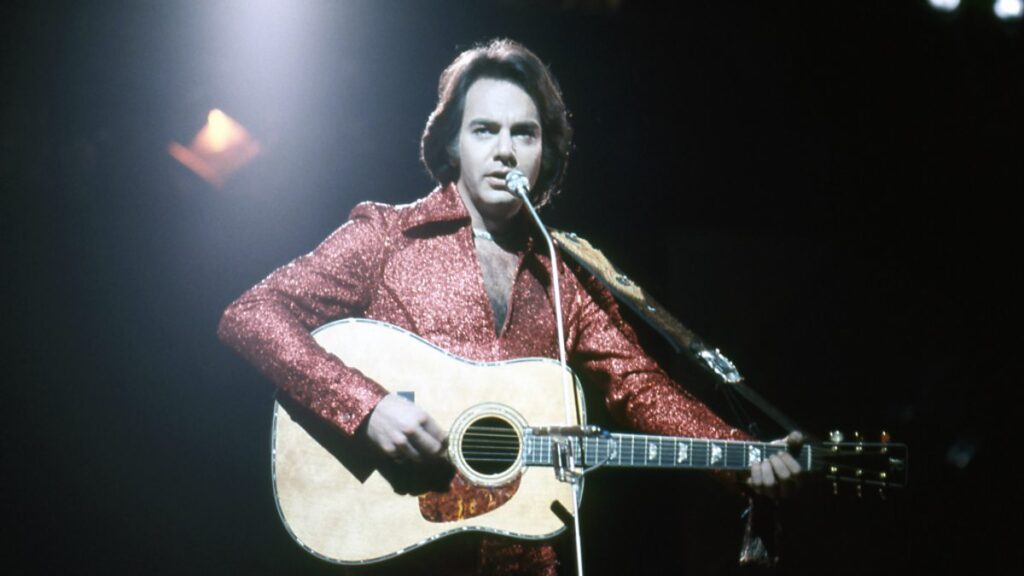
“Little Drummer Boy” in Neil Diamond’s voice is a humble offering made enormous—an old carol turned into a quiet act of dignity, where the smallest gift becomes the bravest kind of love.
There are Christmas songs that sparkle like tinsel, and there are Christmas songs that feel like a candle held in two hands. Neil Diamond’s “Little Drummer Boy” belongs to the second kind. He recorded it for The Christmas Album, released September 22, 1992 on Columbia, produced by Peter Asher, with David Campbell credited for orchestral and choir arrangements. That’s the factual frame—and it matters, because Diamond didn’t approach this material as novelty. He approached it with the same serious, grainy sincerity that made his best records feel like they were written for real rooms and real lives.
If you’re looking for the “ranking at launch,” the most accurate story is the album’s, not a single’s. Diamond’s “Little Drummer Boy” wasn’t rolled out as a chart single; instead, it lived inside an album that became a genuine seasonal mainstay. The Christmas Album reached No. 8 on the Billboard 200—a strong mainstream peak for a holiday set, especially one aimed at adult contemporary listeners rather than teen pop churn. And that’s exactly how many people met this recording: not as “the new song on the radio,” but as a track inside a record that returned every December like an old friend who never needs to explain why they’re back.
Now, the older story behind the song Diamond is singing reaches far beyond 1992. “The Little Drummer Boy” began life as “Carol of the Drum,” written by American composer Katherine Kennicott Davis in 1941. It was later popularized widely by the Harry Simeone Chorale’s 1958 recording—one of those cultural moments where a song seems to suddenly belong to everyone. The tale itself—this poor boy summoned to the Nativity with nothing to offer but his playing—isn’t found in the Bible; it’s a folk-like invention that endures because it speaks to a human fear that never goes out of date: What if I have nothing worthy to bring?
That question is where Neil Diamond becomes the perfect narrator.
Diamond’s gift has never been delicate refinement; it’s conviction. His voice is famously rough-edged, a little weathered even when it’s warm—like a hand that has done work. On “Little Drummer Boy,” that grain makes the boy’s humility feel physical. You can almost hear the cold air outside the stable, the awkwardness of arriving empty-handed, the private panic of being seen among gifts you can’t match. Yet the song doesn’t pity the boy. It honors him. The drummer doesn’t argue for his worth; he simply plays his best. And the miracle, in the carol’s logic, is not that he becomes rich or praised—it’s that sincerity is accepted as enough.
That’s the deeper meaning of this carol, and why Diamond’s interpretation can hit so hard in the quiet hours of December. Christmas, for all its brightness, often brings a shadow: memory, absence, time passing, people you wish were still at the table. A song like “Little Drummer Boy” doesn’t deny any of that. It answers it with a gentler truth—one that feels almost radical in a season of display: what matters most is the offering that comes from the heart, not the one that comes from the store.
And because Diamond recorded this within a carefully orchestrated, choir-backed setting—Peter Asher shaping the production, David Campbell giving it that cinematic, reverent lift—his performance becomes a kind of late-night pageant, but without emptiness. It’s grandeur used in service of humility: a big sound making room for a small boy’s gift.
So when Neil Diamond sings “Little Drummer Boy,” he isn’t merely revisiting tradition. He’s reminding us what tradition is for: to carry the simplest, most necessary ideas through the years. That you can arrive imperfect. That you can arrive afraid. That you can arrive with only your “best,” whatever that is—and still be welcomed.