
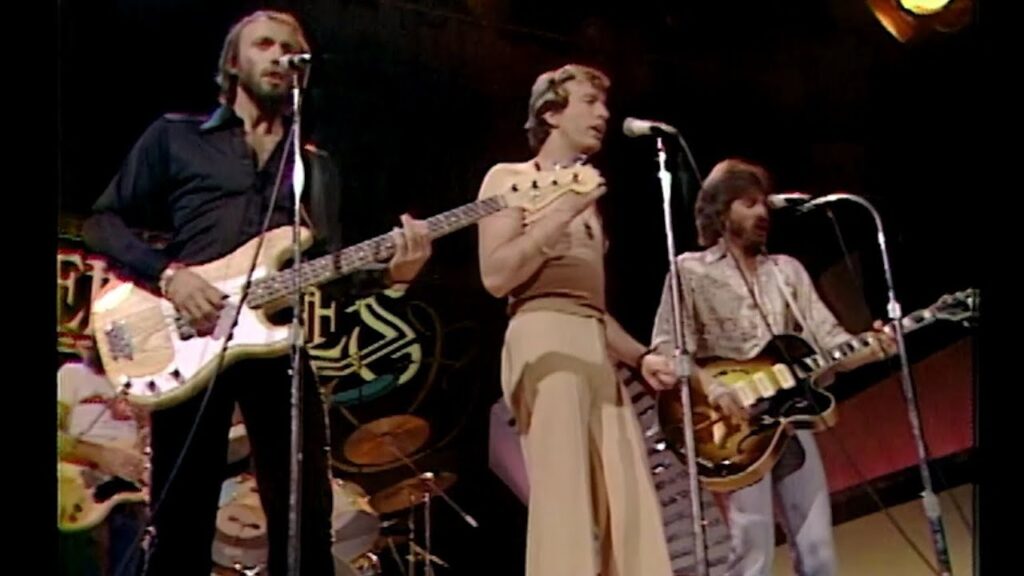
“Baby As You Turn Away” is the Bee Gees’ soft goodbye at the edge of reinvention—love fading in real time, sung so gently it feels like it’s happening in your own room.
If the Bee Gees’ 1975 comeback is often summarized with the snap of “Jive Talkin’” and the midnight shimmer of “Nights on Broadway,” then “Baby As You Turn Away” is what happens after the lights thin out and the door finally clicks shut. It’s the closing track on Main Course—released in May 1975 (U.S.) and August 1975 (U.K.)—and it wasn’t promoted as a major single, which is part of its strange power. This isn’t a song that tries to “win” you quickly. It waits. It watches someone leave. And it turns that small human moment into something almost ceremonial.
Placed at the very end of Main Course, the song functions like a last exhale—an intimate epilogue after an album that deliberately reshaped the Bee Gees’ sound toward American R&B, funk, and what the world would soon call disco. The record itself proved the strategy worked: it peaked at No. 14 on the U.S. Billboard album chart and stayed on the Billboard 200 for 74 weeks, carried by hit singles that did get the radio push. But “Baby As You Turn Away” wasn’t designed to be a chart bullet. It was designed to be felt—quietly, privately, and maybe a little too honestly.
One of the most important “behind the song” details is also the most revealing: the album’s own recording history notes that “Baby As You Turn Away” was the final song recorded for Main Course, and it features Barry Gibb singing the verses in a new kind of falsetto—not yet the towering, laser-bright instrument of “Stayin’ Alive,” but a softer, more vulnerable version, like a man trying to say goodbye without letting his voice break. This is why the track matters so much in Bee Gees history: it’s a hinge. It’s the sound of a signature being discovered, not declared.
And that discovery isn’t just technical—it’s emotional. Falsetto here doesn’t feel like style; it feels like exposure. The song’s very premise is simple: someone is leaving, and the narrator can only watch it happen, trying to speak gently enough that love might turn around. That restraint is the heartbreak. There’s no theatrical storming out, no grand revenge. Just the quiet terror of realizing you cannot hold a person in place with good intentions alone.
Main Course is often credited to producer Arif Mardin, with the Bee Gees recording in this era at Criteria Studios in Miami, where the warm, modern rhythm textures of mid-’70s American music were in the air. But “Baby As You Turn Away” almost deliberately steps away from the album’s sharper grooves and leans into something more timeless: a slow, sighing ballad shape the Bee Gees had always excelled at—only now the edges are smoother, the room is darker, and the pain is more adult.
There’s also something quietly symbolic in how the song ends the album. Main Course is, in many ways, about movement: new cities, new studio air, new rhythmic language, the Bee Gees learning how to sound contemporary again. But “Baby As You Turn Away” isn’t about movement you choose. It’s about movement that happens to you—someone else walking away, leaving you to stand still and feel the distance grow. That contrast makes the closer linger long after the final note: the album has been dancing forward, and then—suddenly—it admits the cost.
In the Bee Gees’ wider story, this track also carries a special kind of premonition. Later records would turn the falsetto into a cultural landmark, a sound that seemed to own the decade. Yet here, it’s still tender, almost hesitant, like the first time someone admits a truth aloud. And that’s why “Baby As You Turn Away” can feel so personal even now: it doesn’t sound like a band trying to make history. It sounds like three brothers making a small room out of a big career—one last song, one last look, one last plea that arrives too late.
You don’t put “Baby As You Turn Away” on when you want a hit. You put it on when you remember how goodbyes really happen: not with a dramatic speech, but with a body turning away… and the awful gentleness of the heart still speaking as if it might change anything.