
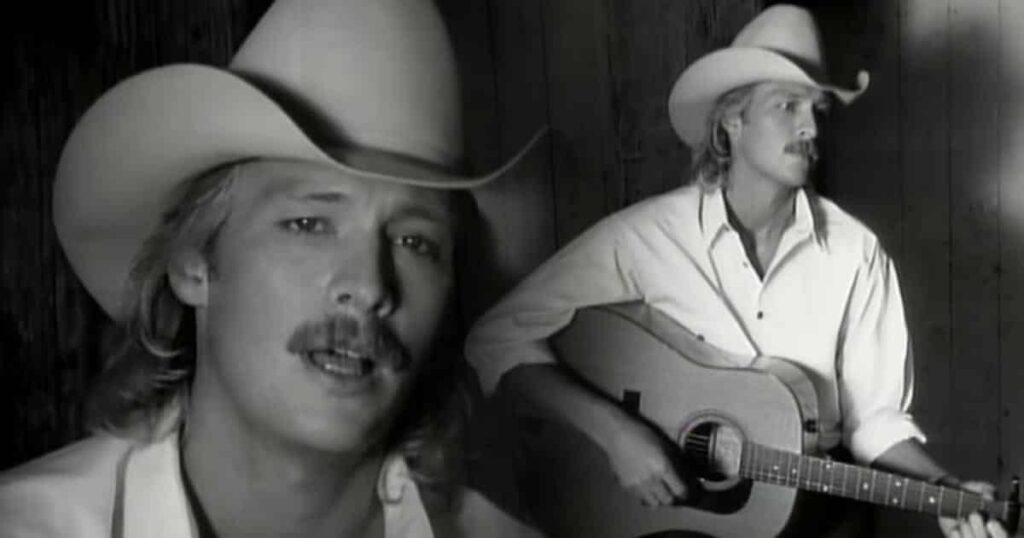
A Rollicking Ode to Chrome, Asphalt, and the American Spirit of Motion
When Alan Jackson released “Mercury Blues” as a single from his 1993 album A Lot About Livin’ (And a Little ’bout Love), he did more than revive a rhythm-and-blues relic—he retooled it into a gleaming piece of country machinery. The song raced up the charts, peaking at No. 2 on the Billboard Hot Country Singles & Tracks chart, proof that Jackson’s easy drawl and tight band could turn even a mid-century car song into something distinctly his own. By this point in his career, Jackson had already cemented himself as one of the defining voices of the neotraditional country movement; “Mercury Blues” was both a tribute to America’s musical past and a reminder of how effortlessly he could bridge the distance between roots and radio.
Originally written by K.C. Douglas and Robert Geddins in 1948, “Mercury Blues” began life as an electric blues number—a rough-and-ready ode to the allure of a car that could win hearts as easily as it could devour miles. Jackson’s rendition preserves that swagger but dresses it in Nashville steel and Telecaster twang. His version is jubilant rather than raw, a barn-burning celebration rather than a lament or boast. There’s a grin behind every chord, the sense that speed and romance have always been cousins on America’s long highways.
To understand this song’s enduring pull, one must listen beyond its playful lyrics and barroom bounce. Jackson transforms an emblem of postwar consumer confidence—the Mercury automobile—into a stand-in for freedom itself. His voice rides above crisp drums and honky-tonk piano, evoking not just horsepower but heart power: the restless spirit that makes people chase horizons simply because they can. The song captures that moment in American history when chrome was king and desire was measured in cubic inches—a cultural shorthand for youth, rebellion, and possibility. Yet Jackson’s genius lies in making this nostalgia sound alive, not archival. He doesn’t merely imitate vintage cool; he revives its energy for an audience still yearning for unbridled joy in an increasingly complicated world.
Musically, “Mercury Blues” exemplifies Jackson’s gift for fusion. The arrangement leans on traditional country instrumentation—fiddle lines that swoop like passing countryside, steel guitar accents shining like sun off polished metal—but it’s built atop an R&B chassis that keeps the rhythm pulsing forward. That blend gives the track its irresistible drive: country heart, blues engine. It’s no wonder Ford Motor Company later used Jackson’s rendition in advertising campaigns—the song itself feels like motion incarnate.
In essence, “Mercury Blues” stands as one of Alan Jackson’s most spirited recordings: a joyous reminder that beneath every great country tune hums a longing for movement, romance, and release. It is not merely about a car; it is about what that car represents—the promise of escape, the thrill of pursuit, and the enduring melody of freedom roaring down an open road lined with memory and myth.