
“Islands in the Stream” is a promise sung in two voices: that love can be a safe shore, even when the world keeps pulling everything apart.
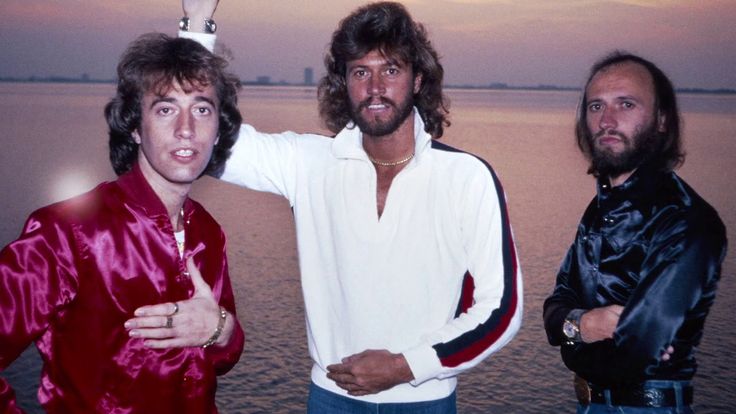
First, one important correction—because the truth makes the song’s magic even richer: “Islands in the Stream” is not a Bee Gees single in the usual sense. It was written by the Bee Gees (Barry, Robin, and Maurice Gibb) and recorded as a duet by Kenny Rogers and Dolly Parton, released August 15, 1983 as the lead single from Rogers’ album Eyes That See in the Dark. If you’ve ever felt that unmistakable Bee Gees “glow” in the melody—warm, adult, slightly aching—you’re hearing the brothers’ songwriting fingerprints, pressed gently into country-pop.
The chart story is the kind that only happens when a record crosses borders without losing its soul. In the United States, the duet reached No. 1 on the Billboard Hot 100—and according to Billboard’s own No. 1 chronology for 1983, it ruled the top spot for two consecutive chart weeks: October 29, 1983 and November 5, 1983. A contemporary anniversary recap also notes that during those same two weeks, the song held No. 1 simultaneously on Billboard’s pop, adult contemporary, and country charts—a rare three-crown moment that tells you just how universally it landed.
In the UK, we can pinpoint the “at debut” position precisely: Official Charts shows the single’s first UK chart date as November 12, 1983, entering at No. 70, and eventually peaking at No. 7 on January 7, 1984. That slow climb is part of its romance—this wasn’t a flash of hype; it was a song that kept being invited back into living rooms, long drives, and late-night radios.
The story behind the song is full of fascinating “almosts.” The title nods to Ernest Hemingway’s 1970 novel Islands in the Stream, lending the duet a quietly literary frame—two people trying to stay connected while life keeps moving around them. And while the best-documented origin points to the Bee Gees initially shaping it in an R&B direction for Diana Ross, the myth of “it was for Marvin Gaye” has its own famous moment: on Good Morning America in 2001, Barry begins, “We wrote ‘Islands in the Stream,’ originally for Diana Ross—” and Robin jumps in to insist they wrote it for Marvin Gaye, joking that they sent it but “he was dead,” which—history being what it is—became part of the song’s lore. (The band themselves, even in that exchange, sound like brothers teasing each other—memory, ego, and laughter all tangled up.)
But the meaning of “Islands in the Stream” doesn’t depend on which star it was “meant” for. Its emotional core is simpler—and deeper. The phrase suggests separation and connection at once: islands are apart, yet they share the same water. The lyric turns that into a relationship philosophy: we may be distinct people with separate worries, histories, and bruises, but we can still be a steady pair inside the same moving current. That idea hits hardest not when love is easy, but when it’s being tested—when the world feels loud and unreliable, and the only real relief is a voice that answers yours.
That’s why the duet works so beautifully. Kenny Rogers sings like reassurance—calm, grounded, a hand on the shoulder. Dolly Parton sings like light—bright but never shallow, a little tremble that makes the devotion feel brave. And behind them, invisibly, are the Bee Gees: craftsmen of longing, shaping a melody that knows how to bloom without shouting. The production team—credited as Gibb-Galuten-Richardson—polishes the track until it feels effortless, but the emotional effect is anything but casual: it’s intimacy made singable.
Years later, the Bee Gees did record it themselves—first as a live performance released on One Night Only (1998) and then as a studio version released in 2001—almost like the song eventually came home, carrying with it everything it gathered in the world.
In the end, calling it “Bee Gees – Islands in the Stream” isn’t wrong in spirit—it’s simply incomplete. This is a Bee Gees song that became a Kenny & Dolly classic, and that’s the miracle: three brothers in pop’s most sophisticated workshop wrote a love song sturdy enough to live anywhere. And decades on, it still feels like what it always was—two people choosing each other, not because the waters are calm, but because they aren’t.