
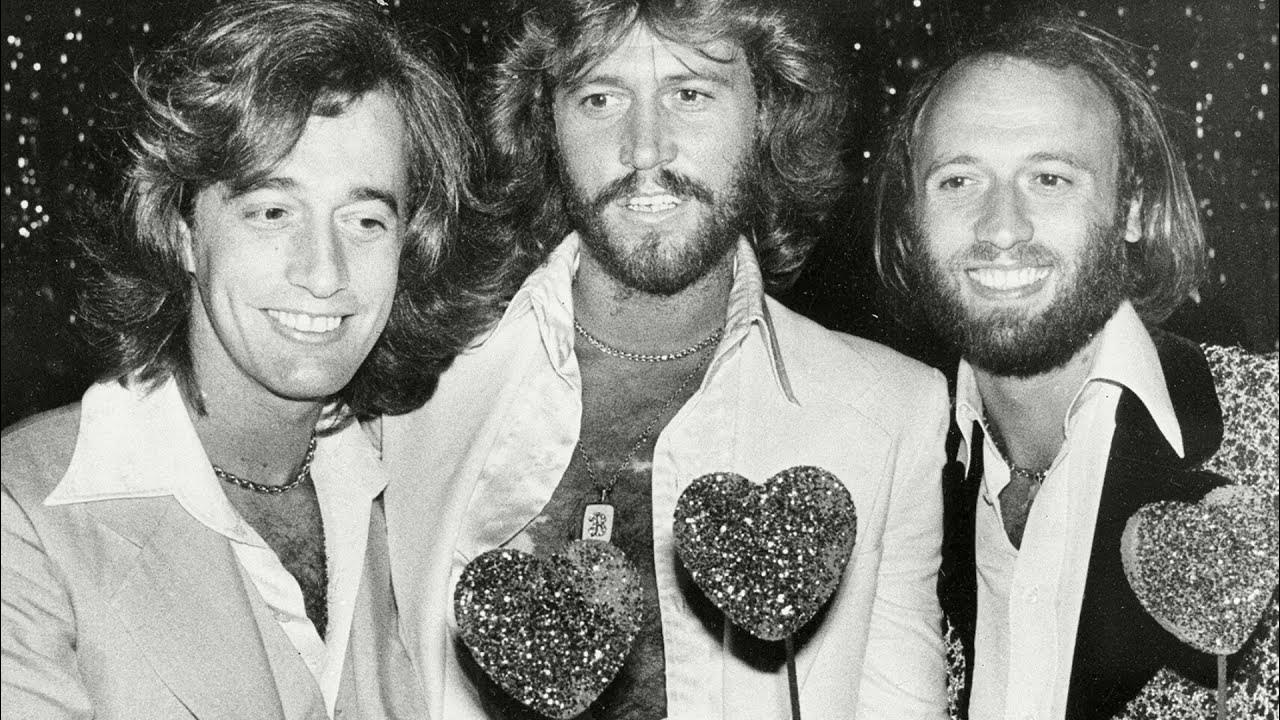
“Somebody Stop the Music” is the Bee Gees’ paradox: a song that moves like a party, yet thinks like a heartbreak—dancing on the edge of panic, where the tune won’t stop and neither will the feeling.
“Somebody Stop the Music” belongs to the Bee Gees’ early-’70s “in-between” era—after the psychedelic glow of the late ’60s and before the world-changing disco years—when Barry Gibb, Robin Gibb, and Maurice Gibb were writing in rich colors and restless shapes. It appears on their 1971 album Trafalgar, released in September 1971 in the U.S. (and November 1971 in the U.K.), recorded from January 28 through April 1971 at IBC Studios in London, and produced by the Bee Gees with Robert Stigwood. The track itself is credited to Barry Gibb and Maurice Gibb as writers—an interesting detail, because that pairing gives the song a slightly different emotional architecture than the Barry/Robin ballad machinery that dominates parts of the album.
If you’re looking for the “ranking when it arrived,” “Somebody Stop the Music” wasn’t pushed as a major standalone single—its impact is album-deep rather than chart-led. The album Trafalgar did chart strongly, reaching No. 34 on the Billboard 200 in the U.S. So this song’s “debut” is really the album’s debut: it arrived inside a record that listeners were buying for “How Can You Mend a Broken Heart”—the group’s first U.S. No. 1 single—then discovering the stranger corners when they stayed for the rest of the side.
And “Somebody Stop the Music” is one of those corners—unusual, slightly crooked, and therefore unforgettable.
On paper, it’s placed as track 6 on the album sequence, surrounded by softer material, which makes its energy feel even more startling when it arrives. The personnel also explains the texture: Alan Kendall on lead guitar and Geoff Bridgford on drums (Bridgford’s only full-length appearance as an “official member” on a Bee Gees album), with orchestral arrangements by Bill Shepherd and engineering credited to Bryan Scott. Even when the song leans toward rock bite, there’s still that unmistakable Bee Gees sense of structure—melody and harmony stacked like careful architecture, emotion carried by craft.
The story behind the song, as best we can trace it, isn’t a tabloid anecdote but a composer’s one: Bee Gees historian/sessionographer Joseph Brennan points out that Barry and Maurice’s collaboration here feels like it “breaks free” from a certain staleness, and he notes how the track seems to pivot into a “song fragment” midstream—an example of the brothers letting a piece evolve rather than behave politely. Another critic, Julian Cope, hears it as deliberately “uncertain,” stitched from odd segments in a way that feels intentionally dislocated—like the music itself can’t settle down, because the narrator can’t.
That’s the key to its meaning.
Despite the title’s lively surface, “Somebody Stop the Music” is not a carefree dance tune. It’s closer to a nervous waltz with the lights turned low. The phrase “stop the music” sounds at first like a joke—something you’d shout at a party when the night has spun too far. But in the Bee Gees’ hands, it becomes a plea: please, stop the spinning in my head; stop the memory-loop; stop the tune that keeps reopening the same wound. It’s a song about being unable to escape your own soundtrack.
What makes it so emotionally effective is that it never commits to one single mood. It shifts—sometimes quickly—between momentum and melancholy, as if happiness and dread are sharing the same body. That kind of writing is very Bee Gees in 1971: romantic, theatrical, slightly surreal, willing to risk “too much” feeling because understatement wouldn’t tell the truth. Even writers who aren’t always gentle with Trafalgar tend to single out “Somebody Stop the Music” for its oddness—because oddness, in this case, is honesty.
And there’s something else—something quietly nostalgic—about hearing it now. Trafalgar takes its name from an old battle, and much of the album carries a wintery seriousness. In that setting, “Somebody Stop the Music” feels like the moment the narrator tries to run—tries to laugh it off, tries to move faster than the sorrow—only to realize the sorrow is keeping pace. That’s a very grown-up kind of heartbreak: not the first break, but the break you recognize, the one you can’t romanticize anymore.
So the song remains what it has always been: a restless little theatre piece inside a soft-rock album, the Bee Gees proving—long before disco made them mythic—that they could turn a simple phrase into a complicated human truth. Sometimes the music is the problem. Sometimes it’s the thing that keeps love alive long after love has left. And sometimes, when the night is too loud and memory won’t behave, the most human prayer you can manage is the same one this song keeps whispering—half smiling, half undone:
Somebody stop the music.