
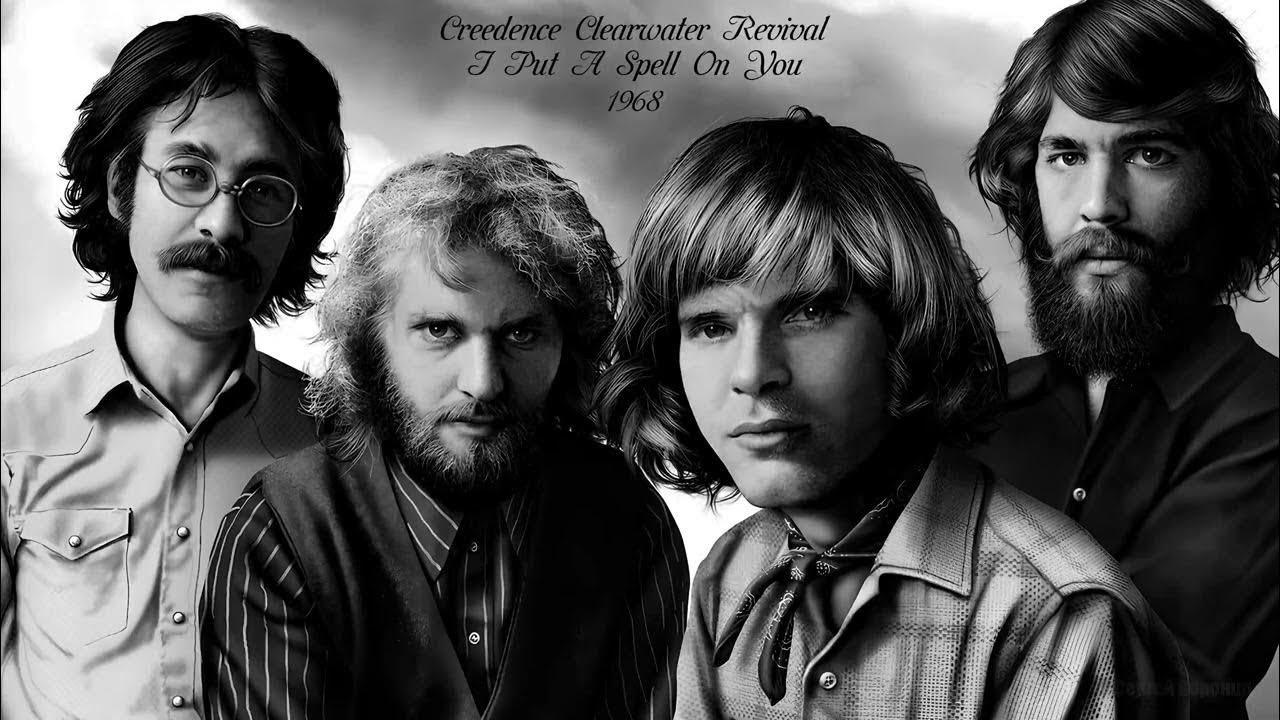
Before the hits made Creedence Clearwater Revival a household name, Get Down Woman revealed the band in its rawest and most hard-driven form, already full of tension, confidence, and unmistakable character.
Released in 1968 on Creedence Clearwater Revival, the band’s self-titled debut album, Get Down Woman was never issued as a major standalone hit, so it did not chart on the Billboard Hot 100 by itself. But the album that carried it reached No. 52 on the Billboard 200, and that mattered. It was the record that introduced a wider audience to a group that sounded older, tougher, and more weathered than many of their late-1960s peers. The album’s commercial doorway was Susie Q, which climbed to No. 11 on the Hot 100, yet songs like Get Down Woman told a deeper story about who this band really was before the legend fully arrived.
There is something especially fascinating about early CCR recordings because they let us hear the moment before destiny hardens into identity. By the time the world embraced Proud Mary, Bad Moon Rising, and Green River, the sound of the band felt inevitable. But on the debut album, the edges are still close enough to touch. Get Down Woman comes from that threshold. It is not polished in the way later classics would be polished. It is lean, a little rough around the corners, and all the better for it. You can hear a young band that had already spent years paying dues under earlier names, learning how to strip a song down until only the groove, the attitude, and the nerve remained.
Written by John Fogerty, Get Down Woman carries the blunt emotional language of blues and garage rock rather than the mythic Americana that would later become one of his signatures. The song feels like a confrontation in a dim room, a warning delivered with a clenched jaw and a steady rhythm behind it. It is not tender. It is not dreamy. It moves with the kind of directness that suggests a band still playing for survival as much as expression. That is part of its appeal. Before Creedence Clearwater Revival became masters of atmosphere, they were masters of pressure, and this track presses forward with exactly that kind of urgency.
Musically, the performance says a great deal about why CCR stood apart. John Fogerty sings with that familiar rasp that already sounded older than his years, never smooth, never overly decorative, always committed. Tom Fogerty helps shape the rhythm guitar bed, while Stu Cook and Doug Clifford keep the track anchored with the kind of no-nonsense pulse that would become one of the band’s great strengths. Even this early, they understood something many groups miss: a rock song does not need excess if the beat feels true and the vocal carries conviction. Get Down Woman is built on that principle.
The story behind the song is inseparable from the story behind the debut album itself. After years of frustration in the music business, changing names and trying to find the right direction, the band emerged as Creedence Clearwater Revival with a clearer sense of purpose. Their first album mixed covers with originals, and that balance matters. It showed where they came from and where they were headed. On the same record, listeners could hear the ominous drama of I Put a Spell on You, the long-form hypnotic pull of Susie Q, and then a song like Get Down Woman, which felt less like an attempt at a hit and more like a statement of internal character. This was not decoration. This was foundation.
In terms of meaning, Get Down Woman speaks in the language of mistrust, emotional friction, and hard boundaries. It belongs to a long blues tradition of romantic conflict, but what makes it memorable is the way CCR avoids theatrical excess. They do not overplay the drama. Instead, they tighten it. The tension lives in the groove, in the clipped phrasing, in the refusal to sweeten the message. That restraint gives the song durability. It feels less like a period piece and more like a glimpse into the emotional bluntness that older rhythm-and-blues records carried so naturally.
What also makes the song worth revisiting is how clearly it shows the distance between fame and essence. Not every important Creedence Clearwater Revival track became a radio monument. Some songs remained album cuts, known best by devoted listeners who stayed long enough to hear past the famous titles. Get Down Woman is one of those songs. It may not have the instant recognition of Fortunate Son or Have You Ever Seen the Rain, but it offers something just as valuable: evidence of formation. It lets us hear the band before the mythology was complete, when the sound was still being hammered into shape by instinct, discipline, and hunger.
And perhaps that is why the song lingers. It carries no grand historical slogan, no giant chorus built for an arena, no sentimental afterglow. What it has is honesty of attack. In that sense, it feels almost private, as though the listener has stumbled into the workshop before the masterpieces were framed. For anyone who loves tracing an artist back to the first sparks, Get Down Woman is more than a deep cut from Creedence Clearwater Revival. It is a reminder that greatness often begins not in triumph, but in grit, repetition, and the sound of a band discovering how powerful it already is.