
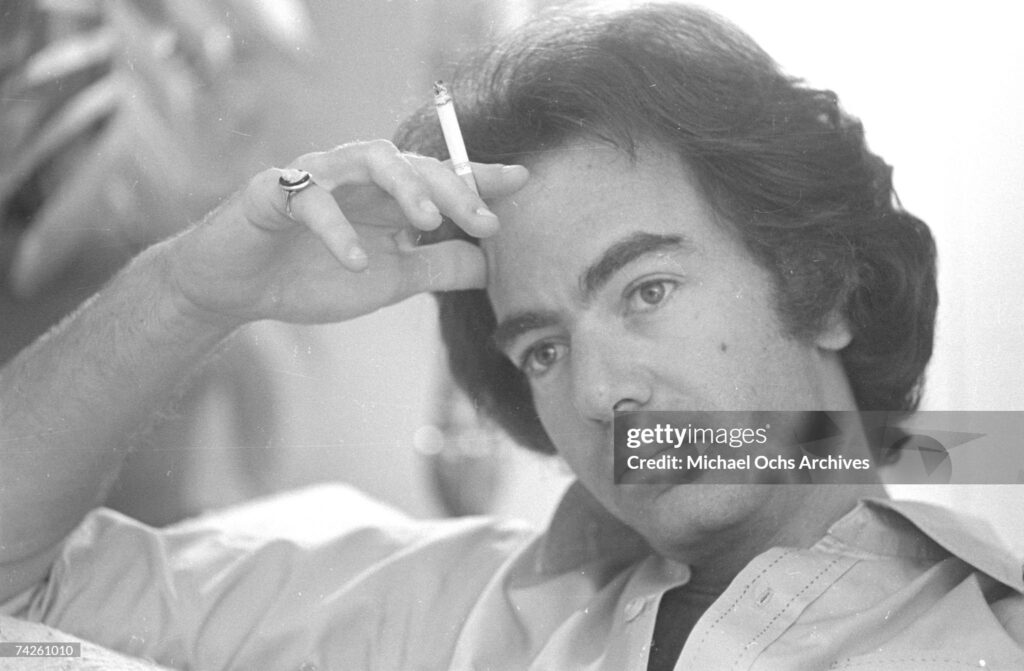
“Suzanne” captures the moment when Neil Diamond was still young, hungry, and searching—turning uncertainty, desire, and tenderness into a pop song that already carried the emotional signature of a future legend.
Long before the sold-out arenas, the sequined shirts, and the giant choruses that would make Neil Diamond one of the defining voices of his era, there was “Suzanne”—a 1966 single that showed just how quickly his songwriting instincts were sharpening into something unmistakable. Released during his early years with Bang Records, the song climbed to No. 17 on the Billboard Hot 100, a strong showing that helped confirm Diamond was far more than a promising songwriter behind the scenes. He was beginning to emerge as a performer with a voice, a mood, and a point of view all his own.
That matters, because “Suzanne” sits at a fascinating crossroads in the Neil Diamond story. This was still the period when he was building his reputation song by song, single by single, before the grand emotional sweep of later records such as Hot August Night, Tap Root Manuscript, or Jonathan Livingston Seagull. Yet even here, in a compact mid-1960s pop framework, you can hear the qualities that would define him for decades: yearning, rhythm, romantic tension, and that curious ability to sound both confident and vulnerable at the same time.
Musically, “Suzanne” has the brisk movement of the era, but it is not disposable pop. It carries a pulse that feels urgent, almost conversational, as if the singer is trying to close the distance between himself and someone who already occupies too much of his thoughts. There is a slight ache beneath its brightness. That was one of Neil Diamond’s quiet gifts even in the beginning—he could write songs that moved with radio-friendly immediacy while still letting emotional complexity seep through the melody.
The story behind the song is also part of what makes it memorable. In the mid-1960s, Diamond was coming out of the Brill Building tradition, writing with discipline and commercial instinct, but also pushing toward something more personal. Many young writers of that period could deliver a catchy single; fewer could plant a mood that lingered after the record ended. “Suzanne” may not be discussed as often as “Solitary Man,” “Cherry, Cherry,” or “Girl, You’ll Be a Woman Soon,” but it belongs to that same breakthrough chapter. It helped establish the emotional world that listeners would come to recognize immediately as Diamond’s own.
There is also something deeply revealing in the way the song handles romance. “Suzanne” is not written as a grand declaration from a man who has everything figured out. It feels more human than that. It suggests fascination, longing, and the uncertainty that comes when affection is stronger than certainty. That emotional shading is one reason the song still feels alive. It does not merely present love as triumph. It presents it as a force that unsettles, excites, and exposes.
For listeners who discovered Neil Diamond later through monumental songs like “Sweet Caroline,” “Cracklin’ Rosie,” or “I Am… I Said,” returning to “Suzanne” can be a moving experience. You hear an artist before the full mythology formed, but the seeds are all there. The phrasing already leans toward drama. The vocal already knows how to press into a line until it sounds lived in. And the songwriting already reveals a man who understood that the most memorable pop songs are often the ones carrying a private bruise beneath a polished surface.
Its historical place is important too. The mid-1960s were crowded with extraordinary voices, ambitious singles, and a rapidly changing pop landscape. To break through at all required craft; to be remembered required identity. Neil Diamond had both. “Suzanne” may not have become his signature anthem, but it played a meaningful role in shaping his path. It widened his audience, strengthened his chart presence, and proved that his early success was not a fluke. Each single was adding another piece to the portrait.
And perhaps that is why the song still resonates with such warmth. It carries the feeling of an artist on the verge—already gifted, already recognizable, but still reaching toward the larger destiny waiting ahead. There is something touching about hearing Neil Diamond at that stage: not yet the towering live performer, not yet the elder statesman of American song, but a young man writing and singing as though emotion itself were a kind of compass.
In that sense, “Suzanne” is more than an early hit. It is a glimpse into the making of a musical identity. It reminds us that before the biggest choruses came the intimate tensions, the searching melodies, and the songs that tested how much feeling a three-minute record could hold. And Neil Diamond, even then, was already learning how to make a song feel like a confession wrapped in rhythm.
That is the lasting meaning of “Suzanne”: not simply that it succeeded on the charts, but that it preserved a young songwriter’s emotional fingerprint at the very moment the wider world was beginning to notice. For anyone who loves the long arc of Neil Diamond’s career, this record remains a beautiful and revealing early chapter—restless, romantic, and unmistakably his.