
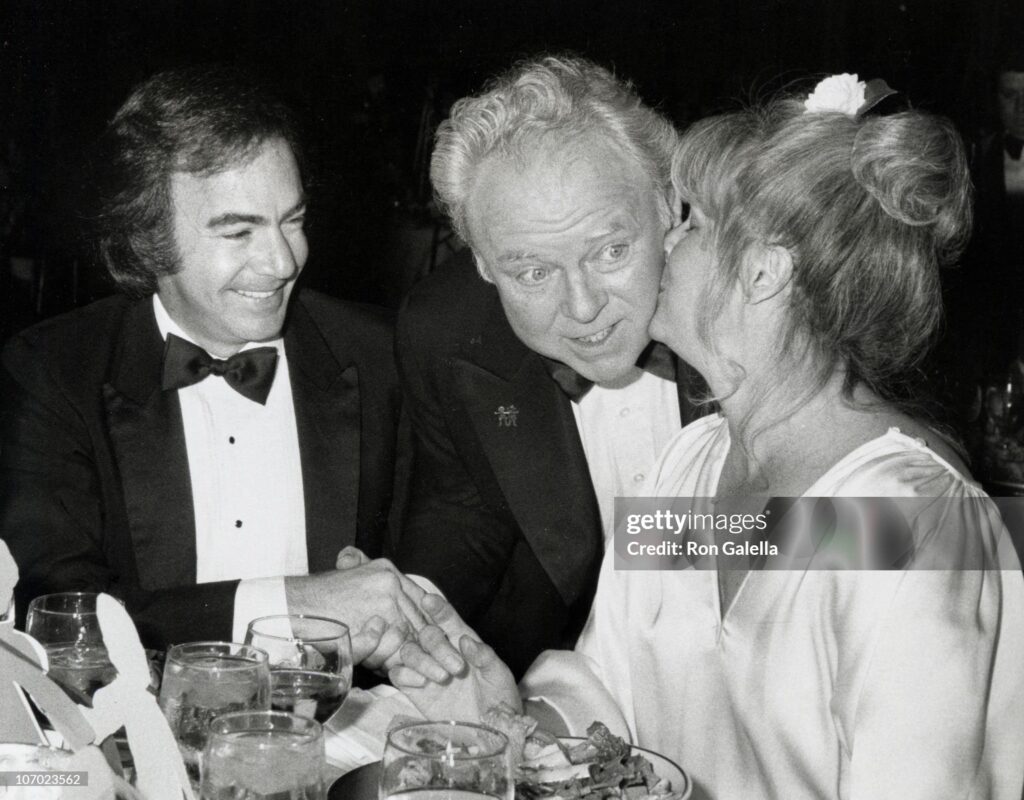
“The Boat That I Row” captures the young Neil Diamond in a state of restless motion—part confession, part declaration of independence, and all heart.
Long before Neil Diamond became one of the defining voices of American popular music, he was already writing songs that carried his signature mix of urgency, melody, and emotional candor. “The Boat That I Row” is one of those early jewels—a song that may not always sit first in the public memory beside his biggest standards, but one that tells us a great deal about the artist he was becoming. It is spirited, stubborn, melodic, and full of movement, as if even in its earliest bars it refuses to stand still.
Written by Neil Diamond in the 1960s, the song first gained major attention when Lulu recorded it in 1967. Her version became a substantial hit in the United Kingdom, climbing to No. 6 on the UK Singles Chart. That chart success mattered. It showed not only that Diamond could write for himself, but that his songs had enough character and emotional drive to travel through someone else’s voice and still arrive with force. In those years, that was no small thing. Songwriters were often judged by whether their work could live beyond a demo, beyond a publishing office, beyond the hope of a first hearing. “The Boat That I Row” did exactly that.
When listeners return to the song now, what stands out is its tension between freedom and strain. The title itself is deceptively simple. A boat suggests motion, direction, solitude, and responsibility. To row your own boat is to accept your own burden, but it is also to claim your own course. That idea runs straight through the song’s emotional center. There is determination in it, but also fatigue. There is self-belief, but not comfort. It is the sound of a young man pushing forward because standing still is not an option.
That is one reason the song still feels so vivid. In Neil Diamond’s early writing, there was often a strong sense of inner momentum—songs that sounded as though they were trying to break out of the room they were written in. “The Boat That I Row” belongs to that world. It carries the pulse of ambition, the unease of self-discovery, and the loneliness that sometimes comes with refusing to let others steer your life. Those themes would echo across much of Diamond’s later work, but here they appear in a leaner, younger, almost raw form.
There is also something deeply revealing in the way the song balances pop craft with emotional meaning. The melody is direct and memorable, and the structure is accessible enough to feel immediate on first listen. But underneath that accessibility is a writer reaching for something more personal than a disposable pop single. That was one of Diamond’s great gifts. Even in songs built for the radio, he often found a way to suggest a private struggle, a human ache, or a life being wrestled into shape.
His own recorded version, issued during his early recording years, gives the song another layer of meaning. Hearing Neil Diamond sing “The Boat That I Row” brings the lyric closer to its source. The phrasing has that familiar Diamond intensity—the sense that he is not merely delivering a line but leaning into it, testing it, trying to live inside it. In that sense, the song feels less like a performance piece and more like a personal statement from an artist who already understood that identity is not handed to you; it is built, choice by choice, stroke by stroke.
The period in which the song emerged is important too. The mid-to-late 1960s were crowded with transformation in pop and rock music. Artists were expanding what a single could say, how it could sound, and how much personality it could carry. Neil Diamond, still early in his rise, was finding a voice that could compete in that landscape without imitating it. He had Brill Building discipline, a pop instinct for hooks, and a performer’s hunger for direct connection. “The Boat That I Row” reflects all three.
What makes the song endure is not simply its catchy construction or its chart history through Lulu. It endures because it speaks to a familiar human condition: the feeling that life is yours to steer, yet the effort of steering it can be exhausting. That is a mature emotional truth wrapped in a brisk, memorable song. Many listeners know that feeling intimately—the need to keep moving, to trust your own hand, to carry yourself through uncertain water even when no one can do the work for you.
And perhaps that is why this early Diamond composition still carries such a pull. It reminds us that before the arena anthems, before the platinum-selling albums, before “Sweet Caroline” became a communal ritual, there was already a songwriter with his sleeves rolled up, writing about struggle, will, and self-direction in language simple enough to sing and deep enough to remember. “The Boat That I Row” may come from the beginning of the story, but it does not feel minor. It feels foundational.
In the end, the song stands as an early map of Neil Diamond’s artistic character: melodic but driven, accessible yet inward-looking, polished on the surface and quietly searching underneath. For those who admire not only the legend he became but the young craftsman he once was, “The Boat That I Row” is more than an early song. It is a glimpse of the engine already running.