
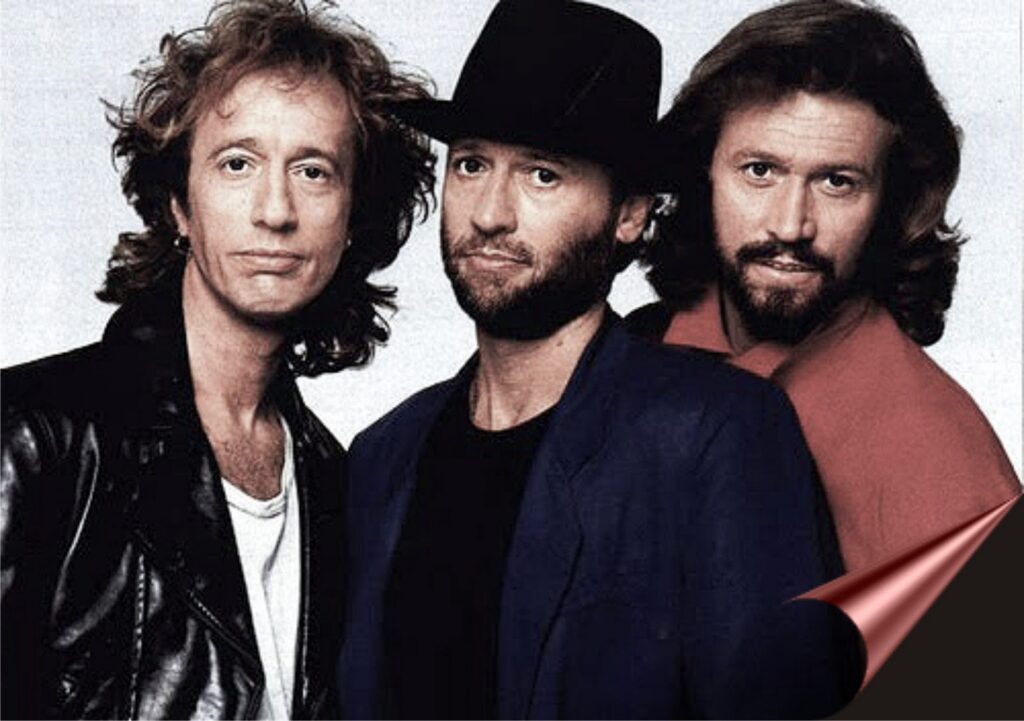
“Don’t Forget to Remember” has your heart almost before the melody finishes introducing itself, because the Bee Gees understood how to make tenderness sound immediate—as if memory, regret, and love had all arrived in the same breath.
There are songs that become moving once the chorus opens up, once the arrangement swells, once the listener has had time to settle into the story. And then there are songs like “Don’t Forget to Remember”, which seem to touch something fragile almost at once. Before the melody fully lands, the feeling is already there. You hear the title, you hear that soft, pleading tenderness in the line itself, and suddenly the song is no longer simply playing—it is remembering for you.
That was one of the Bee Gees’ quiet miracles in this period. They had an instinct for emotional immediacy, for writing songs that did not need to explain their sadness too heavily because the ache was already built into the phrasing. “Don’t Forget to Remember”, released in August 1969, came from the Cucumber Castle era and was written by Barry Gibb and Maurice Gibb. It reached No. 2 on the UK Singles Chart, while in the United States it climbed only to No. 73 on the Billboard Hot 100—a striking difference that says something about how powerfully the song connected in Britain and several overseas markets even if America responded more modestly at the time. It also topped charts in countries including Ireland, the Netherlands, New Zealand, and South Africa.
But chart history, useful as it is, only grazes the surface of why the song still lingers. What makes “Don’t Forget to Remember” so affecting is the emotional paradox in the title itself. It is both a plea and an acceptance. It asks to be held in memory, yet it already sounds aware that separation has happened or is happening. That is the sting of it. The song does not rage against loss. It simply asks not to be erased by it. And few things in popular music are sadder than that kind of modest request.
The timing of the song deepens everything. By mid-1969, Robin Gibb had left the group, and the Bee Gees were in a visibly fractured period. “Don’t Forget to Remember” belongs to that unsettled chapter, when Barry and Maurice were carrying on without him. In retrospect, that makes the song’s emotional atmosphere feel even more poignant. It is not only a song about romantic remembrance; it emerges from a moment when the group itself was living through division, uncertainty, and a fragile sense of continuation. Sometimes a song absorbs the mood of the hour around it, even without stating it directly. This one seems to do exactly that.
Musically, the record is gentler than some of the Bee Gees’ more ornate late-1960s productions, and that gentleness is part of its power. It leans toward a country-flavored ballad style, with Barry Gibb singing in a lower register than usual. That choice matters. Instead of floating above the song, he settles into it. The voice sounds intimate, almost conversational, as if the words are being spoken across a distance that cannot quite be crossed anymore. There is very little strain in the performance, and that restraint makes the sadness feel more believable. The song does not try to conquer your emotions. It simply places its hand on them.
And perhaps that is why your line feels exactly right: before the melody fully lands, the song already has your heart in its hands. Because the first emotional gesture is enough. The title is enough. The tone is enough. There is no need for melodrama when the central feeling is so universally understood. To ask someone not to forget you is one of the simplest things a heart can say, and one of the most vulnerable. It contains love, fear, pride, and defeat all at once.
What I have always found especially beautiful about “Don’t Forget to Remember” is that it belongs to a Bee Gees chapter often overshadowed by the bigger mythologies around them—the psychedelic ambition of the late 1960s, the international triumphs of the 1970s, the disco era that came to define them for millions. Yet this song reminds you how exquisite they could be in a quieter register. They did not always need grandeur. Sometimes they were at their most piercing when they sounded almost plainspoken, almost humble, as if they were trusting the song to carry itself on feeling alone.
That feeling, of course, is memory. Not nostalgia in the decorative sense, but memory as ache—memory as the one thing left when presence is gone. “Don’t Forget to Remember” understands that beautifully. It does not ask for reconciliation. It does not demand explanation. It asks only for a place in the other person’s inner life. That smallness is exactly what makes it so large.
So yes, before the melody has even completely unfolded, “Don’t Forget to Remember” has already done its work. It has already reached the listener where the most lasting songs do—somewhere between longing and recognition, where the heart hears itself being addressed. And that is why the record still feels so tender all these years later. The Bee Gees were singing softly, but they knew exactly where to touch the wound.