
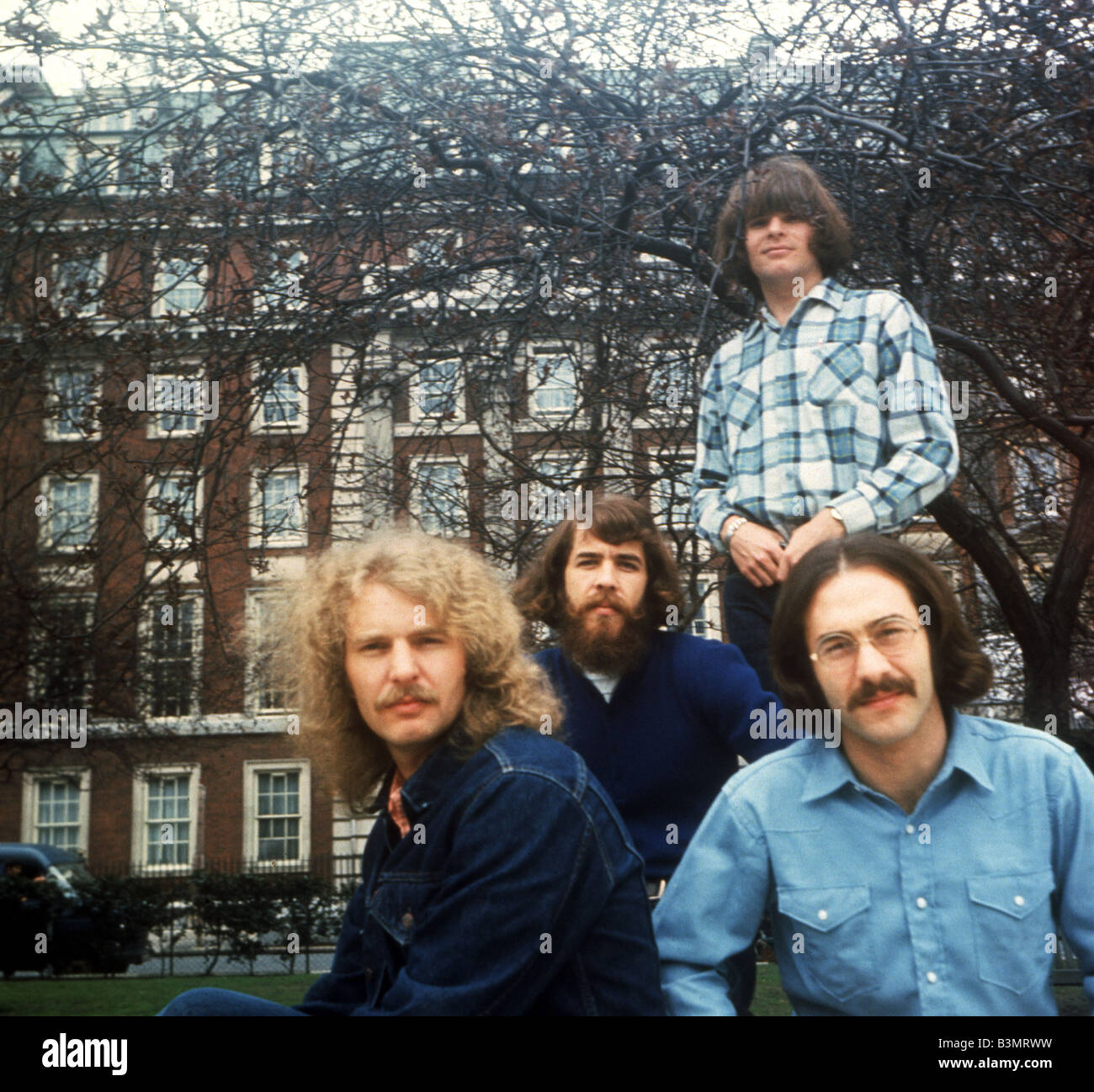
“Who’ll Stop the Rain” still feels heavy before it feels comforting, because Creedence Clearwater Revival turned one troubled moment in American life into a song that sounds as if the sky itself has learned how to remember.
There are songs that belong to an era, and then there are songs that seem to carry the weather of that era inside them forever. “Who’ll Stop the Rain” is one of those. Before the melody has fully settled, before the listener has even decided whether the song is sad or resolute, it already brings with it a sense of burden—of skies that do not clear quickly, of promises that do not quite hold, of ordinary people looking up and wondering how much more they are meant to endure. That is why the song still reaches so deeply. It is not merely about rain. It is about the feeling of living through a time when the storm seems larger than any one person can stop.
When Creedence Clearwater Revival released the song in January 1970 as the flip side of “Travelin’ Band,” they were already one of the great American groups of their moment, but “Who’ll Stop the Rain” revealed something especially enduring about John Fogerty as a writer. He could take a plain image—rain, crowd, cold, waiting—and let it stand for a whole national mood without making the song feel forced or self-important. The single rose to No. 2 on the Billboard Hot 100, and later the song appeared on Cosmo’s Factory, released on July 8, 1970, the album that would spend nine weeks at No. 1 on the Billboard 200. Those are major chart facts, yes, but with a song like this they almost feel secondary. The record’s real achievement was emotional. It said something people already felt but had not heard made this simple, this haunting, this human.
Part of what makes the song last is that it never sounds like a slogan. Many listeners have long heard it as a shadowed reflection of the Vietnam era, and that reading has stayed with the song for good reason. But Fogerty also tied its final verse very specifically to Woodstock, recalling the scene of the crowd “rushed together, trying to keep warm.” In other words, the song holds both the public and the personal at once: the broad anxiety of a troubled age, and the immediate, almost physical memory of standing in the rain with everyone else, wet, cold, and no wiser than before. That is one of the reasons the song still feels so powerful. It does not preach from above the moment. It stands inside it.
And that, really, is the quiet genius of “Who’ll Stop the Rain.” It is political without becoming rigid, poetic without becoming obscure. The opening lines carry a biblical weariness, as if disappointment did not begin in 1970 at all, but had been following mankind for generations. Then the song moves through images of plans, crowds, and history’s false assurances with such ease that you hardly notice how much it is saying until the ache is already inside you. Fogerty was never an overwriter. He trusted ordinary language. In this case, that plainness makes the song sting more. A storm described too elegantly might have become decorative. This one feels real.
Musically, too, the song is part of its own meaning. Set against the ferocious rock-and-roll charge of “Travelin’ Band,” “Who’ll Stop the Rain” comes in with an almost homespun steadiness—acoustic guitar, folk-rock grace, and that unmistakable CCR blend of rootsiness and restraint. It sounds as though it has been around forever, which is one of the hardest effects a songwriter can achieve. There is nothing inflated about it. No grand orchestral sorrow, no theatrical collapse. Instead, there is movement—gentle, persistent movement—like a person walking through bad weather because there is nothing else to do. That modest musical frame is exactly what allows the song’s emotional weight to grow.
What I think still moves listeners most is that the song never pretends storms pass neatly. It offers no triumphant solution. The title itself is a question, and a painful one. Who’ll stop the rain? Not when will it stop, but who can stop it. That difference matters. It suggests that trouble is not only natural but human-made, woven into power, history, and the repeated failure of leaders and crowds alike to deliver the world they promise. Yet the song is not hopeless. Its very act of asking carries a kind of battered faith. To ask the question is still to believe that someone, somewhere, ought to answer.
That is why “Who’ll Stop the Rain” continues to carry the weight of a troubled era so beautifully. It remembers confusion, disillusionment, and the cold discomfort of living through history when history does not feel noble at all. But it also remembers endurance. It remembers the human habit of standing together in the weather, however uncertainly, and singing anyway. Creedence Clearwater Revival made many great records, but this one has a special gravity because it turns an era’s unrest into something intimate enough to feel like your own memory. The storm may belong to 1970, but the ache in the song belongs to every time people look at the world around them and wonder why the sky still has not cleared.