
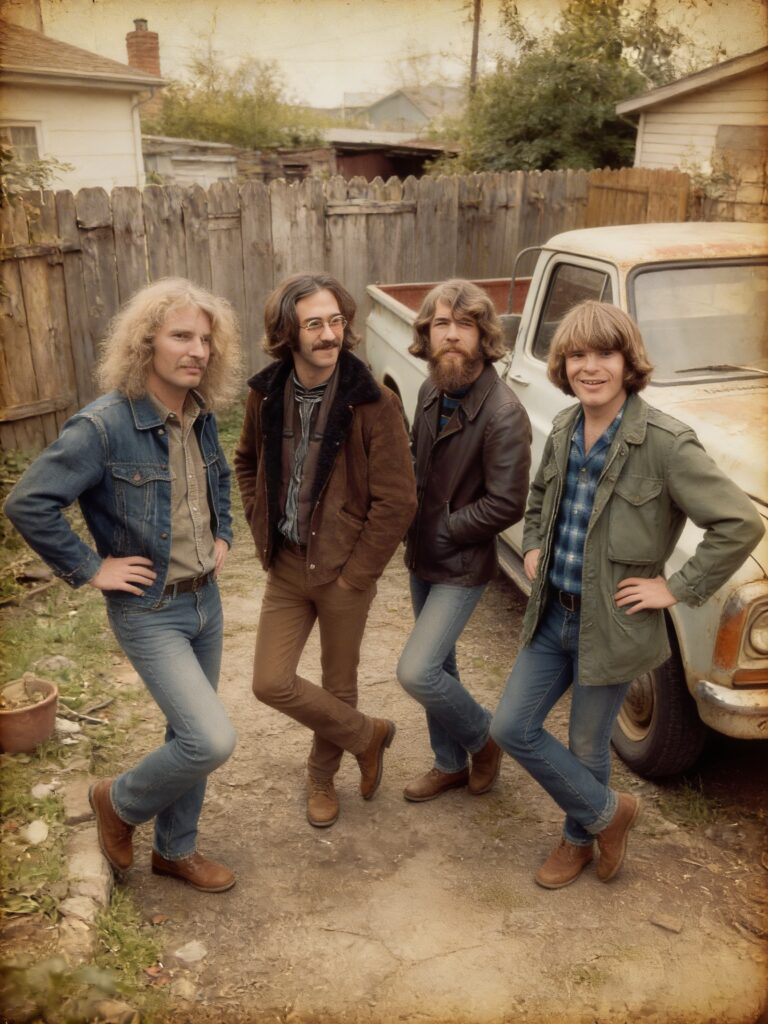
“Lookin’ Out My Back Door” endures because Creedence Clearwater Revival took a little burst of backyard imagination and turned it into something larger than novelty—joyful, strange, wonderfully loose, and somehow as comforting as a summer afternoon that never really leaves you.
There is a special delight in “Lookin’ Out My Back Door” because it arrives like a grin. Not a forced grin, not one of those songs straining to prove how playful it is, but something lighter and more natural than that. When Creedence Clearwater Revival released it in July 1970 from Cosmo’s Factory, they were already masters of toughness, drive, and hard American momentum. They had made records that felt urgent, swampy, suspicious of power, and full of working-man motion. Then along came this one—bouncy, whimsical, almost childlike in its imagery—and instead of feeling slight, it felt liberating. That contrast is part of why the song became one of their most beloved hits. It showed that John Fogerty could loosen his grip on the storm clouds and still sound unmistakably like himself.
The chart story helps explain just how deeply people took to it. “Lookin’ Out My Back Door” was released as a single on July 25, 1970, with “Long as I Can See the Light” on the other side. It became CCR’s fifth and final No. 2 hit on the Billboard Hot 100, blocked from the top spot by Diana Ross’s “Ain’t No Mountain High Enough,” and it did even better on Cash Box, where it reached No. 1. Internationally, it also topped charts in places like Australia, Canada, Norway, and Sweden. Meanwhile, Cosmo’s Factory, released earlier that same month on July 8, 1970, spent nine consecutive weeks at No. 1 on the Billboard 200. In other words, this was not some charming little side note in the CCR catalog. It was a major hit from a major album at the very height of the band’s power.
But numbers alone do not explain why the song still feels so loved. The real secret is the mood. “Lookin’ Out My Back Door” has whimsy in it, yes, but it is whimsy with rhythm, with swagger, with that wonderfully easy rolling motion CCR could summon better than almost anyone. The song does not float away into fantasy. It stays grounded even while its images turn playful and surreal. That balance is what makes it so appealing. A lesser band might have made the song merely cute. CCR made it feel lived-in, like imagination stepping into ordinary life for a few sunlit minutes.
Its backstory only makes that sweetness more appealing. For years, plenty of listeners assumed the song was drug-coded because of its oddball imagery, but John Fogerty has long said otherwise. He has pointed instead to Dr. Seuss, specifically And to Think That I Saw It on Mulberry Street, as an inspiration, and social posts from Fogerty and CCR have repeated that explanation in recent years. That matters, because it changes the emotional color of the song. Instead of a wink from the counterculture, it feels more like a fatherly piece of make-believe—private, playful, affectionate, and touched by the freedom of seeing the world through a child’s delighted eyes.
And perhaps that is exactly why the song has worn so well. Creedence Clearwater Revival were often associated with bayou grit and social unease, but here they proved they could make room for ease and wonder without losing their identity. The record still has that clipped Fogerty phrasing, that sturdy groove, that no-nonsense American directness. Yet inside it is a little parade of absurdity and pleasure. It reminds us that even in 1970, with all the heaviness in the air, a great rock-and-roll band could still open a window and let in a little laughter.
There is something deeply endearing in that. So many classic songs survive because they are grave, wounded, or monumental. “Lookin’ Out My Back Door” survives because it trusts delight. It trusts the listener to enjoy a tune that dances a little, smiles a little, and never apologizes for being bright. That is not a small achievement. Joy, when it is done honestly, can be just as lasting as sorrow. CCR understood that. They gave the song enough muscle to keep it from turning flimsy, and enough charm to make it feel instantly familiar.
In the end, that may be why this song remains one of their most beloved hits. Creedence Clearwater Revival did not merely flirt with whimsy here—they gave it shape, pulse, and staying power. They turned a playful glance out the back door into a piece of American pop memory that still feels fresh, still lifts the room, and still reminds us how beautiful a little nonsense can sound when a great band plays it straight.