
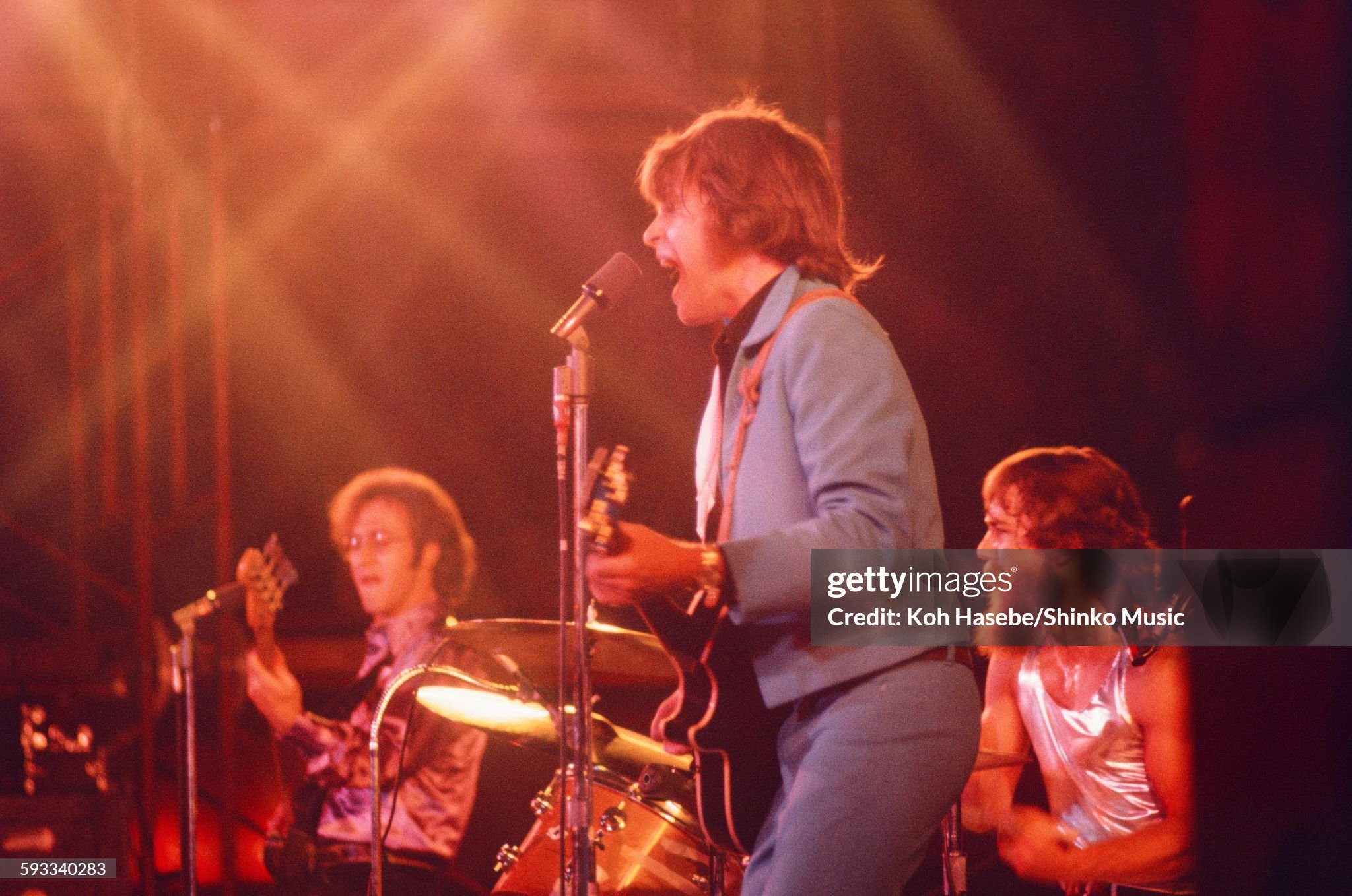
“Born on the Bayou” at Woodstock is Creedence Clearwater Revival at their most primal—dark, swampy, and thunderously alive, the sound of a California band turning an imagined Southern dream into something raw enough to shake a midnight field.
One of the most important facts to put right at the top is that “Born on the Bayou (Live at the Woodstock Music & Art Fair / 1969)” comes from Creedence Clearwater Revival’s legendary Woodstock set, performed at Max Yasgur’s farm in Bethel, New York, in the early hours of August 17, 1969. The song was the opening number of their set, and later official live releases and track listings preserved it as the first blast of CCR’s long-overlooked Woodstock appearance. That matters, because this was not a casual festival performance buried in the middle of the night and forgotten by the band’s own standards alone. It was the opening strike of one of the tightest, hardest-working American bands of the era, playing at the most mythic festival in rock history.
The song itself already carried enormous weight by then. “Born on the Bayou” had been released in January 1969 on Bayou Country, the second Creedence Clearwater Revival album, and it also appeared as the B-side of “Proud Mary.” Written by John Fogerty, it was never the main A-side hit, yet it quickly became one of the defining songs in the CCR catalog. It is one of those records that tells you almost everything about the band in one sweep: the swamp-rock pulse, the ominous guitar, the rough authority in Fogerty’s voice, and the astonishing ability to make an invented Southern landscape feel more real than reality.
That invented quality is crucial to the song’s magic. John Fogerty did not grow up in Louisiana bayou country. He grew up in California, and later reflections on his writing have emphasized that he had never really lived the Southern world he evoked so vividly in songs like “Born on the Bayou.” But that only makes the song more fascinating. It is not documentary. It is myth. Fogerty took American fragments—heat, water, mud, childhood memory, danger, desire—and turned them into a place that feels both specific and dreamlike. That is why the song still hits so hard. It is less about geography than atmosphere. It is about the dark, seductive pull of an America that may exist more fully in music than on any map.
And this is exactly why the Woodstock version matters so much. In the studio, “Born on the Bayou” is already thick with menace and humidity. Live at Woodstock, it feels more immediate, more muscular, and more dangerous. The crowd setting, the late-night hour, and the sheer force of CCR’s live attack make the song sound even more elemental. It no longer feels like a carefully shaped studio atmosphere. It feels like weather rolling in across the field. Fogerty does not merely sing it; he drives it. The band locks into that stern, relentless groove with the kind of discipline that made Creedence Clearwater Revival so different from many of their peers. They were not about psychedelic drift or indulgent sprawl. Even at Woodstock, even in the dark, they were about command.
What makes “Born on the Bayou” so enduring, though, is the emotional contradiction at its center. It is a song of place, but also of longing. A song of identity, but also of invention. The title sounds like a proud declaration, yet the atmosphere of the song is uneasy, shadowed, almost haunted. The singer seems drawn toward something older, rougher, and more dangerous than ordinary life. In that sense, the song is not simply about being born somewhere. It is about wanting to belong to a world of deeper instinct and darker beauty. That yearning gives the song its real depth. It is not nostalgia in the soft sense. It is nostalgia with mud on its boots and thunder in the background.
Placed inside the Woodstock legend, the performance gains another layer. CCR’s set was famously not included in the original Woodstock film, which helped make their appearance seem almost ghostlike for years, despite the strength of the playing. That absence only adds to the fascination now. Hearing “Born on the Bayou” from Woodstock feels like recovering a missing chapter from rock history: a great American band, at the height of its powers, stepping onto the most famous stage of the era and opening with one of its darkest, strongest songs.
So “Born on the Bayou (Live At The Woodstock Music & Art Fair / 1969)” deserves to be heard as more than a festival curio. It is a Woodstock opener, a live counterpart to one of CCR’s essential 1969 studio creations, and a reminder that this band could bring swamp-rock dread and American myth into a muddy upstate New York field and make it sound completely inevitable. What lingers longest, though, is the feeling of that opening surge: a guitar, a howl, and the dark water of the song rising at once.