
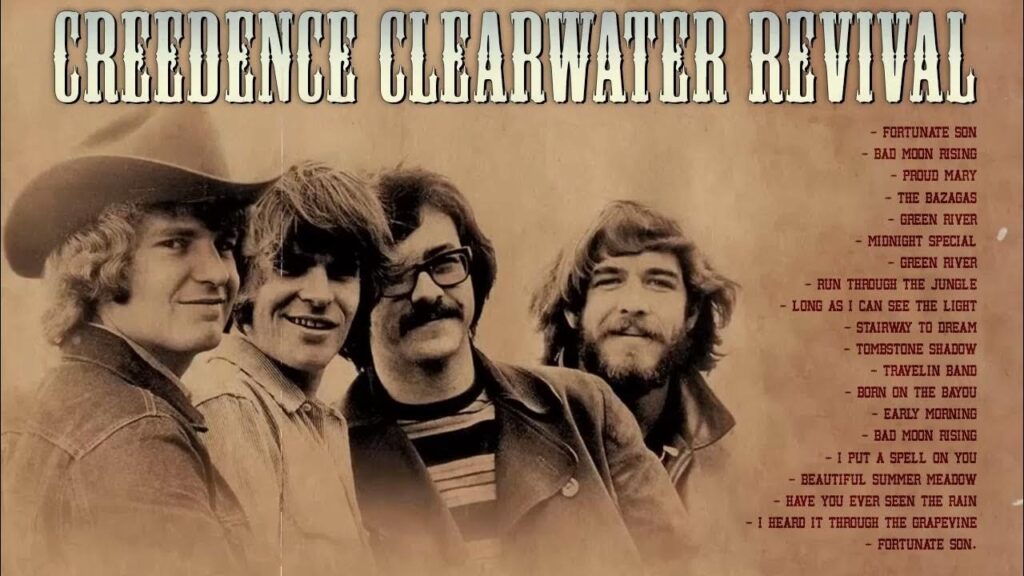
“Green River/Suzie Q” live in Stockholm catches Creedence Clearwater Revival in two of their purest elements at once—memory and menace, the bright pull of summer freedom suddenly melting into the darker, deeper groove that first made them dangerous.
One of the most important facts to place right at the beginning is that “Green River/Suzie Q (Live in Stockholm)” is not a studio-era medley from 1969, but an archival live recording from Stockholm on September 21, 1971, later issued as a bonus track on the 40th Anniversary Edition of Green River. The medley runs about 4:28, and its later release history places it alongside other 1971 European live recordings added to the expanded album. That matters, because this performance belongs to the final stretch of Creedence Clearwater Revival’s working life, not to the original moment when “Green River” and “Suzie Q” first became part of the band’s legend.
That contrast is part of what makes the performance so fascinating. By 1971, CCR were no longer the roaring young American band that had stormed through 1969 with impossible speed and discipline. They were older, more strained internally, and much closer to the end. Yet in this Stockholm performance, they still sound unmistakably like themselves—lean, unsentimental, and electrically alive. The medley brings together two songs that represent different but equally essential sides of the group’s identity. “Green River”, originally a 1969 single and a No. 2 hit on the Billboard Hot 100, is one of John Fogerty’s great memory songs, all childhood heat, riverbank freedom, and the myth of American summer. “Suzie Q,” by contrast, was the group’s breakthrough epic from 1968, the long, hypnotic remake of Dale Hawkins’s rockabilly-blues number that first announced CCR as something tougher, swampier, and stranger than the polished rock around them.
Put together onstage, those two songs reveal a great deal about Creedence Clearwater Revival. “Green River” is compact and vivid, one of Fogerty’s most economical acts of musical nostalgia. Its roots lie not in some actual Southern swamp, but in Putah Creek memories from his California childhood, transformed into a broader American dream of water, dust, and freedom. “Suzie Q,” on the other hand, belongs to the band’s darker early vocabulary—repetition, groove, and a kind of roadhouse hypnosis. It was the track that first let the band stretch out and brood. In the Stockholm medley, those two impulses meet: the daylight of memory and the nighttime pull of the groove.
That is the deeper beauty of this live pairing. It reminds us that CCR were never only a singles band, however brilliant their singles were. They were also a live unit that understood tension, pacing, and how to let a song breathe without losing its hard spine. “Green River/Suzie Q” does not feel like a casual mashup. It feels like a little summary of the band’s emotional range. The first half offers the open air of remembered freedom; the second drifts toward the heavier, more insinuating pulse that made early CCR so riveting. The songs do not cancel each other. They deepen each other.
There is also something quietly poignant in hearing this from September 1971. Because the recording comes from the final year of the band’s existence, it carries a faint afterglow. The crowd hears the power; we, listening later, also hear the closing of a chapter. A medley like this becomes more than a performance. It becomes evidence of what the band still could do even when the internal story was fraying. The toughness is still there. The snap of the rhythm is still there. Fogerty’s voice still cuts like wire. What remains strongest is that old CCR miracle: even live, even late, even with history pressing in, they could make American rock feel at once immediate and mythic.
And that is why “Green River/Suzie Q (Live in Stockholm)” deserves to be heard as more than a bonus-track curiosity. It is a 1971 Stockholm performance later attached to the expanded Green River reissue, but emotionally it reaches backward through the whole CCR story. It touches the childhood glow of “Green River” and the long-shadowed menace of “Suzie Q,” then binds them together in one compact live statement. What lingers is not only nostalgia, and not only force. It is the meeting of both. In just a few minutes, Creedence Clearwater Revival manage to sound like river water in summer and neon in the dark—two sides of the same American dream, still crackling under the stage lights.