
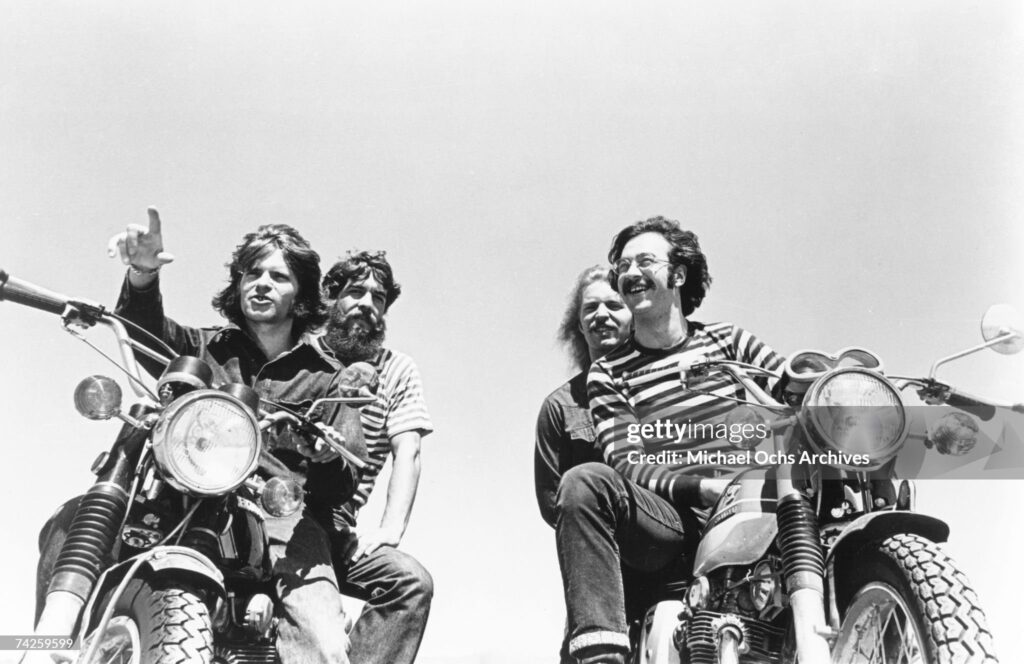
“Run Through the Jungle” turns paranoia into poetry—an urgent warning that danger isn’t only “out there,” but can be waiting in your own backyard.
Released in April 1970 as a double A-side single with “Up Around the Bend” on Fantasy Records, “Run Through the Jungle” arrived at the very height of Creedence Clearwater Revival’s relentless hot streak. The single’s commercial story is crystal-clear: it climbed to a No. 4 peak on the Billboard Hot 100, and you can see it sitting at that peak on the chart dated June 13, 1970. Across the Atlantic, the same release became a major UK hit, reaching No. 3 on the Official Singles Chart, with its first UK chart date recorded as 20 June 1970.
But the deeper truth of “Run Through the Jungle”—the reason it still prickles the skin decades later—is that it has been widely misheard. Because the title sounds like combat footage and the era was saturated with war images, many listeners assumed it was another Vietnam-era protest song. CCR’s own history (think “Fortunate Son”) made that assumption feel natural. Yet John Fogerty later clarified the target of his fear: it wasn’t Vietnam. It was America. In a 2016 interview, he said plainly that what he wanted to talk about was gun control and the proliferation of guns. Once you know that, the song’s jungle stops being a distant battlefield and becomes something far more unsettling: the everyday landscape where “too many loaded weapons” makes ordinary life feel feral.
That shift in meaning changes how the track lands in the heart. “Run Through the Jungle” isn’t a travelogue; it’s a sprint. It doesn’t stroll into its message—it charges in, tense from the first seconds, as if the air itself has turned hostile. The famous “jungle” atmosphere is partly literal studio craft: the recording (made in March 1970 at Wally Heider’s Studio in San Francisco) uses eerie, manufactured sound effects—backwards textures and strange shadows—to make the listener feel surrounded. It’s the kind of sonic storytelling CCR did so well: John Fogerty writes a little “movie,” then forces you to stand inside it.
And what a strange, haunting movie it is—because the fear is not heroic. There’s no triumph here, no victory march. The narrator’s urgency suggests a society where the rules of safety have been quietly rewritten, where you can’t assume the day will remain ordinary just because the sun came up. That’s why the song has been repeatedly pulled into the cultural shorthand of the era—especially in Vietnam-themed films and scenes—even though its message is not actually about the war. In a way, that misunderstanding only proves Fogerty’s point: when the air is thick with violence, everything begins to sound like the jungle.
As a piece of CCR craft, “Run Through the Jungle” also shows how fearless they were about contrast. On the other side of the same 45 sat “Up Around the Bend”—bright, inviting, open-road exhilaration. Together, the two songs feel like the split-screen of American feeling in 1970: hope in one hand, dread in the other. You could dance to one side and then flip the record over and suddenly feel the room darken—same band, same year, two different truths.
Maybe that’s the lasting power of Creedence Clearwater Revival at their peak: they didn’t need long songs to say heavy things. In just over three minutes, “Run Through the Jungle” gives you a warning that still feels current—because it isn’t tied to one headline, one uniform, one foreign battlefield. It’s tied to a broader anxiety about what happens when a society grows accustomed to being armed to the teeth. It asks you to listen carefully to your surroundings, to question what you’ve accepted as “normal,” and to recognize how quickly innocence can become vigilance.
And when the final notes fade, what lingers isn’t just the riff—it’s the feeling of moving fast through darkness, trying to reach a safer clearing that may or may not exist. A song like “Run Through the Jungle” doesn’t simply entertain. It leaves a footprint on the mind… the way a real jungle does: you get out, you breathe again, and only then do you realize how tightly your body was bracing the whole time.