
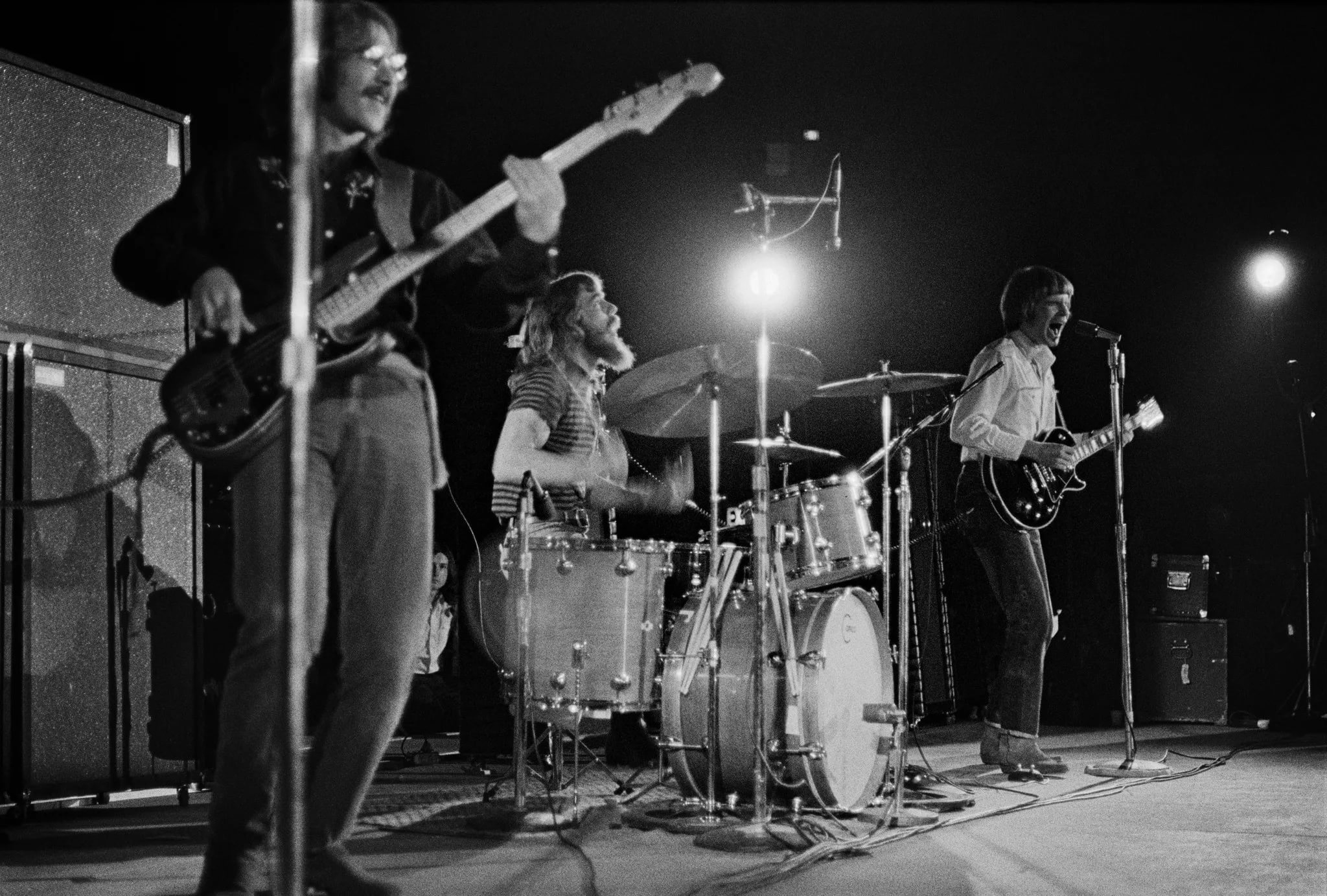
“Lodi” is one of Creedence Clearwater Revival’s saddest little miracles—a road song without romance, where the dream of making it in music has already curdled into fatigue, cheap rooms, and the slow humiliation of being stranded far from where you meant to be.
One of the most important facts to place right at the beginning is that “Lodi” was first released in 1969 as the B-side of “Bad Moon Rising,” the single issued on April 16, 1969, ahead of the album Green River. Although remembered by many listeners as simply the flip side of a huge hit, “Lodi” developed a life of its own and is documented as having climbed the Billboard Hot 100, peaking at No. 52. That matters, because it tells us this was no disposable extra. Even standing in the shadow of “Bad Moon Rising,” it was strong enough to reach the charts on its own merit. The label “Remastered 1985” seen on streaming services does not mean a different performance or a later re-recording. It points instead to the remastered catalog presentation associated with later issues of Chronicle: 20 Greatest Hits, where several CCR songs carry the same 1985 remaster tag while still being the original 1969 recordings.
The story behind “Lodi” is one of the most revealing in the whole CCR catalog because it is not about triumph at all. John Fogerty wrote it as the tale of a struggling musician stuck in a dead-end town, unable to move forward, unable to go home with dignity, and dimly realizing that the road he once imagined as freedom may instead become a trap. Later reflections connected the song to Fogerty’s awareness of how fragile success really is, and to his memory of the hard years before Creedence Clearwater Revival broke through—those bleak, unglamorous days playing wherever they could and hoping something would change. Fogerty himself later described the song as tragic in tone, which is exactly right. “Lodi” is not bitter, not theatrical, not self-pitying. It is simply tired, and that weariness is what makes it cut so deep.
That is the heart of the song’s meaning. “Lodi” is not really about the California town alone, though the title gave the place a permanent and rather complicated immortality. It is about failure arriving quietly. Not the spectacular kind, not the kind that makes headlines, but the ordinary slow-motion failure of discovering that the world is not waiting for your songs, that the crowd is indifferent, that the money is gone, and that pride is becoming harder to carry. In many rock songs, the road means possibility. In “Lodi,” the road has already run out. The singer is stranded in more ways than one—financially, emotionally, almost spiritually. That is why the song remains so haunting. It captures the exact moment when aspiration turns into endurance.
What makes Creedence Clearwater Revival so extraordinary is that they could express all of this with almost no wasted motion. “Lodi” is musically plain in the best possible sense. There is no grand flourish, no excessive arrangement, no attempt to decorate the pain. John Fogerty sings it with that unmistakable mixture of toughness and vulnerability, as if the narrator has already told himself the truth and has no energy left to dramatize it. That restraint is one reason the song has lasted so strongly. It sounds believable. It sounds like what disappointment really feels like when the audience has gone home and the dream is left sitting alone under bad light.
Placed within the Green River era, the song becomes even more moving. In 1969, CCR were at full creative force, turning out major hits and defining a uniquely American rock sound. Yet in the middle of that ascent, Fogerty wrote a song imagining the opposite fate—the collapse of a working musician into obscurity and exhaustion. That contrast gives “Lodi” a special poignancy. It is a successful band singing about failure, and perhaps sensing how thin the line can be between the two. Great artists often imagine the darkness even in their brightest seasons. “Lodi” feels like one of those moments: a warning from inside success itself.
So “Lodi (Remastered 1985)” should be understood as a later remastered issue of one of Creedence Clearwater Revival’s most quietly devastating originals: a 1969 song released as the B-side of “Bad Moon Rising,” later associated with Green River, and remembered not just as a companion to a hit but as a charting classic in its own right.
But beyond release dates and catalog tags lies the reason the song still lingers. It knows that not every life on the road becomes legend. Some become cheap gigs, empty pockets, and one more night in a town you never meant to know so well. And in that knowledge, “Lodi” becomes more than a song about a musician. It becomes a song about every dreamer who has stayed too long in the wrong place, still hoping morning might somehow bring enough money, enough luck, enough mercy to move on.