
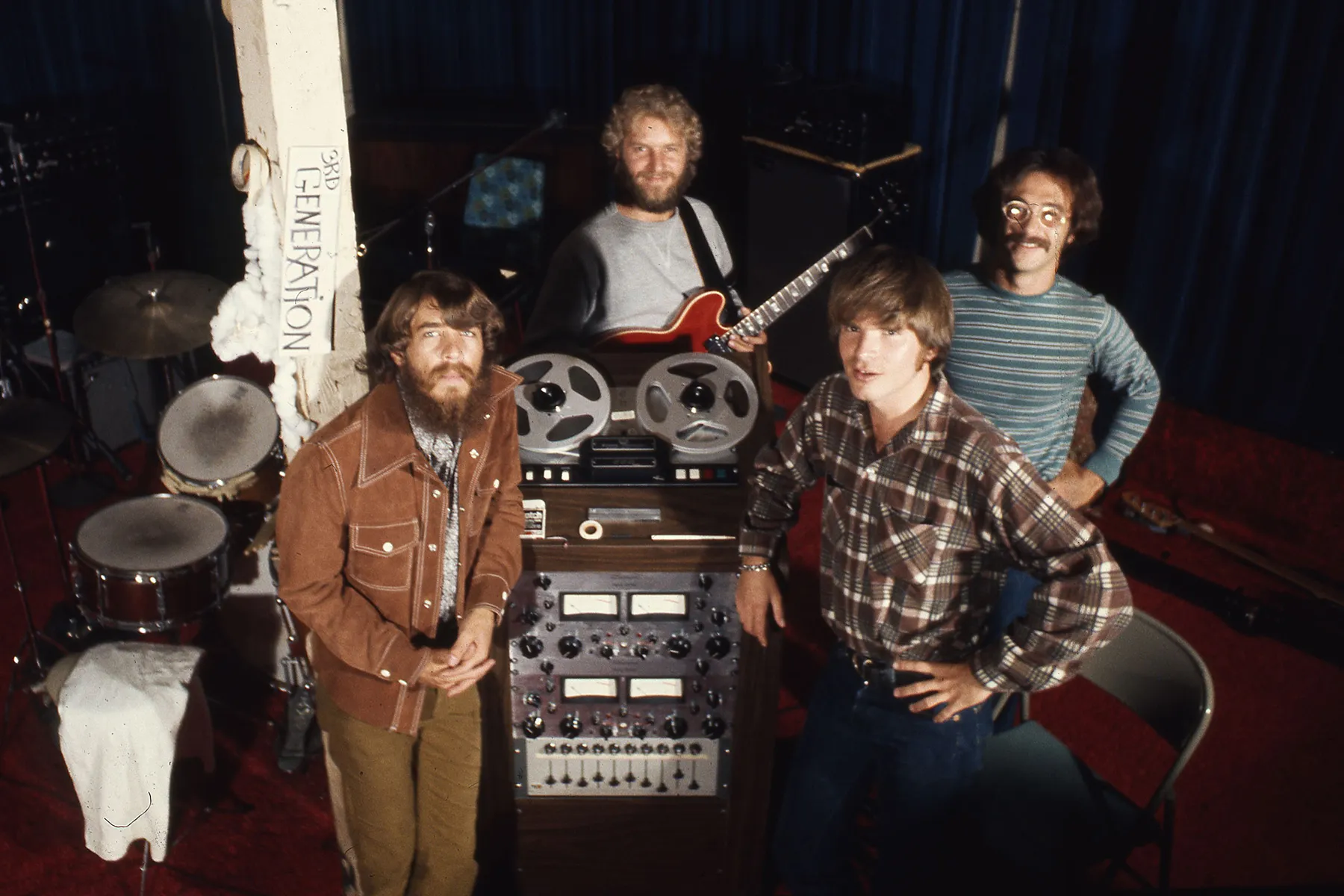
“Ooby Dooby” is Creedence Clearwater Revival tipping their hat to the first, wild spark of rock ’n’ roll—two minutes of carefree nonsense that still feels like a cure.
On Cosmo’s Factory (released July 8, 1970), Creedence Clearwater Revival place “Ooby Dooby” early in the journey—track 4, right after the band’s own jet-fueled “Travelin’ Band,” like a mischievous grin breaking through the album’s muscular seriousness. The placement is the point: this isn’t a “bonus” or a joke tucked away at the end. It’s CCR saying, plainly, we remember where this all came from. And they were saying it at the very peak of their powers—Cosmo’s Factory spent nine consecutive weeks at No. 1 on the Billboard 200, a kind of chart dominance that turns even a playful cover into a statement.
The “story behind” “Ooby Dooby” starts in the 1950s, when rock ’n’ roll still sounded like a dare. The song is most closely associated with Roy Orbison, whose 1956 recording became his first real brush with national chart attention—peaking at No. 59 on Billboard, as documented in Orbison discography references and even on Orbison’s own official site. In other words: before the operatic heartbreak, before “Only the Lonely,” there was this joyous bit of teenage racket—nonsense syllables, sweaty rhythm, the kind of tune that doesn’t explain itself because it doesn’t have to.
CCR’s version doesn’t try to “improve” Orbison’s original. It does something more affectionate: it re-animates it with the band’s famously tight, no-frills attack. You can almost hear the rehearsal-room discipline in how cleanly it locks in—Doug “Cosmo” Clifford’s drumming pushing forward like a hot engine; the guitars bright and uncluttered; John Fogerty singing with that half-smile in his voice, as if he’s remembering a time when a song could be just a song, and that was more than enough. Apple Music’s editorial notes on the album even single out “Ooby Dooby” as one of the “inspired covers” that help make Cosmo’s Factory feel like a hits-packed celebration of roots and radio.
And that’s where the meaning of this track quietly deepens. On the surface, “Ooby Dooby” is pure fun—rock ’n’ roll babble designed for dancing, flirting, laughing too loud. But beneath that, it’s also a little act of gratitude. By 1970, CCR were the most efficient hit machine in America, yet they were still reaching backward toward the music that lit the fuse. To cover Roy Orbison—the Sun-era kid with the strange voice and the fearless phrasing—was to honor the moment when rock first felt like freedom.
It also adds a crucial shade to Cosmo’s Factory itself. That album contains stormy originals and anxious undercurrents, songs that stare at war and weather and uncertainty. So when “Ooby Dooby” bursts in, it’s like opening a window for a second—letting in air from an earlier decade when the future still felt simple enough to shout. Not because life was truly simpler, but because the music gave you permission to pretend it was.
That’s why CCR’s “Ooby Dooby” endures. It isn’t profound in the way a sermon is profound. It’s profound in the way laughter can be—brief, physical, communal, and strangely healing. Two minutes that remind you rock ’n’ roll began not as a lifestyle or a debate, but as a pulse: a beat, a grin, a chorus of joyful nonsense that makes the room feel lighter. And sometimes, that’s the most honest kind of “alive” a record can offer.