
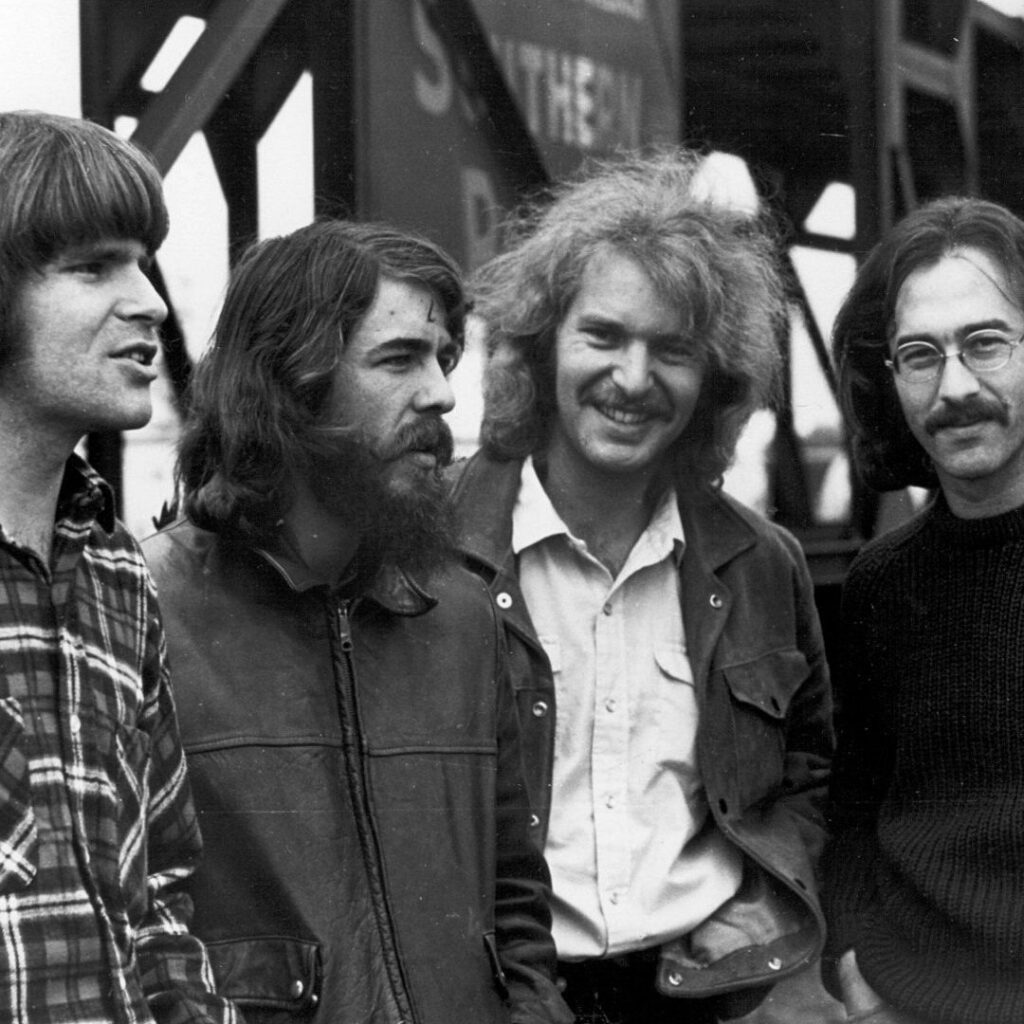
“Lookin’ Out My Back Door” is CCR’s little miracle of escape: a playful, child-eyed vision that turns everyday life into a backyard parade, reminding you that wonder can still arrive unannounced.
Released as a single on July 25, 1970, “Lookin’ Out My Back Door” came out backed with “Long As I Can See the Light” on Fantasy Records, and it quickly proved—again—that Creedence Clearwater Revival could make three minutes feel like an entire American summer. The song was drawn from Cosmo’s Factory, CCR’s fifth studio album, released earlier that month on July 8, 1970—an album that would go on to spend nine consecutive weeks at No. 1 on the Billboard 200.
At the moment of impact, the chart story was pure Creedence: huge, undeniable, and just shy of the summit. “Lookin’ Out My Back Door/Long As I Can See the Light” reached No. 2 on the Billboard Hot 100, held off the top spot by Diana Ross’ “Ain’t No Mountain High Enough.” Billboard’s own artist-chart listing for CCR shows the single’s Hot 100 run beginning August 8, 1970, with a peak week dated October 3, 1970. And in the UK, the situation flipped in a way that feels almost poetic: “Long As I Can See the Light” was treated as the A-side there and reached No. 20, while “Back Door” rode as its companion on the record.
But numbers—however satisfying—don’t explain why “Lookin’ Out My Back Door” still feels like a door you can actually open.
The first thing to say, because it clears away decades of misunderstanding, is this: despite all the psychedelic imagery, John Fogerty repeatedly explained the song was written for his three-year-old son, Josh—a father’s gift, a bright, friendly introduction to rock and roll. Listeners, especially in the 1970 era, often assumed the “flying spoon” and the parade of strange animals must be drug references; Fogerty pushed back on that reading, saying the childlike scene was real in intention, not coded. He also pointed to Dr. Seuss as inspiration—specifically And to Think That I Saw It on Mulberry Street—and once you carry that book in your mind, the song’s world snaps into focus: it’s not an acid trip, it’s a children’s-book daydream set to a country-rock shuffle.
That’s the secret genius of “Lookin’ Out My Back Door.” It sounds like a grin, yet it’s built with the discipline of a master craftsman. CCR’s groove is steady as a porch swing, and Fogerty sings with that familiar bite—earthy, unpretentious—while the lyric floats off into pure imagination. A “parade passing by,” improbable creatures dancing through a yard: it’s the oldest human wish dressed in American slang—the wish that the world might become gentle again for a moment, that life might turn playful instead of demanding.
And then, right in the middle of the whimsy, the song drops a wonderfully specific name: Buck Owens. It’s more than a casual shout-out. It’s a quiet declaration of lineage: CCR may have been rock radio royalty, but Fogerty’s heart kept one boot in country music’s plainspoken tradition. That mention is like a wink to the Bakersfield sound, a reminder that the band’s “swamp” was always partly imagined—built from records, childhood, and longing, not just geography.
Even the song’s framing feels like a small life lesson. Fogerty begins and ends with that homely, almost comic detail—Illinois, the “front door” locked to keep “troubles” from following him home. It’s funny, yes, but also familiar: we all know the feeling of wanting one safe space where the day can’t reach you. And that’s why the backyard matters. The back door is not just a door; it’s a boundary. Step through it and the noise softens. Step through it and the mind remembers how to play.
So if you hear “Lookin’ Out My Back Door” as a happy little romp, you’re not wrong. But if you listen a second time—older, slower, more aware of how quickly years move—you may hear something else underneath the bounce: a kind of tenderness, almost protective. A father singing into a world that can be harsh. A man building a small carnival out of words because, for three minutes, he wants innocence to win.
That’s the lasting meaning of CCR at their best: they didn’t need grand philosophy to speak to the soul. Sometimes all they needed was a tight groove, a sunlit melody, and the courage to believe that somewhere—right behind the house—wonder is still marching by.