
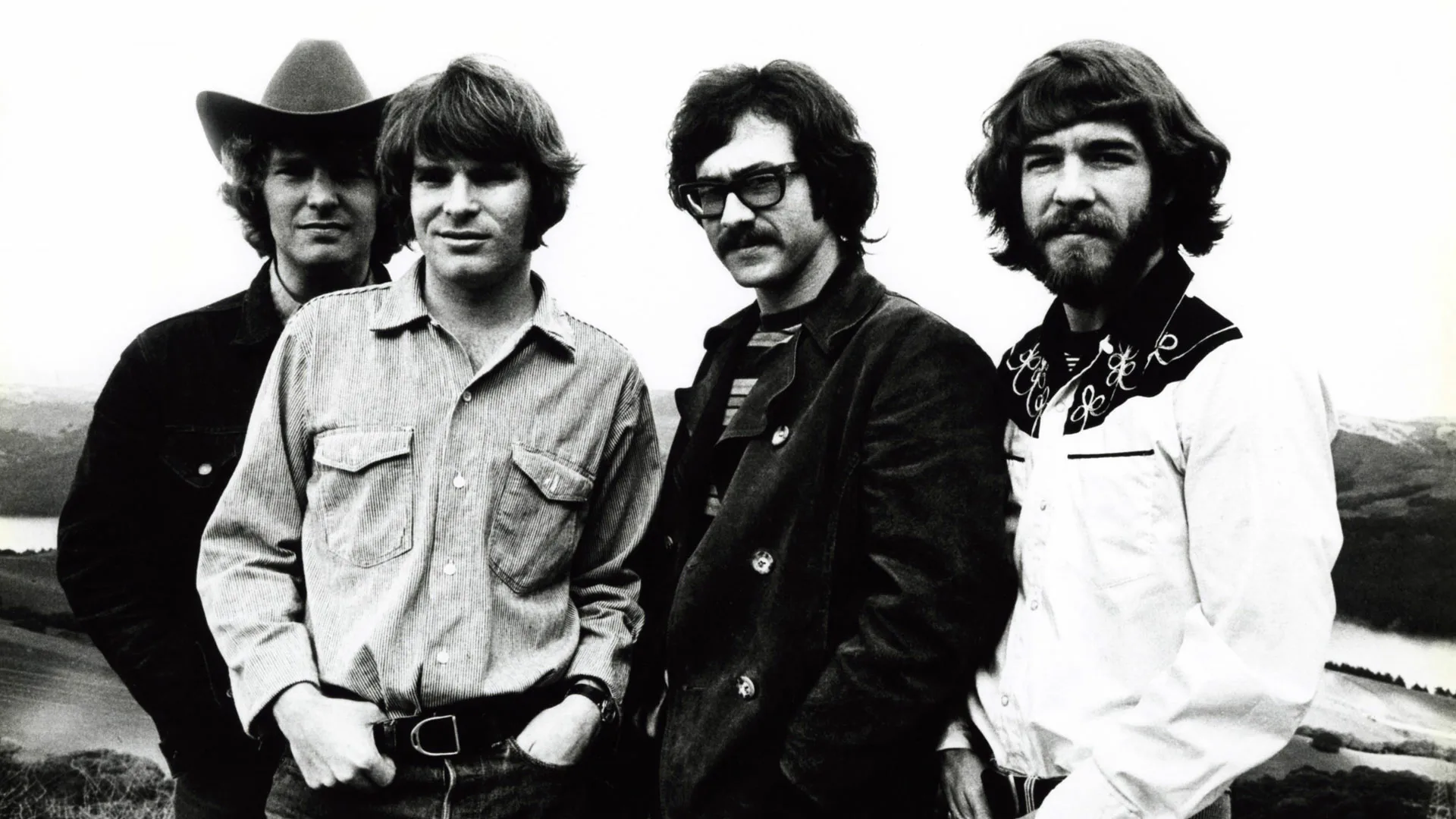
At Woodstock, “Ninety-Nine And A Half (Won’t Do)” stopped sounding like a mere cover and became a test of force, groove, and midnight resolve — Creedence Clearwater Revival taking Southern soul and turning it into something raw, hard, and unmistakably their own.
The first important facts deserve to come right at the top, because this performance carries two histories at once. “Ninety-Nine And A Half (Won’t Do)” was originally a Wilson Pickett song, written by Steve Cropper, Wilson Pickett, and Eddie Floyd, released in 1966, and it became a major soul hit, reaching No. 13 on the Billboard Hot 100 and No. 53 on the R&B chart. Years later, Creedence Clearwater Revival brought it to Woodstock, where they played it in the early hours of Sunday, August 17, 1969, during the set that would eventually be released in full as Live at Woodstock on August 2, 2019. That is the key starting point: this was not a CCR studio hit dusted off for a festival victory lap. It was a live act of transformation, a soul standard being run through the band’s swamp-rock engine at the height of their power.
And what a moment to do it. According to Concord/Craft’s official release notes, CCR had been slotted for a prime Saturday-night appearance, but delays pushed them to after midnight, following the Grateful Dead’s overlong set, when many of the crowd had already retreated to tents or simply fallen asleep. That detail matters enormously, because it explains the feeling inside this performance. Creedence Clearwater Revival were one of the hottest bands in America in 1969, with “Proud Mary,” “Bad Moon Rising,” and “Green River” already on the airwaves, yet at Woodstock they were not walking into a perfect peak-hour triumph. They were walking into mud, darkness, and exhaustion — and playing as if sheer conviction could wake the field back up.
That is exactly why “Ninety-Nine And A Half (Won’t Do)” lands so hard in this set. On the official track listing, it comes third, right after “Born on the Bayou” and “Green River.” In other words, CCR were not using it as a novelty detour late in the show. They were placing it near the front, as part of the statement they wanted to make. The choice says a great deal about the band. Even at the moment when they could have relied almost entirely on their own rising catalog, they still made room for a song from the soul tradition that had helped shape their sound. But once they got hold of it, they did not play it like respectful preservation. They played it like possession.
That is the great thrill of the performance. Wilson Pickett’s original has all the urgency of mid-60s Southern soul — pleading, grit, rhythmic push. CCR’s live version keeps the demand in the lyric but changes the emotional temperature. The song becomes tougher, leaner, and more relentless. John Fogerty does not sing it with soul revue elegance. He drives it with that clenched, cutting intensity that made Creedence so different from many of their peers. They were never a band of ornate psychedelic drift. They were a band of attack. On a song like this, that attack becomes its own kind of revelation.
There is also something beautifully revealing in the wider release history. For years, CCR’s Woodstock appearance remained strangely underexposed because the band declined to be included in the original 1970 Woodstock film and soundtrack. Only a few tracks surfaced later, including “Ninety Nine and a Half (Won’t Do)” on the 1994 box set Woodstock: Three Days of Peace and Music, before the full concert finally arrived in 2019. So this song lived for decades as part of Woodstock’s half-seen mythology — known, but not fully absorbed into the public picture of the festival. That delayed emergence gives it an extra charge now. It feels less like a familiar old live favorite than like a missing page finally restored to the book.
And perhaps that is why the performance still feels so vivid. It captures Creedence Clearwater Revival at a point where everything essential about them is already present: the tightness, the grit, the refusal to waste motion, the deep dialogue with older American music, and the ability to make a borrowed song sound completely native to their world. In the official notes for Live at Woodstock, Concord emphasizes how strongly CCR’s Southern-steeped sound stood apart from the reigning psychedelia of the day. “Ninety-Nine And A Half (Won’t Do)” proves that point beautifully. This is not flower-power looseness. It is hard-driving American rhythm music, stripped to the bone and played with conviction.
So when we hear “Ninety-Nine And A Half (Won’t Do) (Live At The Woodstock Music & Art Fair / 1969)”, we are hearing more than a cover in a famous set. We are hearing CCR at Woodstock doing what they did better than almost anyone: taking a song with deep roots, tightening it into a weapon, and firing it into the night. It may not be the most mythologized moment of their Woodstock performance, but it may be one of the clearest. The title says ninety-nine and a half won’t do. At Woodstock, Creedence Clearwater Revival played it as if nothing less than total force would do either.