
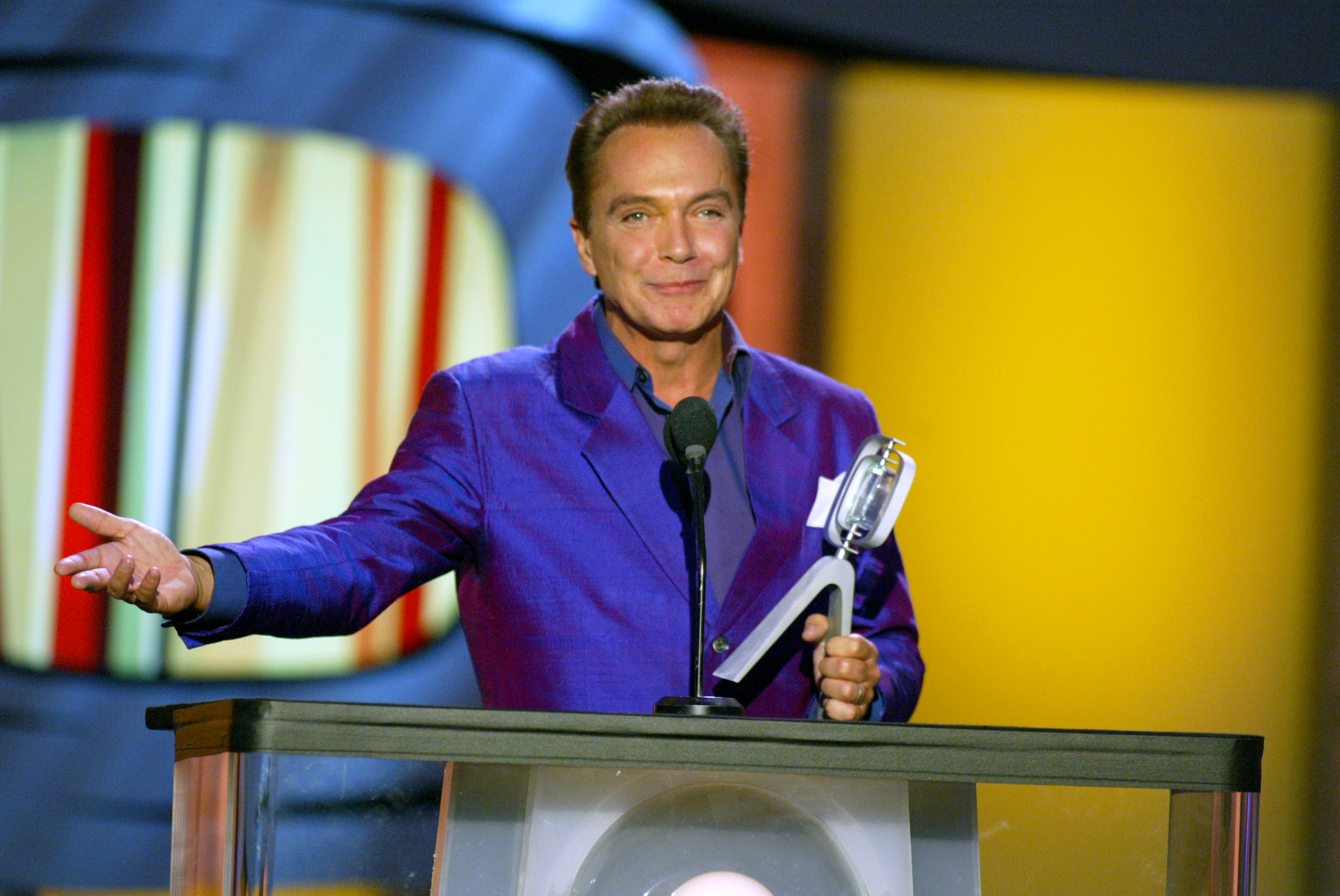
A velvet confession of grown-up tenderness—“Show and Tell” is about love stripped of performance, where the only convincing proof is the heart you’re willing to place in someone’s hands.
When David Cassidy chose “Show and Tell” for his 1998 album Old Trick New Dog, it wasn’t a bid to relive teenage stardom. It was something rarer: a mature singer reaching back for a classic and bringing it forward with the calm authority of experience. The album—released in 1998 on Cassidy’s own label—was widely described as a blend of fresh material and affectionate revisits to earlier favorites, a record that let him sound less like a poster on a bedroom wall and more like a man who’d lived inside his voice.
And right near the end of that track list sits “Show and Tell”—credited, unmistakably, to songwriter Jerry Fuller. That credit matters because this song has a long, storied life before Cassidy ever stepped into it. Fuller wrote it, and it was first recorded by Johnny Mathis in 1972 (a version that reached No. 36 on the Easy Listening chart). But the performance that turned it into a cultural phrase came a year later, when Al Wilson took it to No. 1 on the Billboard Hot 100 (week of January 19, 1974), selling over two million copies and becoming one of those slow-dance standards that seemed to drift out of every radio at closing time.
So by the late ’90s, choosing “Show and Tell” wasn’t just picking a cover—it was stepping into a song people already remembered with their bodies. That’s why Cassidy’s decision feels so telling. On Old Trick New Dog, he’s not trying to outshine the past; he’s trying to speak through it. The album itself was framed as “fresh and contemporary, with a tip of the hat” to his earlier era—an approach that suits this particular song perfectly, because “Show and Tell” has always been about sincerity rather than novelty.
The title gives away the emotional engine. “Show and tell” is what you do as a child—standing in front of a room, holding something precious, hoping it won’t be misunderstood. In the song, that childhood ritual becomes adult vulnerability: love as something you can’t merely say; you have to prove it in the only way that counts—through openness, through touch, through the risk of being seen. The lyric is filled with that “here I am” honesty, the sense that a person’s eyes, arms, and heart only truly learn their purpose when someone else arrives and changes the weather inside them.
What makes Cassidy’s version especially poignant is where it sits in his timeline. By 1998, the screaming crowds of the early ’70s were no longer the point. This was the era when he was actively reintroducing himself—still melodic, still romantic, but less eager to charm and more willing to confess. Old Trick New Dog is often described as his last full studio album, mixing new songs with remakes, and even generating an Adult Contemporary Top 25 single (“No Bridge I Wouldn’t Cross”). That context tells you the stakes: he wasn’t hiding behind nostalgia; he was working.
And that’s the quiet beauty of “Show and Tell” in this setting. The song’s original soul-pop glow—especially in Wilson’s famous hit version—can feel like a slow spotlight, warm and theatrical. Cassidy’s placement of it at track nine, near the album’s closing stretch, lets it behave more like a late-night conversation after everyone else has gone home. It becomes a pause in the room. A moment where the performer stops “selling” and starts simply offering. You can almost hear the intention in the choice alone: If you want to know who I am now, listen to what I’m willing to sing when the lights aren’t blinding.
There’s also something fitting—even moving—about Cassidy gravitating toward a song with such a direct emotional vocabulary. He came up in an era when fame could be loud and fast, when identity was sometimes assigned before it was chosen. A song like “Show and Tell” insists on the opposite: no costume, no cleverness—just the plain evidence of devotion. That insistence feels almost like a personal corrective. Not a reinvention, but a return to what lasts.
Ultimately, the meaning of “Show and Tell” is simple in the way the most enduring things are simple. It says love is not a speech; it’s a demonstration. It’s the steady courage of putting your feelings where they can be held—or dropped. And when David Cassidy sings it within Old Trick New Dog, you can hear an artist choosing that courage on purpose: not to recreate the past, but to stand in the present with a song that still tells the truth—softly, clearly, and without flinching.