
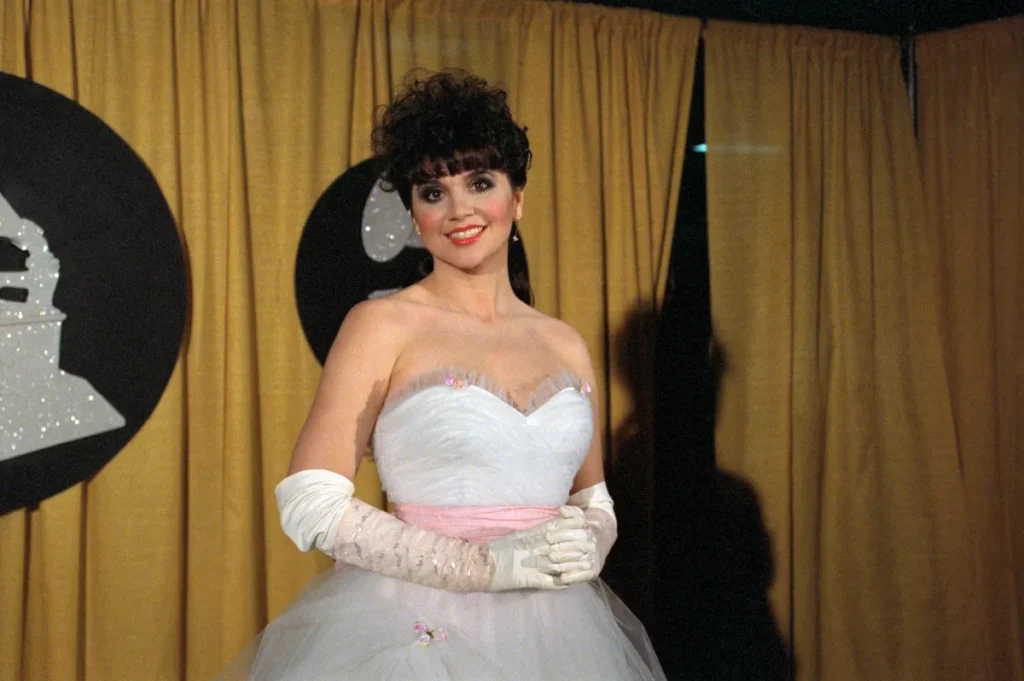
**A Gershwin confession, carried on a Grammy-stage hush—**a moment when Linda Ronstadt turned a vast auditorium into the intimate space of a single, unguarded crush.
The essential landmarks first, so the memory has firm ground to stand on. “I’ve Got A Crush On You” (music by George Gershwin, lyrics by Ira Gershwin) became one of the signature selections from Linda Ronstadt’s traditional-pop pivot on the 1983 album What’s New. The album was released September 12, 1983, rose as high as No. 3 on the U.S. Billboard 200, and went 3× Platinum in the United States—a commercial triumph for a record built from Great American Songbook standards rather than contemporary radio material. The single “I’ve Got a Crush on You” followed in January 1984, and it proved especially strong on adult radio—peaking at No. 7 on the U.S. Adult Contemporary chart and No. 1 on Canada’s Adult Contemporary chart.
And then came the performance that still feels like velvet on the ear: Live at the 1984 Grammy Awards—the 26th Annual Grammy Awards, held on February 28, 1984, at the Shrine Auditorium in Los Angeles. Photo archives and event captions have long noted Ronstadt singing “I’ve Got a Crush on You” at that Grammy telecast, a detail that aligns with circulating broadcast clips and the way this moment has been remembered and shared.
What makes this particular rendition endure isn’t just that it’s technically “good”—Ronstadt was rarely anything but excellent—it’s why it mattered. In the early 1980s, Linda Ronstadt could have stayed exactly where the industry preferred her: the reigning chameleon of rock, country, pop—reliably modern, reliably bankable. Instead, What’s New asked a braver question: what if the songs our culture had politely shelved—those pre-rock “standards,” the elegant craftsmanship of an older America—were not antiques at all, but living things that only needed a voice brave enough to reintroduce them? Ronstadt herself spoke of rescuing these songs from being treated like background “elevator” fare, insisting they were small masterpieces worth hearing anew.
On a Grammy stage, that idea becomes visible. A televised awards show is built for the big gesture: spectacle, volume, a sense of “now.” Yet “I’ve Got A Crush On You” is a song of contained emotion—almost stubbornly private. It isn’t about love as conquest; it’s love as confession. The lyric’s charm lies in its candor: the world may be full of suitors and noise, but one person’s persistence has quietly undone the narrator’s defenses. And Ronstadt sings it in a way that doesn’t wink at the sentiment—she dignifies it. She makes the crush feel less like a fling and more like a truth finally admitted after long resistance.
This is where the “live” aspect—especially at the Grammys—changes everything. In the studio, What’s New is polished and beautifully proportioned. Live, on that 1984 broadcast, the song becomes a kind of balancing act: a pop superstar standing in formal light, choosing restraint when the room expects fireworks. That’s the hidden drama. She doesn’t overpower the Gershwins; she steps inside the song as if it were a well-tailored coat, letting the melody fall naturally on her shoulders. The performance feels like a reminder that control can be more moving than force—that the softest statement, delivered with conviction, can travel farther than a shout.
There’s also the quiet presence behind the whole What’s New era: Nelson Riddle, the arranger-conductor whose name evokes the classic orchestral sophistication associated with mid-century vocal pop. The collaboration was, in effect, a bridge—between eras, between audiences, between the radio landscape of the 1980s and the songwriting architecture of earlier decades. And when you watch or simply listen to that Grammy performance, you can almost hear the point being made without speeches: that elegance is not a museum piece; it’s a language. Ronstadt speaks it fluently.
So “I’ve Got A Crush On You (Live at the 1984 Grammy Awards)” isn’t merely a clip preserved for nostalgia. It’s a small cultural turning: a night when a modern star chose an old standard—and made it feel current, not by modernizing it, but by trusting its emotional intelligence. In that trust, there’s something deeply comforting: the sense that what was beautifully written once can still be beautifully felt, decades later, if someone sings it like it matters.