
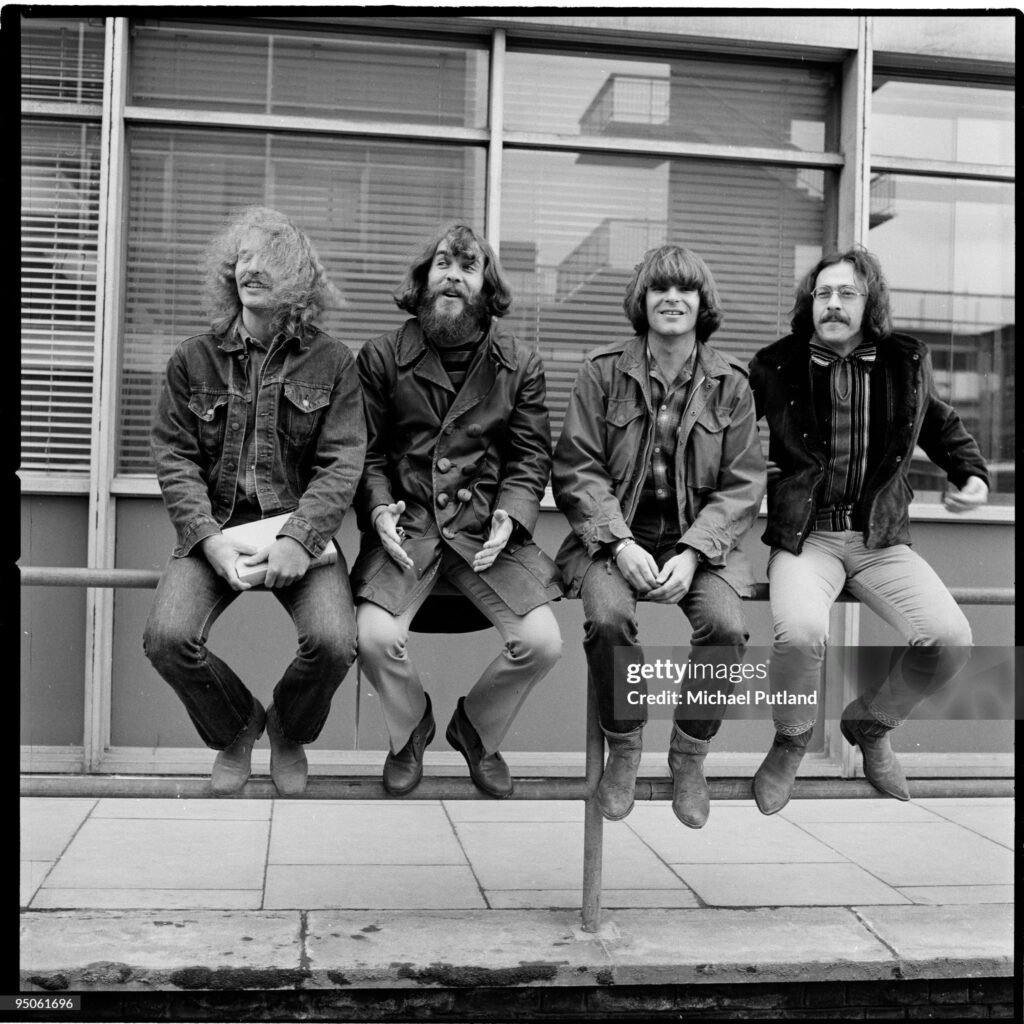
In “The Midnight Special,” Creedence Clearwater Revival takes an old prison song and sets it in motion so forcefully that it no longer feels like history being revisited—it feels like wheels already turning, light already flashing, escape already beginning in the mind.
There are songs that tell a story, and there are songs that move before they even explain themselves. Creedence Clearwater Revival’s “The Midnight Special” belongs to that second kind. From the first seconds, it does not feel still. It rattles, rolls, and surges forward with the kind of momentum that makes you feel the body of the song as much as its meaning. That is one reason it still hits so hard. When CCR included it on Willy and the Poor Boys, released on November 2, 1969, they were not just filling space on a landmark record. They were taking a traditional American song—one long associated with prison lore, Southern folk memory, and Lead Belly’s towering shadow—and giving it the kind of hard, unstoppable drive that made it sound reborn. The album itself became one of the defining statements of their astonishing 1969 run, and “The Midnight Special” stood within it as one of the clearest examples of how John Fogerty could reach backward into older music and make it feel urgent in the present.
The precious fact at the center of the story is simple but important: this was not a John Fogerty original. “The Midnight Special” is a traditional folk song, thought to have originated among prisoners in the American South, with lyrics documented in print as early as 1905 and the song itself appearing in print by 1923. It had been carried through American musical life by many voices before CCR touched it, and it was Lead Belly who helped make it especially famous in the modern era. Fogerty later acknowledged just how deeply Lead Belly mattered to him, saying that learning those songs through figures like Pete Seeger felt like getting “down to the root of the tree.” That is a beautiful way to understand CCR’s version: not as nostalgia, but as contact with the roots—followed by a sudden jolt of electricity.
And that is exactly why the record feels like motion you can’t stop.
Because Creedence Clearwater Revival does not perform the song as a respectful antique. They grab hold of its rhythm and make it run. The old imagery is still there—the train, the light, the longing for release—but the band plays it with such physical conviction that the song becomes less about reflection than propulsion. You do not merely hear the idea of a train. You feel the track beneath it. The rhythm has that characteristic CCR combination of looseness and force: a churning forward push that sounds almost casual until you realize how locked-in it really is. That is where the “rattle” in your title comes alive. It is not just percussion or guitar tone. It is the whole recording trembling with movement, as if the song itself can barely stay inside the speakers.
What makes the performance even stronger is the emotional fit between the traditional lyric and Fogerty’s style. The old song is about the Midnight Special train and its “ever-loving light,” a symbol often understood as hope, release, or rescue shining into a prisoner’s darkness. In many earlier versions, that image carries sorrow first and deliverance second. CCR shifts the balance. They do not erase the longing, but they make the hope feel more muscular, more immediate. Their version sounds like a body leaning toward freedom, not just dreaming of it. That changes everything. The song stops being only about confinement and starts becoming about the force of wanting out.
There is also something quietly revealing about where the song sits on Willy and the Poor Boys. This was the same album that carried “Fortunate Son,” “Down on the Corner,” and “It Came Out of the Sky”—songs of class anger, communal joy, and satire. In that company, “The Midnight Special” does not feel out of place at all. It fits because CCR had a gift for seeing American music as one long connected road: folk song, blues, rock and roll, protest, working-class storytelling. The album history notes that “The Midnight Special” and “Cotton Fields” both reflected Lead Belly’s influence on the band. So even when CCR was covering older material, they were still saying something about who they were: a group that knew how to make roots music feel lean, direct, and full of dust and voltage.
And then there is the release itself—that feeling of release inside the groove. That may be the deepest reason the recording lingers. So many versions of traditional songs ask us to admire their history. CCR’s “The Midnight Special” asks us to feel their necessity. It reminds us that old American songs were not born to sit politely in archives. They were born out of labor, distance, confinement, heat, night travel, bad luck, and the need to keep singing anyway. Creedence Clearwater Revival understood that instinctively. So when they play this song, they do not smooth it out. They let it keep its rough grain, then they strap an engine to it.
That is why the record still feels so alive. It is not simply a cover of a famous traditional tune. It is a moment when a great late-1960s American band met an old folk-blues current and drove straight into it. The result is exhilarating because it feels both ancient and immediate, both rooted and restless. The train light still means hope. But in CCR’s hands, hope does not drift in gently from a distance. It comes pounding down the rails.
So yes, the rhythm, the rattle, the release—that is the soul of it. “The Midnight Special” feels like motion you can’t stop because Creedence Clearwater Revival understood that the song was never meant to sit still. It was meant to travel through dark places carrying a little light. And once they got hold of it, they made that light move fast enough to shake the whole room.