
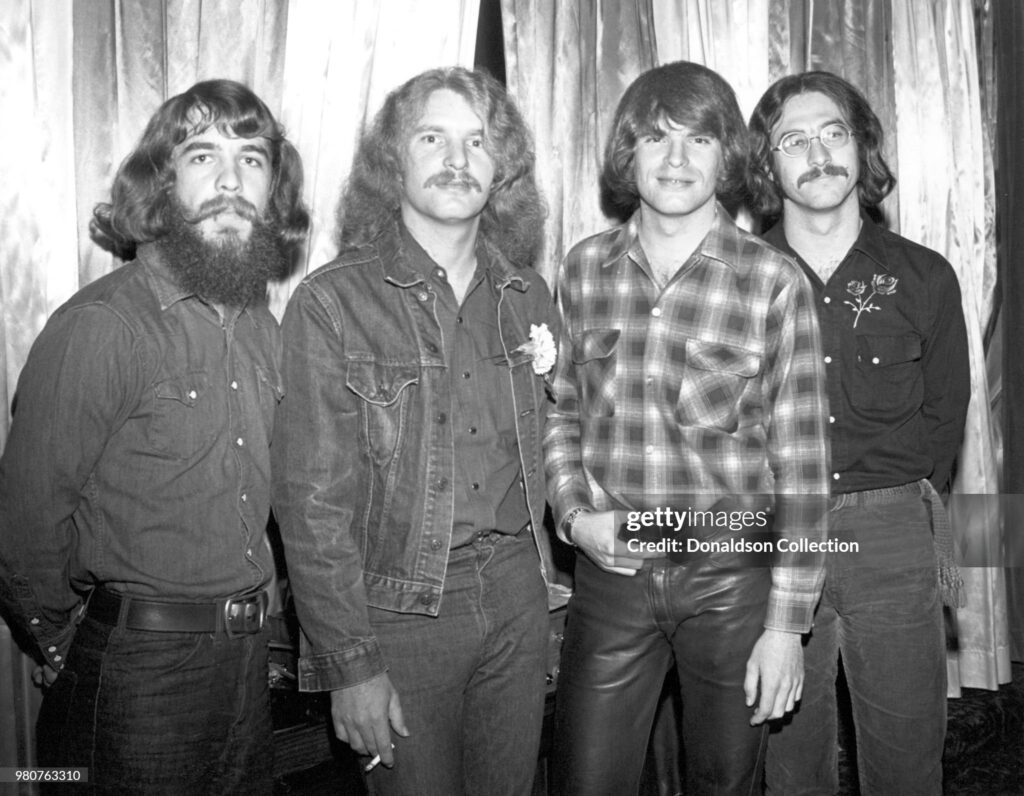
In “Good Golly Miss Molly,” Creedence Clearwater Revival do not treat a rock-and-roll classic like a museum piece. They seize it, roughen it, and drive it forward until it feels less like a tribute than a band testing how much voltage an old song can still hold.
More than a cover—yes, that is exactly the right way to hear it. When Creedence Clearwater Revival cut “Good Golly Miss Molly” for Bayou Country, released on January 15, 1969, they were still early in their rise, but already sounding like a band with its own weather. Bayou Country became their second studio album and reached No. 7 on the Billboard 200, with “Proud Mary” giving them their first major breakthrough. In that setting, “Good Golly Miss Molly” was not the headline-grabber. It was the one cover on the album, tucked inside a record that was otherwise helping define the group’s swampy, hard-charging identity. That placement matters, because it tells you the band did not need the song for credibility. They used it because they could make it move.
The song itself, of course, already had a towering past. Written by John Marascalco and Robert “Bumps” Blackwell, it had first been recorded by Little Richard in 1956 and released in 1958, becoming one of the foundational eruptions of early rock and roll. That original version came in hot—wild piano, sexual charge, pure forward motion. So any later band touching it had a choice: preserve it carefully, imitate it faithfully, or grab it and run. CCR chose the third option. They did not soften the song, and they did not prettify it. They treated it like something still dangerous.
That is why the recording feels like a band grabbing a classic and flooring it. John Fogerty’s vocal does not sound reverent in the polished sense. It sounds hungry. He pushes the song with the kind of urgency that suggests he is less interested in honoring history than in proving that history still has teeth. The band around him is just as important: the rhythm section gives the track a heavy, relentless shove, and the whole performance feels leaner and dirtier than the more flamboyant Little Richard model. It is not trying to out-sparkle the original. It is trying to out-drive it.
And that is the precious detail that makes the story warm: “Good Golly Miss Molly” was the one and only cover on Bayou Country. On an album busy establishing what Creedence Clearwater Revival sounded like, they made room for a song that predated them by a decade but still matched their appetite. That says a great deal about their musical instincts. They were not reaching outside themselves for identity. They were reaching backward into rock-and-roll ancestry and pulling out something that could survive their own pressure.
There is also a revealing historical echo in what came after. The Cosmo’s Factory album history notes that “Travelin’ Band” was explicitly inspired by 1950s rock ’n’ roll songs, particularly those by Little Richard, and that the publishers of “Good Golly, Miss Molly” later felt “Travelin’ Band” resembled it enough to file a plagiarism suit, which was settled out of court. That does not change the meaning of CCR’s earlier cover, but it does underline how deeply Little Richard’s energy had gotten into Fogerty’s bloodstream. “Good Golly Miss Molly” was not a one-off detour. It was part of the current feeding the band’s whole engine.
What makes the cover endure, then, is not novelty. It is force. CCR understood that old rock-and-roll songs were built to be played, not dusted off. So they approached “Good Golly Miss Molly” with the confidence of a band that already knew how to turn raw material into motion. They do not ask permission from the song. They inhabit it. And because they do, the record still sounds less like an act of historical respect than an act of musical possession.
That is why it feels bigger than a cover. In Creedence Clearwater Revival’s hands, “Good Golly Miss Molly” becomes a glimpse of something vital about the band itself: they could take a classic everyone knew, strip away any sense of ceremony, and make it sound like the road was opening in front of them at dangerous speed. Not many groups could do that. CCR could. And that is what keeps this performance alive—not just affection for the song, but the thrilling sense that the band hit the gas and never once thought about the brakes.