
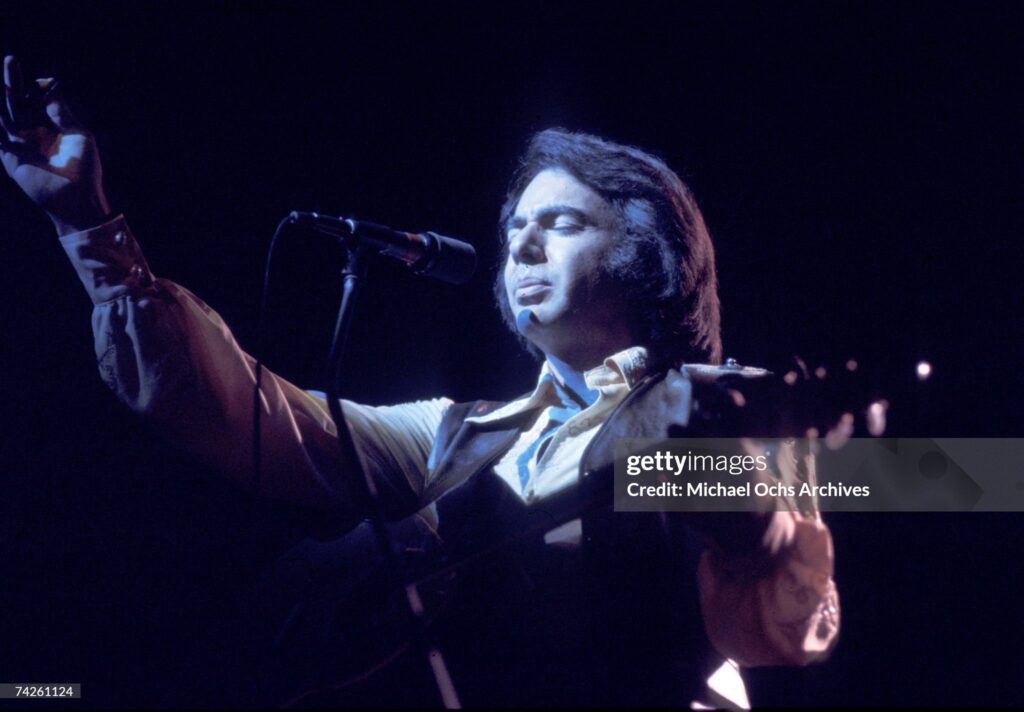
One familiar classic, one very different ache — and in “Everybody’s Talkin’,” Neil Diamond turns a song of escape into something more inward, heavier, and strangely more solitary.
Some songs arrive in public memory already carrying a fixed emotional color. “Everybody’s Talkin’” is one of them. For many listeners, the song still belongs first to that drifting, sun-struck melancholy made famous by Harry Nilsson, where the desire to leave the noise behind feels almost airy, almost liberating. But when Neil Diamond took hold of it on Rainbow in 1973, he did not simply revisit a beloved standard. He changed its weather. The song remained recognizable, of course, yet the feeling inside it shifted. What had once floated now seemed to walk with more weight. What had once sounded detached began to feel more personal, more bruised, more aware of the cost of turning away. Rainbow, released in 1973, was Diamond’s album of contemporary covers, and “Everybody’s Talkin’” sat right at the front of it, almost like an opening statement.
That contrast is what makes his version so compelling. The song itself, written by Fred Neil, had already lived more than one life before Diamond sang it. Fred Neil first recorded it in the mid-1960s, and then Nilsson’s 1968 version carried it into popular immortality after Midnight Cowboy, rising to No. 6 on the Billboard Hot 100 and becoming the interpretation that shaped the world’s memory of the song. Nilsson’s reading has movement in it, but also light; even in loneliness, it seems to keep one eye on the horizon. Diamond hears something different. He seems less interested in escape as freedom than in escape as necessity.
That is where the new emotional color begins.
With Neil Diamond, there is often a private strain beneath even the most public material — a sense that behind the polished song stands a man thinking harder than he is saying. In “Everybody’s Talkin’,” that inwardness changes the song’s center of gravity. The lyric no longer feels like the loose, drifting shrug of someone too cool to care what the world is saying. It feels more like withdrawal, like someone turning away not because the world is trivial, but because it has grown too loud, too insistent, too difficult to bear. The title remains the same, but the ache underneath it is not the same ache.
And that is what makes the performance interesting in a Neil Diamond context. He was never a singer who vanished into songs by becoming neutral. Even when interpreting other writers, he tended to leave a strong emotional fingerprint behind. On Rainbow, an album that also included “Mr. Bojangles,” “Both Sides Now,” and “If You Go Away,” he was clearly drawn to material that already carried emotional history. But “Everybody’s Talkin’” may be one of the clearest examples of how he could take a familiar classic and bend it gently toward his own temperament. Instead of airy detachment, he gives it a more earthbound loneliness. Instead of easy drift, he gives it a sense of burden.
There is something moving in that choice. The song’s famous opening image — all those voices, all that chatter — can be heard many ways. In one version, it sounds like the world slipping harmlessly past. In another, it sounds like emotional pressure, like a man trying to preserve the last small chamber of quiet inside himself. Neil Diamond leans toward the second feeling. He does not overstate it. He does not turn the song into melodrama. But he darkens it just enough that the listener feels the solitude more keenly.
That darker shading suits him. By the early 1970s, Diamond had already become one of popular music’s great communicators of longing, but his longing was rarely casual. Even when the melodies soared, there was often a heaviness beneath them — a sense of distance, searching, incompletion. In “Everybody’s Talkin’,” he finds a song that can hold that quality beautifully. The result is not a version that tries to erase Nilsson’s shadow. It does something more interesting than that. It stands alongside the famous reading and quietly asks the listener to hear the same words with older eyes.
So one familiar classic becomes something else in his hands. Not a reinvention so radical that the song loses itself, but a shift in light, a shift in pulse, a shift in emotional temperature. And that is enough. Neil Diamond’s “Everybody’s Talkin’” reminds us that great songs are never truly finished. They wait for another voice, another mood, another life to pass through them. In his version, the song no longer sounds like the open road alone. It sounds like the inward road too — the one walked in silence, with the world still talking behind you.