
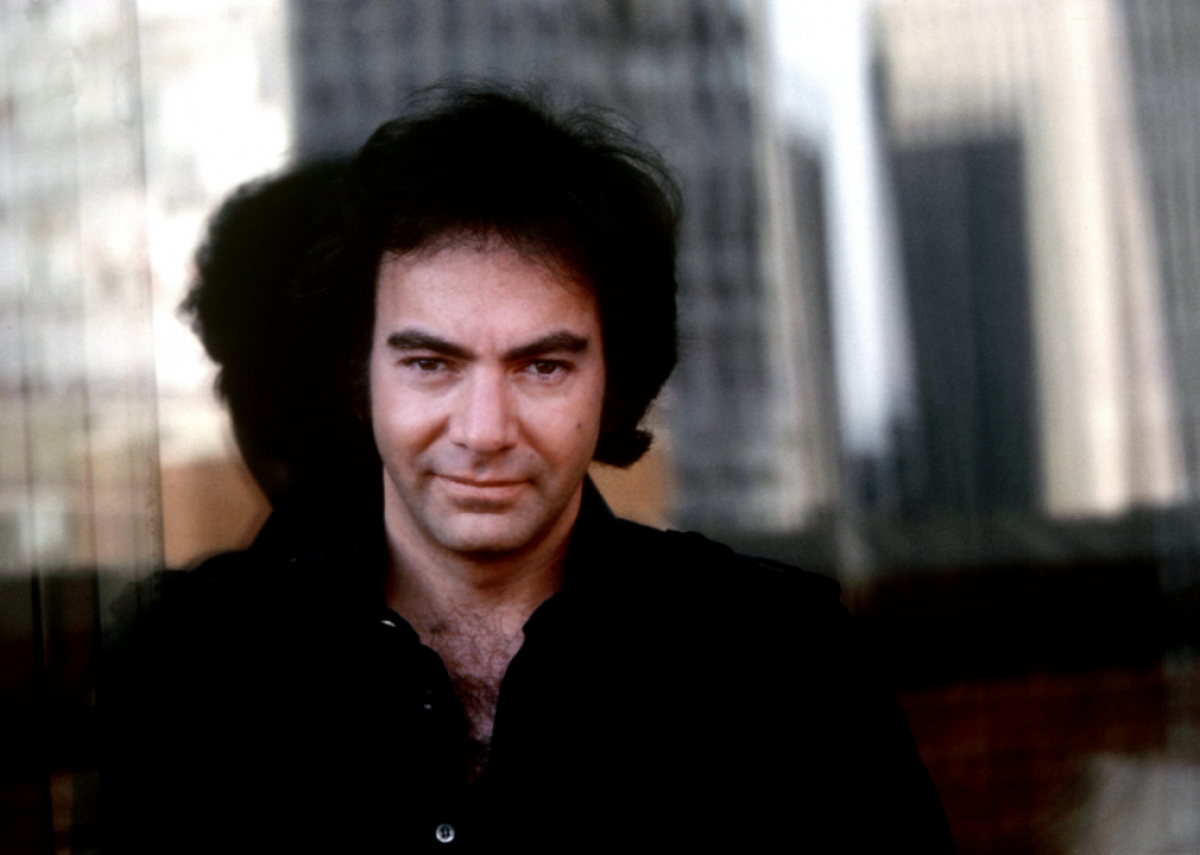
In “Face Me,” Neil Diamond turns confrontation into intimacy. The title sounds like a challenge, and that is exactly its power: this is not a song asking for comfort from a distance, but for truth at close range.
There is something arresting about a song that refuses to look away. “Face Me” is built on that refusal. It appeared on 12 Songs, released on November 8, 2005, the spare, Rick Rubin–produced album that marked one of the most admired late-career renewals in Neil Diamond’s catalog. The album debuted at No. 4 on the Billboard 200, and its whole reputation rests on a stripping back of old excess—less glitter, more nerve, more song, more man. In that setting, “Face Me” feels especially revealing. It is the 11th track on the standard album, and it sits there like a final test of emotional courage: no grand escape, no clever mask, just the demand to be met directly.
The first precious fact is also the simplest: Neil Diamond wrote “Face Me” himself. That matters because the song does not feel like an outside composition handed to him for dramatic effect. It feels inward, personal, and deliberately exposed. MusicBrainz and album documentation both credit Diamond as the lyricist and composer of the track, which fits what the song sounds like: not borrowed confrontation, but self-authored confrontation.
And then there is the second fact that gives the song extra weight: Rick Rubin produced 12 Songs, the album that houses it. Rubin’s approach to Diamond in this period was famously reductive in the best sense—pulling the sound back toward essentials, toward vocal presence, toward the emotional center of the writing. That broader album context matters because “Face Me” is not powerful in a heavily arranged, theatrical way. Its force comes from the bareness around the feeling. The song sounds confrontational because there is so little to hide behind.
That is why the challenge is the hook.
The title alone does so much work. “Face Me” is not merely a romantic request. It sounds like an ultimatum, a plea, and a test of courage all at once. Neil Diamond had written many songs of yearning, devotion, hunger, and surrender, but this one leans into something sharper: the insistence that whatever is broken, unresolved, or evasive can no longer stay turned away. The song’s emotional voltage comes from that stance. It is not asking to be adored from afar. It is asking to be confronted honestly.
That is what makes it so hard to ignore. Many emotionally intense songs soften themselves with nostalgia or beauty. “Face Me” does not quite do that. Even within the introspective world of 12 Songs, which also includes titles like “Create Me” and “Man of God,” this song carries a more direct edge. The standard track list places it near the very end of the album, after so much searching, reflection, and need, and that placement gives it a kind of late-hour urgency. It feels like a point at which patience has run thin and emotional distance is no longer tolerable.
There is also something quietly moving about where this song stood in Diamond’s career. By 2005, he no longer needed to prove he could command a crowd or write a hook that traveled the world. What made 12 Songs important was something deeper: it showed he could still sound vulnerable without sounding diminished. “Face Me” is part of that achievement. It is confrontational, yes, but not blustering. The power is not in aggression. It is in emotional daring. He sounds like a man who knows that asking someone to turn and meet your eyes may be harder than making any grand speech.
And perhaps that is why the song still lingers. The title comes at the listener almost physically. It asks for presence, not fantasy. It asks for reckoning, not decoration. In Neil Diamond’s voice, that demand does not feel cold. It feels wounded, proud, and unwilling to settle for half-light. That combination gives the song its unusual charge. It is not simply dramatic. It is morally tense. Someone must stop hiding. Someone must turn.
So yes, “Face Me” proves that Neil Diamond could make confrontation into compelling music. Not through noise, not through showmanship, but through concentration. A strong title, a stripped-back late-career album, and a self-written song placed deep in one of his most respected comeback records—that is the factual frame. Inside it lives the deeper truth: sometimes the hardest songs to shake are the ones that do not ask us to dream, but to look straight ahead.