
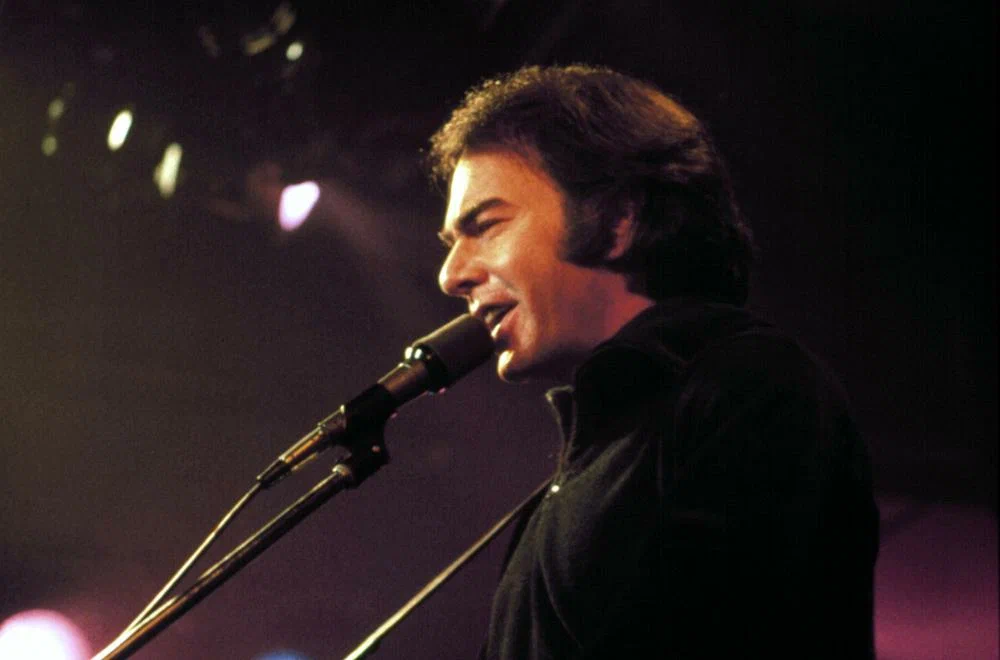
The hope was huge in “Headed For The Future,” and hearing it now feels like opening a window onto an America that still believed tomorrow might arrive brighter, cleaner, and more redeemable than today.
There are Neil Diamond songs built from longing, and there are Neil Diamond songs built from belief. “Headed For The Future” belongs to that second, rarer kind. It came out in 1986 as the title track of his seventeenth studio album, released on March 11 of that year, and even now the title sounds less like a phrase than a declaration. Headed For The Future reached No. 20 on the Billboard 200, the album was later certified Gold in the United States, and the title song itself cracked Billboard’s Adult Contemporary Top 10 while also becoming Diamond’s final Hot 100 entry, peaking at No. 53 in June 1986. Those facts matter because they place the song exactly where it belongs: not as a forgotten curiosity, but as a real public statement from a major artist still trying to speak to the spirit of his time.
What makes the song linger is the scale of its optimism. Neil Diamond had always known how to write toward yearning, toward memory, toward the private ache inside public life. Here he aimed somewhere else. “Headed For The Future” sounds like a man looking over the American horizon and willing himself to trust it. The line most closely associated with the song — “We’re headed for the future, and the future is now” — carries all the confidence and strain of the mid-1980s in one breath. It is forward-looking, almost civic in its energy, but it also carries a slightly breathless edge, as if hope itself had to be asserted before doubt could interrupt.
That is where the song becomes more moving with time. In 1986, a title like “Headed For The Future” could still wear ambition without embarrassment. America in the Reagan years was full of bright surfaces, technological promise, televised confidence, and that very particular national habit of imagining reinvention as destiny. Neil Diamond, with his instinct for grand emotional gestures, turned that atmosphere into song. Not cynically. Not with a raised eyebrow. He sang it straight. And because he sang it straight, the record now feels like a time capsule from a country still comfortable speaking in promises rather than warnings.
The production deepens that feeling. Headed For The Future was a highly polished 1980s album with an unusually large circle of collaborators, including David Foster, Burt Bacharach, Carole Bayer Sager, Maurice White, Greg Phillinganes, and Stevie Wonder among its producers and creative forces. Even that list tells a story. Neil was not retreating into nostalgia. He was trying to sound current, ambitious, and fully engaged with the pop language of his moment. The result is a record with keyboards, sheen, and a certain carefully engineered brightness — the sound of an artist stepping into the age around him rather than pretending it had not arrived.
And yet the song does not survive because of production alone. It survives because there is something touching in how earnestly it reaches. Neil Diamond was never at his most compelling when he acted detached. His gift was emotional commitment, the willingness to lean into a line until it glowed with conviction. In “Headed For The Future,” that conviction is the whole performance. He does not merely describe hope; he inhabits it. He sounds like someone trying to persuade both the listener and himself that history still bends toward promise, that forward motion still means improvement, that the next chapter might yet reward the faith placed in it.
Listening now, that promise feels almost unbearably poignant. Not because the song was naïve, but because it belonged to a moment when public optimism still had a kind of mainstream dignity. Today, the title can sound like it comes from another emotional climate altogether — one in which the future was imagined less as threat than as arrival, less as unraveling than as possibility. The song carries that older confidence in every line, and that is exactly what gives it its afterglow. It does not remind us only of 1986. It reminds us of a national mood that feels farther away than the calendar alone would suggest.
There is also a quiet nobility in the fact that this was Neil Diamond’s last appearance on the Billboard Hot 100. A lesser song might have slipped out unnoticed. Instead, his final Hot 100 entry was a title built on motion, ambition, and the language of tomorrow. There is something almost poetic in that. He did not leave that chart with resignation. He left it still reaching outward.
So “Headed For The Future” still sounds like a bold promise from another America because it really was one. It came from a moment when mainstream pop could still speak in uplift without apologizing, and from an artist who believed a song could hold not only personal feeling but public aspiration. The hope was huge. The confidence was real. And now, years later, the record glows with the melancholy that always gathers around old promises once time has had its say. That does not make the song smaller. It makes it sadder, more human, and in some strange way even braver. Neil Diamond looked ahead and sang as if the road were still open. That faith is what we hear now, and it is what makes the song feel so hauntingly alive.