
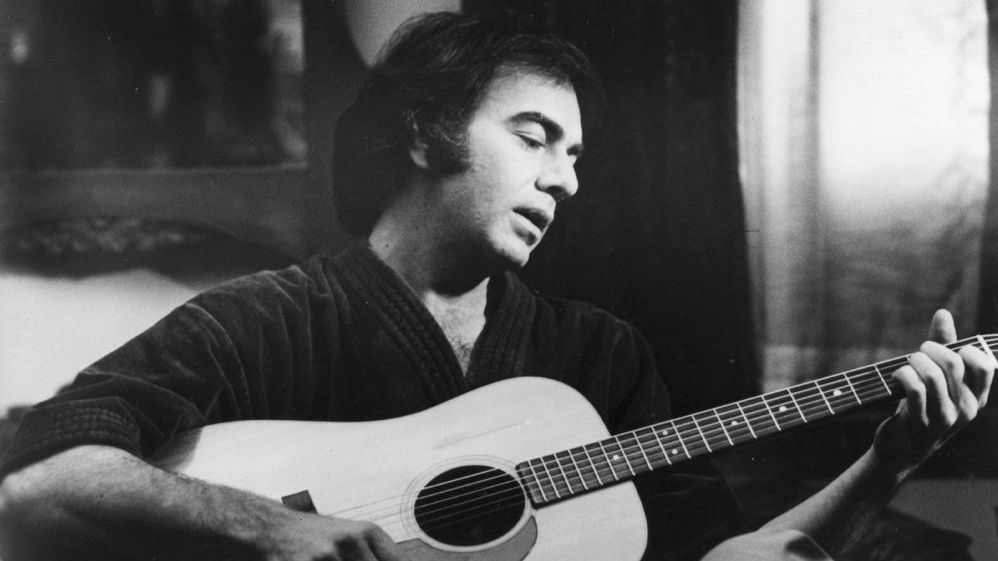
“Brooklyn Roads” feels like Neil Diamond singing not just to a neighborhood, but to a vanished way of being—where family, memory, hunger, hope, and the ache of leaving home all lived on the same narrow street.
When Neil Diamond released “Brooklyn Roads” in 1968, he was opening a much more personal door than many listeners expected at the time. The song appeared on Velvet Gloves and Spit, his first album for Uni Records, issued on October 15, 1968. As a single, “Brooklyn Roads” reached No. 58 on the Billboard Hot 100 and No. 34 in Canada—not one of his biggest early chart triumphs, certainly, but a record whose emotional stature would grow far beyond its original commercial peak. The album itself did not chart in the U.S., which only deepens the story: one of Diamond’s most intimate songs first arrived without the noise that usually announces a classic.
What makes “Brooklyn Roads” so enduring is that it was never merely a song about a place on a map. It was, by Diamond’s own later description, a “consciously autobiographical” work, written to capture what it felt like growing up in Brooklyn and to preserve that feeling for himself. That intention can be heard in every remembered detail: the mother calling from inside, the father coming home, the apartment above the butcher, the ordinary textures of family life made luminous by distance. The song does not describe Brooklyn as a symbol of glamour or myth. It describes it as home—crowded, specific, imperfect, alive. That is why the song carries such unusual force. It does not invent nostalgia; it remembers it.
The background of the song matters greatly. By 1968, Neil Diamond was in transition. He had left Bang Records, where he had already proven he could write sharp, radio-ready hits, and he was beginning a new chapter with Uni. “Brooklyn Roads” was the first single released from that new phase, and it signaled a shift toward something more inward-looking and self-revealing. Contemporary trade reviews noticed that immediately. Cash Box called it a nostalgia-filled glimpse of childhood, while Record World described it as a stirring autobiographical song. Even before time turned it into a beloved deep cut, the song was already being recognized as something more reflective than the usual pop single.
Its meaning lies in the tension between memory and departure. “Brooklyn Roads” is not simply a happy look back at childhood. It is also a song about the quiet wound of outgrowing the world that formed you. The boy in the song dreams forward, but the man singing can already feel what those dreams cost. The neighborhood remains vivid in recollection, yet it belongs to another life. That is why the song feels like a love letter to a lost world: not because Brooklyn vanished, but because the emotional world of youth—the family apartment, the supper call, the certainty that life is still gathering itself—can never be fully re-entered once it has passed. The song keeps returning to place, but what it is truly mourning is time.
There is also something unmistakably literary in the way Diamond shapes the story. Record World heard Thomas Wolfe overtones in it, and that comparison makes sense. Like the finest memory songs, “Brooklyn Roads” understands that the past becomes more powerful once it is gone. The lyric does not rush. It lingers over domestic detail, letting small images do the emotional work that a grand statement never could. That restraint is one reason the song has lasted so strongly among devoted listeners. It feels spoken from within memory, not performed at memory from a safe distance.
Within Velvet Gloves and Spit, the song stands as one of the clearest signs that Diamond was reaching for a broader emotional canvas. The album’s commercial fate was modest, but in retrospect it marked an important threshold. The records that followed would bring larger chart success, yet “Brooklyn Roads” already contained something that would become central to Diamond’s best work: the ability to turn autobiography into shared feeling. Even listeners who never lived in Brooklyn, never knew a butcher downstairs, never heard a parent call them in from the street, can feel the truth of the song because its real subject is not geography. It is belonging, and then the loss of easy belonging.
That is why the song continues to feel larger than its chart position. No. 58 does not tell the full story. Some songs arrive as hits and fade with the season that carried them. “Brooklyn Roads” did something quieter and more lasting. Over the years it came to be regarded as one of Neil Diamond’s most autobiographical songs, a piece that listeners and writers alike return to when they want to understand the inner life behind the more public triumphs. Even in later performances and retrospectives, the song has remained tied to his childhood, his Brooklyn identity, and the emotional roots of his songwriting.
In the end, “Brooklyn Roads” feels unforgettable because it does not merely remember a neighborhood—it remembers the emotional architecture of an earlier life. Neil Diamond turned family routine into poetry, turned departure into ache, and turned one corner of Brooklyn into a permanent address in American song. The world inside “Brooklyn Roads” is not lost because it was unimportant. It feels lost precisely because it meant everything while it lasted. And that is what gives the song its lasting hush: it sings like a man standing far from home, still hearing the voice that once called him in to supper, still carrying the road he left behind.