
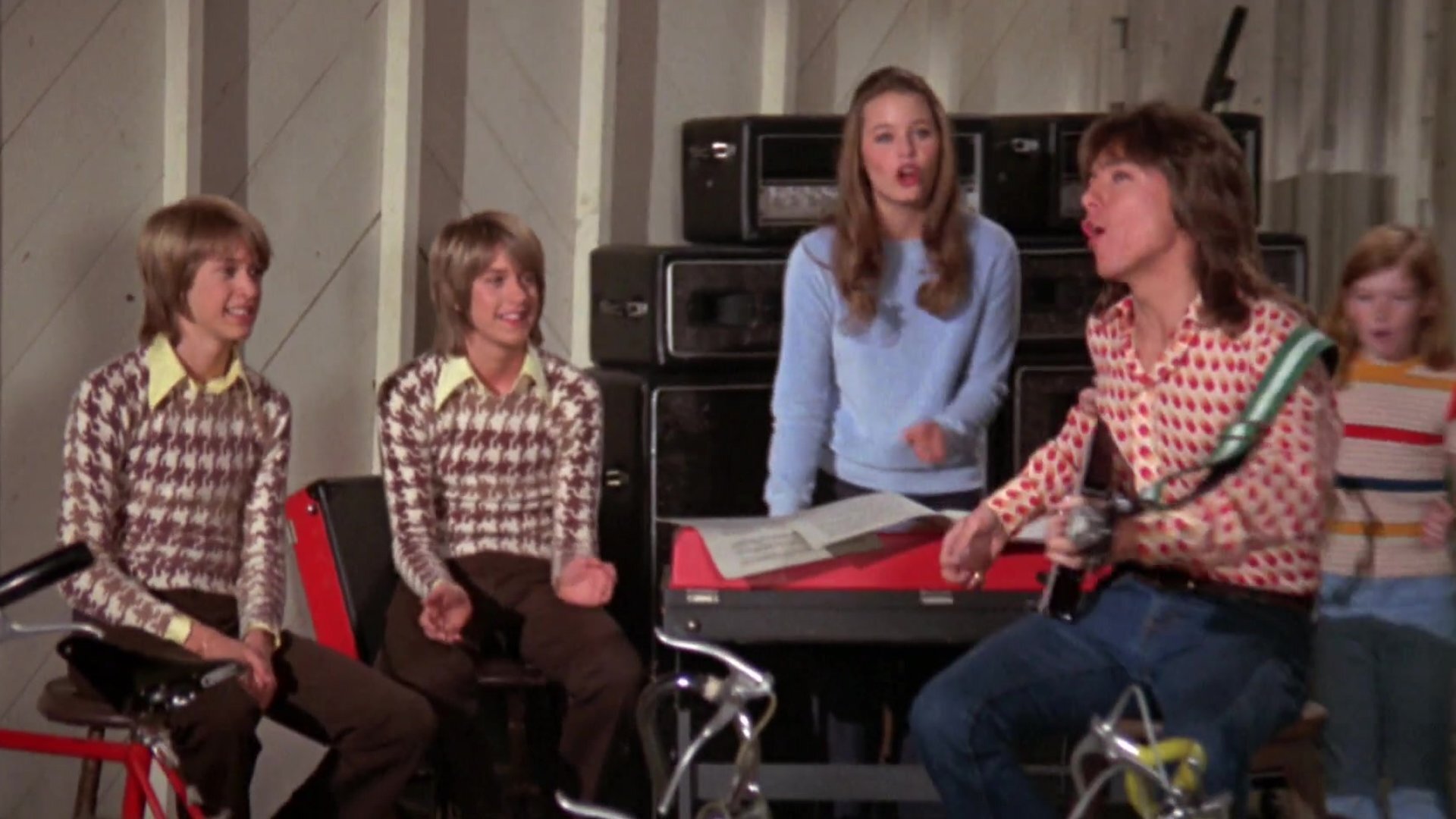
In “Brown Eyes,” The Partridge Family turn a simple gaze into a small emotional risk—sweet on the surface, yes, but charged with the kind of wanting that makes innocence feel just a little dangerous.
There are Partridge Family songs that arrive all sunshine, all smile, all easy young-pop delight. “Brown Eyes” is sweeter than most of them at first touch—but it is not quite as harmless as it seems. That is part of why it still lingers. The song appeared on Sound Magazine, the group’s third studio album, released in 1971, at the height of their early success. That album reached No. 4 on the Billboard 200, and it produced the hit “I Woke Up in Love This Morning,” but “Brown Eyes” was not one of the big singles driving the record into history. It survived more quietly than that, as one of those album tracks listeners kept close because it felt personal rather than public.
That quiet afterlife matters, because “Brown Eyes” works best in close emotional quarters. It was written by Wes Farrell and Danny Janssen, two of the key figures behind the Partridge Family songbook, and that tells you something immediately: this was not an accidental mood or a throwaway filler piece. It came from the same polished pop machinery that knew exactly how to make desire sound clean, catchy, and just intimate enough to stay in the bloodstream.
But what gives the song its special charge is the title itself.
Brown eyes is such a soft phrase. It sounds affectionate, close, almost innocent in its simplicity. Yet songs built around a look often carry more tension than songs built around declarations. A look is where everything begins. Before promises, before heartbreak, before certainty, there is the glance that unsettles you. That is why your title works so well: the look that started everything. In “Brown Eyes,” attraction is still young enough to feel sweet, but already strong enough to feel a little risky. The tenderness is real. So is the pull.
That is where the song becomes so sweet and so dangerous.
Not dangerous in any loud or scandalous sense. Dangerous the way early love often is—because it makes the heart move before the mind is ready. The lyric does not need to become dramatic to suggest that. Its power lies in how direct it is. The feeling comes on quickly, warmly, almost possessively, and that combination gives the song its edge. It is still pop, still melodic, still polished, but underneath it is the old, unsettling truth that affection begins in fascination, and fascination can tip into emotional surrender before anyone has had time to name it properly.
And that voice, of course, is central to the spell. David Cassidy’s lead vocal gives the song exactly the right balance of softness and urgency. He was one of the great teen-idol voices of that moment not simply because he sounded attractive, but because he could make longing feel immediate without making it heavy. On “Brown Eyes,” he does not overpower the listener. He draws nearer. That is the trick. The song is inviting, but there is enough wanting in the delivery to keep it from floating away as mere sweetness.
There is also something quietly revealing about where “Brown Eyes” sits on Sound Magazine. This was an album that showed just how strong the Partridge Family formula had become in 1971—bright studio craft, memorable hooks, and songs built to live easily on radio and in bedrooms alike. Yet among the more obvious, headline-friendly tracks, “Brown Eyes” feels smaller and more private. That often helps a song last. It is not overexplained by fame. It gets to remain a little secretive, a little intimate, a little more open to being felt rather than simply recognized.
So yes, “Brown Eyes” still feels sweet—but sweetness is only half its magic. What keeps it alive is the flicker underneath: the sense that one look has already done more damage than anyone is admitting. In the bright, carefully managed world of The Partridge Family, that kind of emotional quickening can feel especially potent. The song understands that attraction often enters quietly, through beauty, through admiration, through one pair of eyes—and then suddenly nothing feels quite so safe as it did before.
That is why it stays with people. Not because it is one of the group’s loudest songs, and not because it comes wrapped in a giant chart story, but because it catches the first tremor of wanting so cleanly. In “Brown Eyes,” sweetness is the invitation. Danger is the aftertaste. And once that first look lands, the heart is already farther gone than it meant to be.