
The title “Stephanie” sparks curiosity because it sounds so specific, so personal, so much like a real girl standing just offstage. But the truth is more elusive: the mystery is part of the song’s charm, and perhaps part of why it still lingers.
Who was Stephanie, really?
The honest answer is that there does not appear to be any solid, well-documented evidence that “Stephanie” was named after a known real-life person tied to The Partridge Family recording history. What we can say with confidence is that the song was written by David Price, John Henning, and Richard Klein, and that it was not one of the group’s original hit-album staples from the early 1970s. It surfaced later as one of the so-called “lost songs,” officially released on the 2005 compilation Come On Get Happy! The Very Best of The Partridge Family, where it appears as a “new release.” That alone already gives the title a certain glow: it belonged to that half-hidden corner of the Partridge Family story where songs survived in memory before they fully survived on record.
And that hidden quality is exactly why the title catches people so quickly. Stephanie is not an abstract phrase like “love” or “sunshine” or “good times.” It is a name. A single name. That makes the song feel like a clue before you even hear a note. It invites the oldest kind of pop-music curiosity: Who was she? Why her? What story are we stepping into? In a catalog full of bright, accessible titles, “Stephanie” feels just a little more intimate, almost as if the song is addressing someone the listener was never quite introduced to properly.
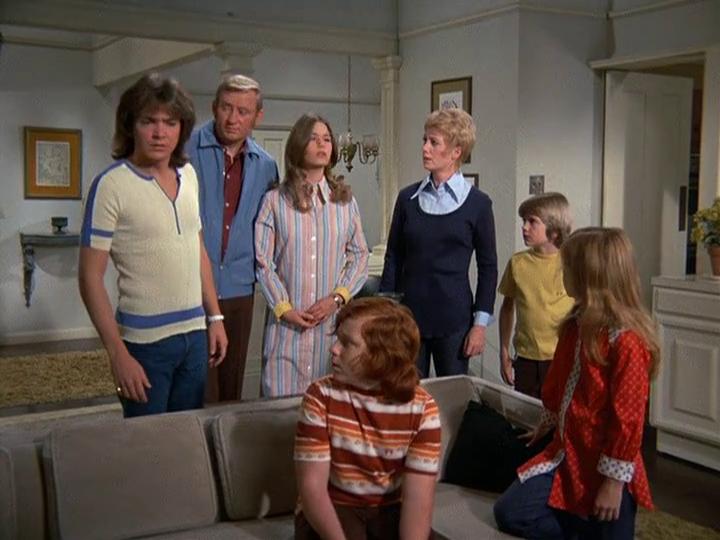
What the documented history does show is that “Stephanie” was closely tied to the television side of The Partridge Family world. It was the featured song in the Season 1 episode “A Knight in Shining Armor,” first aired on March 19, 1971. In that episode, guest star Bobby Sherman appears as Bobby Conway, a musician trying to get his composition off the ground. Contemporary episode guides and fan documentation describe “Stephanie” as the song at the heart of that story. So in the most immediate narrative sense, Stephanie seems to function first as the subject of the song within the episode’s plot rather than as a clearly verified real woman from outside the show.
That matters, because it shifts the mystery in an interesting direction. The question may not be “Which real Stephanie inspired this?” so much as “Why does the name feel so real anyway?” And the answer, I think, is that the song was built to feel personal. A proper name gives a pop song instant emotional focus. It narrows the light. Instead of singing toward everyone, the song sings toward one imagined person, and that makes the listener lean in. Even when no biography is attached, a name can carry the full weight of longing, fascination, or memory. Stephanie sounds less like a concept than a face someone cannot stop seeing.
There is another small twist that deepens the curiosity. Sources tied to Partridge Family discography history note that “Stephanie” was essentially a rewrite of another song, “All of the Things,” using much of the same musical structure with different lyrics. That detail is quietly fascinating because it suggests the song’s identity was still being shaped, still in motion, before it became “Stephanie.” In other words, the title was not inevitable from the beginning. It was chosen. And once chosen, it gave the song a far more immediate emotional magnetism than a more generic title would have offered.
So the real story behind “Stephanie” is not that we have some beautifully preserved, definitive answer about a particular woman. We do not. The stronger truth is almost more appealing: the song survives in that lovely half-light where pop history and television mythology overlap. It came out of the show’s creative machinery, was linked to a memorable 1971 episode, went unreleased for years, and then returned later with all the added romance that lost songs naturally gather. That is why the title still sparks curiosity the second you see it. It sounds like it ought to unlock a secret, and instead it leaves just enough unsaid to keep the imagination working.
And perhaps that is the best fate a song like this could have. If we knew every last practical detail, some of the shimmer might disappear. But “Stephanie” remains suspended between sweetness and mystery. It feels like a name pulled from a notebook, a crush remembered too vividly, a television-era pop song that somehow held on to a little private weather of its own. That is why people still ask about it. Not because the answer is sensational, but because the title itself promises a story—and never quite gives all of it away.