
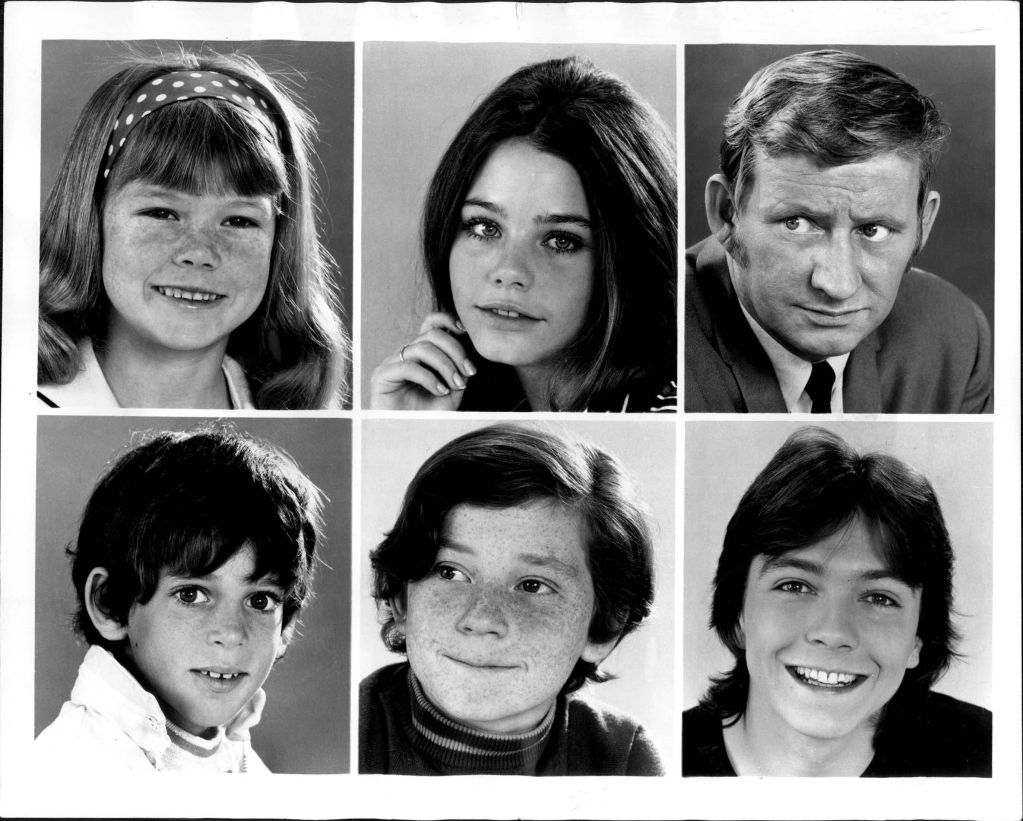
“Love Must Be the Answer” carries the gentle wisdom of later Partridge Family pop—a song that reaches for something larger than infatuation, suggesting that when confusion, longing, and uncertainty crowd the heart, love remains the only truth that finally makes sense.
One of the most important facts to place right at the beginning is that “Love Must Be the Answer” was not a major standalone hit single, but an album track from The Partridge Family Notebook, the group’s sixth studio album, released in November 1972. That album reached No. 41 on Billboard’s Top LP’s chart in early 1973, making it a respectable but more modest success than the group’s earlier blockbuster releases. The song itself appears near the end of the album’s running order, and the available album documentation places its recording date on May 1, 1972, during the main sessions for Notebook.
The songwriting credits matter too, because they reveal the careful pop craftsmanship behind the song. Discography sources credit “Love Must Be the Answer” to Wes Farrell, Peggy Clinger, and Johnny Cymbal. That is a revealing trio of names in the Partridge world. Wes Farrell was one of the principal architects of the group’s recorded sound, while Johnny Cymbal and Peggy Clinger were skilled writers with a strong instinct for concise, emotionally direct pop. In other words, this was not a casual filler track tossed onto an album. It was one of those carefully built songs designed to deepen the emotional character of the record rather than dominate radio by itself.
That distinction is important, because “Love Must Be the Answer” feels exactly like the sort of song that rewards listeners who stay with an album instead of chasing only the charting titles. Its meaning is already present in the title, and the title is beautifully simple. This is not a song built around doubt, revenge, or dramatic heartbreak. It is built around a conclusion. After all the confusion that love songs often describe, this one arrives at a kind of emotional certainty: love must be the answer. There is something deeply appealing in that old-fashioned belief. The song does not try to sound cleverer than the heart. It trusts the heart’s instinct that beyond all the complications of life, affection and devotion remain the truest things we know.
Within the larger world of The Partridge Family, that message feels especially fitting. The group is often remembered for brightness, melodic ease, and the polished optimism of early-1970s television pop. Yet the later albums, especially The Partridge Family Notebook, often carried a little more softness and reflection. They were still tuneful and radio-friendly, but there was sometimes a gentler emotional shading beneath the surface. “Love Must Be the Answer” belongs beautifully to that later mood. It does not rush. It does not shout. It glows. The song feels less like a teenage outburst than like a quiet realization, and that gives it a special grace within the catalog.
There is also something moving about the song’s place in time. By late 1972, The Partridge Family were no longer at the absolute fever pitch of their first great success, but the musical machine behind them was still producing records with real polish and feeling. That can give later songs an added poignancy. Heard now, “Love Must Be the Answer” carries not only its own sweetness, but also the atmosphere of an era beginning to soften at the edges. It sounds like music made in the afterglow of a phenomenon—still bright, still attractive, but touched by the faint wistfulness that often settles over pop as time begins to move on.
The emotional core of the song is what makes it linger. Many love songs ask questions. This one seems to offer a response. The phrase “must be” is especially telling. It suggests that the singer has looked around at confusion, disappointment, and uncertainty, and found only one thing that still feels trustworthy. That gives the song a slightly deeper resonance than a simple romantic trifle. It becomes, in its modest way, a statement of faith. Not faith in the doctrinal sense, but faith in tenderness, connection, and the possibility that human closeness can still rescue life from emptiness. That is one reason the song remains so appealing. It believes in something without embarrassment.
And that sort of sincerity was one of The Partridge Family’s real strengths when the material was right. A song like “Love Must Be the Answer” survives because it does not hide behind irony. It embraces melody, emotional clarity, and the straightforward language of feeling. In another singer’s hands, that could sound slight. In the Partridge setting, it sounds natural. Their records were built to make direct emotions feel singable, and this song does exactly that. It turns a broad, almost philosophical idea into something intimate and warm enough to carry in memory.
So “Love Must Be the Answer” deserves to be heard as one of those quietly lovely later Partridge Family recordings that reveal the softer heart beneath the group’s pop image. It came from The Partridge Family Notebook in 1972, was written by Wes Farrell, Peggy Clinger, and Johnny Cymbal, and lived on an album that reached No. 41 in the United States while producing other more visible singles. But beyond those facts lies the real reason it still glows. It offers an old, simple conviction in an age that often complicates everything: that after all the noise, all the uncertainty, and all the restless searching, love still feels like the answer worth trusting.