
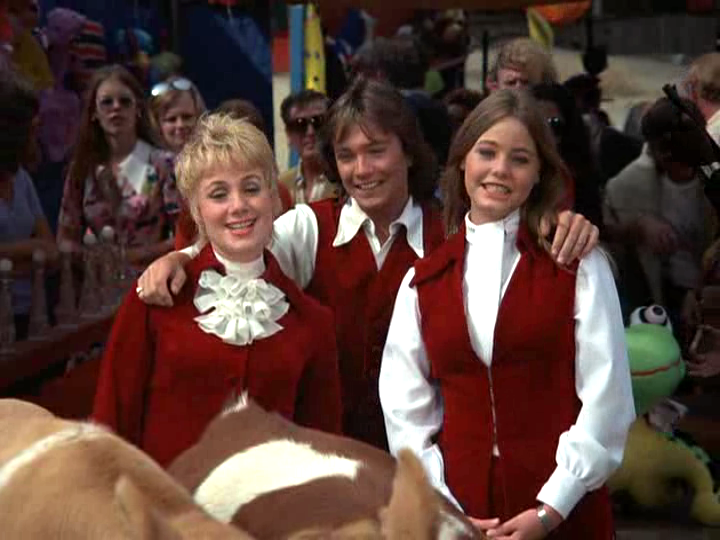
“One Day at a Time” is The Partridge Family offering a gentle survival mantra—where hope isn’t a grand speech, but the quiet discipline of getting through today.
Some songs don’t “hit” you; they steady you. The Partridge Family’s “One Day at a Time” belongs to that steadier tradition: a small, warm piece of early-’70s pop that treats emotional endurance as something ordinary people practice—quietly, without applause. It isn’t a chart-conquering single; it’s the kind of album track you discover the way you used to discover meaning—by letting the record play, by listening past the songs everyone already knows.
The facts place it clearly in the Partridge timeline. “One Day at a Time” appears on The Partridge Family Notebook, released November 1972 on Bell Records, produced by Wes Farrell. On standard listings, the song runs about 2:34 and appears as track 2 on the album—early enough that it feels like a tone-setter, a quiet reassurance offered right after the record begins.
Now, the “ranking at launch,” stated plainly and accurately: “One Day at a Time” was not released as an A-side single, so it did not receive an individual Billboard Hot 100 peak. The album’s chart performance is the measurable context instead. The Partridge Family Notebook peaked at No. 41 on Billboard’s album chart in January 1973, spending 16 weeks in the Top 200—also noted as the group’s first album not to crack the Top 40. That’s not a failure; it’s a snapshot of shifting pop weather, when the Partridges’ television-fueled pop moment was cooling slightly—even as the records continued to hold small treasures for listeners who stayed.
The songwriting credit gives the track an unexpected little spark of pedigree: “One Day at a Time” is credited to Gerry Goffin and Wes Farrell. Seeing Goffin’s name here matters—because it suggests that beneath the group’s bright branding, there were writers who understood real emotional mechanics. Goffin’s best work always knew how to make a simple phrase carry a whole life, and “one day at a time” is exactly that kind of phrase: common enough to say casually, heavy enough to mean everything when you actually need it.
Behind the scenes, the recording details are also preserved with unusual precision: the track was recorded on May 8, 1972 at United Western in Hollywood. That date places it in the same studio burst that produced several other songs for the album—a reminder of how efficiently this music was made, and how much emotional warmth it could still carry even under tight, professional pop assembly.
And now the meaning—because the title alone tells you the song’s emotional job.
“One Day at a Time” is about coping without drama. It suggests a narrator who has learned—maybe through heartbreak, maybe through disappointment, maybe simply through growing up—that the future is too big to hold all at once. So you hold the present instead. One day. Then the next. It’s a philosophy disguised as a pop tune, and that disguise is part of its tenderness: the song doesn’t stand on a soapbox. It simply repeats a truth that works.
That’s also why it feels so nostalgic in a way that isn’t only about the early ’70s. It reminds you of a time when pop music made room for reassurance that wasn’t ironic. When a singer could say “we’ll get through it” and mean it, and the audience could accept that sincerity without needing a wink. The Partridge Family world was bright by design—but songs like this reveal the softer, more human underside: the awareness that even bright lives contain hard days, and hard days are survived in small, steady steps.
In the end, “One Day at a Time” isn’t a headline in the Partridge catalog. It’s something closer to a quiet handrail—there when you need it. It doesn’t promise miracles. It promises something more believable: that you can make it through today, and that tomorrow can wait its turn.