
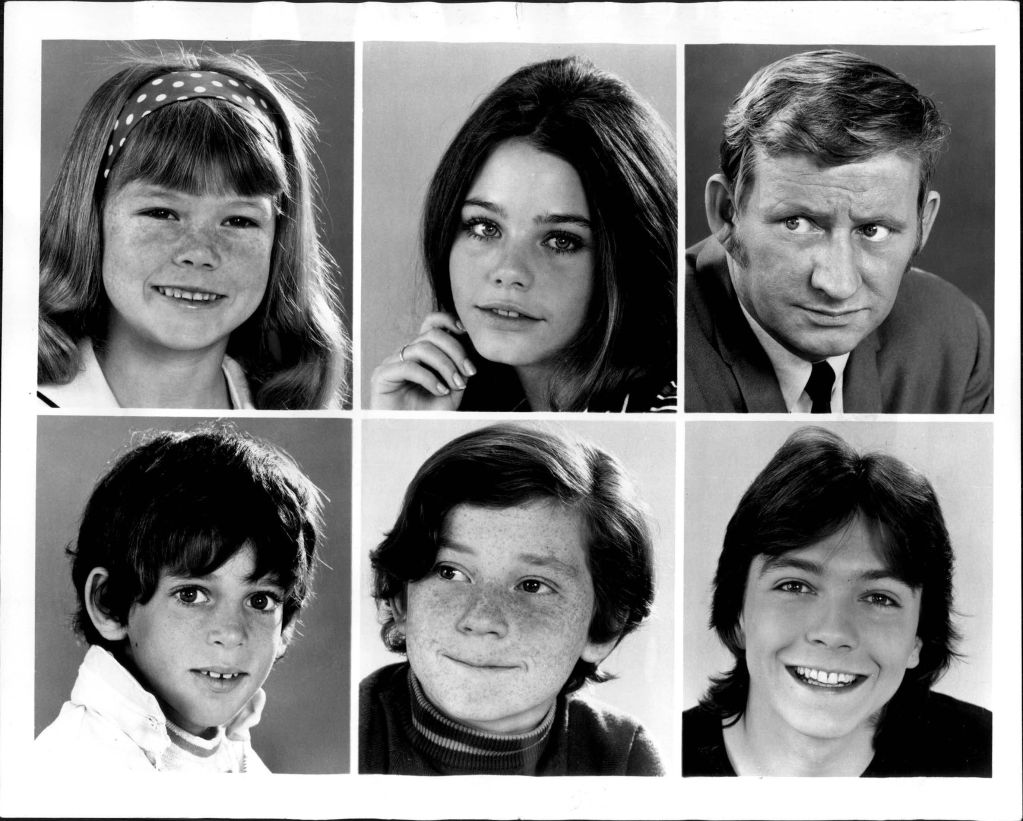
“Walking in the Rain” is a pop memory drenched in thunder—romance told as weather, where every step forward feels heavy with what can’t be said.
If you place The Partridge Family in your mind as bright harmonies and television-sunny smiles, “Walking in the Rain” is the moment the sky darkens—beautifully. Their version was released only in the UK as a single in 1973, backed with “Together We’re Better”, and it reached No. 10 on the UK Singles Chart. That chart peak matters because it shows something quietly surprising: even after the group’s biggest U.S. hit-making period, this particular song—moody, older-sounding, and drenched in classic pop drama—still found a wide audience when given a proper spotlight.
The recording also belongs to their 1972 album The Partridge Family Notebook (often shortened to Notebook), where it sits among a set of covers and originals that lean into a more reflective, late-era Partridge mood. And the songwriting credit tells you immediately why it feels so “classic”: Barry Mann, Cynthia Weil, and Phil Spector—architects of that early-’60s Brill Building/Wall of Sound emotional grandeur.
Because “Walking in the Rain” is, at heart, a song with a shadowy pedigree. It was first recorded by The Ronettes in 1964, produced by Phil Spector, and their original became a hit—reaching No. 23 on the Billboard Hot 100 (and later charting strongly on the R&B side as well). The Ronettes’ version is famous for its storm atmosphere—thunder as emotional punctuation—and for how it turns a simple premise into a whole cinematic scene: love that’s uncertain, pride that’s bruised, and a person moving through weather because staying still hurts more.
So what happens when The Partridge Family step into that storm?
They don’t try to out-Spector Spector. Instead, their take feels like a television-era echo of an earlier pop cathedral—still dramatic, but cleaner at the edges, less haunted by urban noir and more haunted by something gentler: the sadness of realizing you can’t talk your way out of a feeling. The genius of “Walking in the Rain” is that the weather isn’t background; it’s metaphor made physical. Rain becomes the place you go when you don’t want anyone to see your face clearly. Thunder becomes the sentence you can’t bring yourself to say. And the simple act of walking becomes a small act of courage—because heartbreak, in real life, often looks exactly like that: you keep moving, even if you don’t know where you’re going.
There’s also a subtle but important cultural twist here. The Partridge recording is typically credited as “The Partridge Family starring David Cassidy” on the single-era documentation, reflecting how the brand increasingly leaned on David Cassidy as the emotional center of the project. That framing changes how the song feels. On the one hand, it’s still the Partridge “world”—studio polish, pop discipline, a performance meant to fit radio. On the other, “Walking in the Rain” asks for a kind of maturity: it’s not puppy-love comedy; it’s the slow ache of waiting for someone who might never arrive, the dread that you may already know the answer.
And perhaps that’s why it worked so well in the UK in 1973, where it rose to No. 10. British pop audiences have often had a soft spot for elegantly melancholy records—songs that dress sadness in melody and make it feel almost noble. This one does exactly that. It’s not a rage song. It’s a resignation song—yet not hopeless. There’s still longing inside it, still the fragile belief that love might show up late, soaked through, and finally tell the truth.
In the end, “Walking in the Rain” endures because it understands something timeless: when the heart is confused, the world looks like weather. And some songs, when they’re sung just right, don’t merely describe that weather—they let you stand in it for a while, remembering every time you tried to look composed while your insides were anything but.