
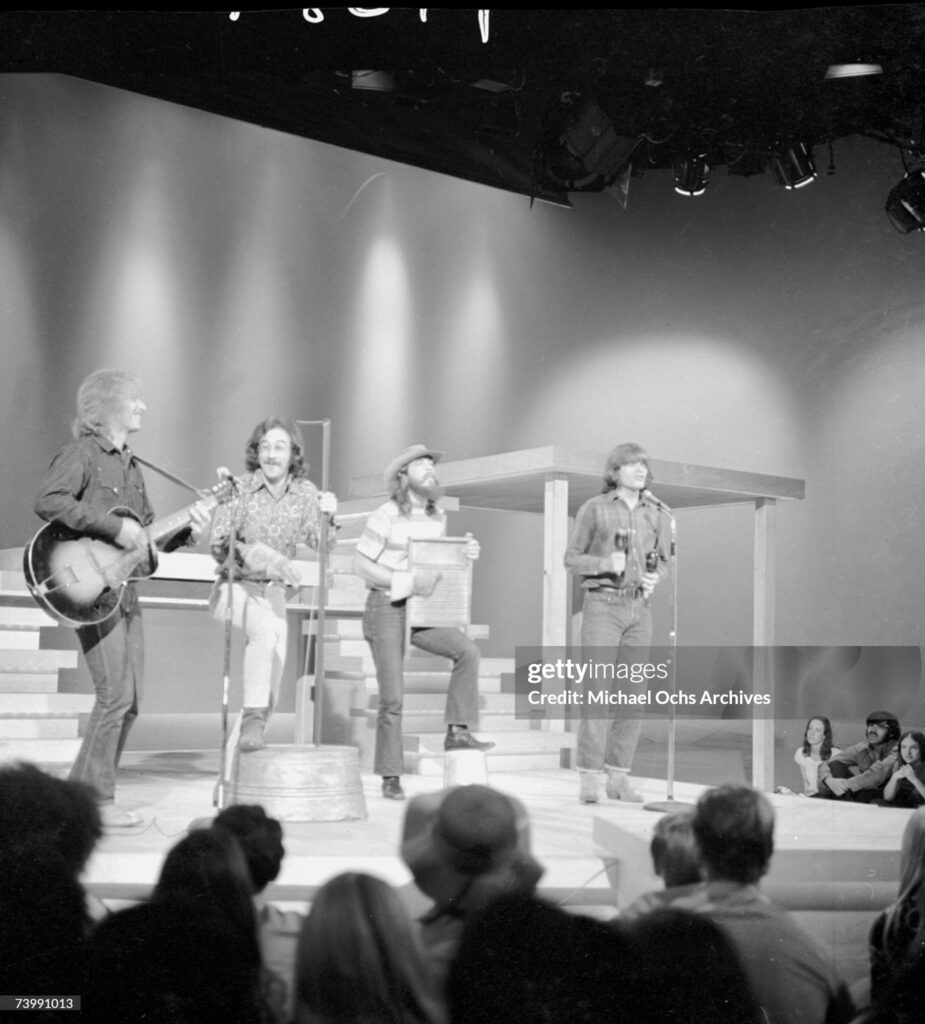
“I Put a Spell on You” is CCR’s most feral early statement—an old blues curse reborn as swamp-rock thunder, where desire turns into a vow you can’t take back.
When Creedence Clearwater Revival cut “I Put a Spell on You”, they weren’t chasing a novelty cover—they were reaching backward into the darker riverbed of American music and pulling up something raw, theatrical, and dangerous. Their version first appeared on the debut album Creedence Clearwater Revival, released May 28, 1968 on Fantasy Records. It’s an important placement: this was CCR before the run of 1969 masterpieces, before the cultural ubiquity, when the band still sounded like a tough bar band determined to prove it could out-sweat the room.
The “ranking at launch” for the song itself comes not from that album release, but from the single that followed the breakthrough of “Suzie Q.” In October 1968, CCR issued “I Put a Spell on You” as a single with “Walk on the Water” on the B-side, and it reached No. 58 on the U.S. charts. That’s not a massive peak—especially compared with what was coming—but it’s revealing: listeners were willing to follow CCR from an eight-minute psychedelic jam (“Suzie Q”) into something stranger and more primal, a song that didn’t flirt with darkness so much as stared straight into it.
Of course, the spell began long before CCR. The original “I Put a Spell on You” was recorded by Screamin’ Jay Hawkins—a 1956 single, recorded September 12, 1956, released on Okeh, and co-written by Hawkins with Herb Slotkin. Hawkins later described how what was meant to be a “refined love song” turned into a notorious, drunken, explosive performance—so outrageous it was banned by many radio programmers, yet still reportedly sold over a million copies. It’s one of the great American contradictions: a record too wild for polite airwaves, yet too compelling to disappear.
CCR’s genius was understanding that the song’s power didn’t lie in copying Hawkins’ shock-theater (coffins, capes, smoke). It lay in the emotional core: obsession as poetry, love as possession, longing as a kind of spiritual violence. John Fogerty doesn’t sing it like a cartoon villain; he sings it like a man whose restraint has finally snapped. The band strips the song down to muscle—tight rhythm, serrated guitar, a groove that feels like boots in wet earth—and lets the lyric’s menace sound almost ordinary. That’s the swamp-rock trick: make the supernatural feel like local news.
The meaning of “I Put a Spell on You” has always lived in that uneasy double vision. On one level, it’s the oldest story in the book: I want you, I can’t stand losing you, I’ll do anything to keep you. On another level, it’s a warning about what love becomes when it stops being love and starts being control. The phrase “spell” is seductive because it shifts responsibility—it isn’t my fault; I’m under something. Yet it also confesses intent—I am the something. In CCR’s hands, that tension feels especially modern. Their version doesn’t wink. It doesn’t apologize. It simply documents the moment a feeling turns into a force.
There’s one more detail that quietly seals the song’s status in CCR lore: the band performed “I Put a Spell on You” at Woodstock in 1969. That’s fitting. Woodstock is often remembered in pastel—peace signs, idealism, communal haze—but CCR always carried a tougher, working-class edge, even when they were “celebrating.” Bringing a song like this onto that stage was like reminding everyone that the American dream has teeth, too.
So “I Put a Spell on You” endures as more than a cover. It’s an early window into CCR’s identity: reverent toward roots, fearless about grit, and willing to make a pop single out of something slightly frightening. It doesn’t offer comfort. It offers electricity—love as storm weather—crackling across a 1968 recording and still raising the hair on your arms when the chorus hits and the spell finally takes hold.