
A song about love as an engine—restless, tuned by longing—where the open road becomes the one place your heart can tell the truth.
The version of “Hot Rod Heart” you’ve named—John Fogerty trading lines and lightning with Brad Paisley—arrived not as a radio single trying to “win the week,” but as a late-career statement of vitality on the collaboration album Wrote a Song for Everyone, released in the U.S. on May 28, 2013. Even more telling than the date is the reception: the album debuted at No. 3 on the Billboard 200, a reminder—measured in the most modern way possible—that his voice still moved people in bulk, not just in memory.
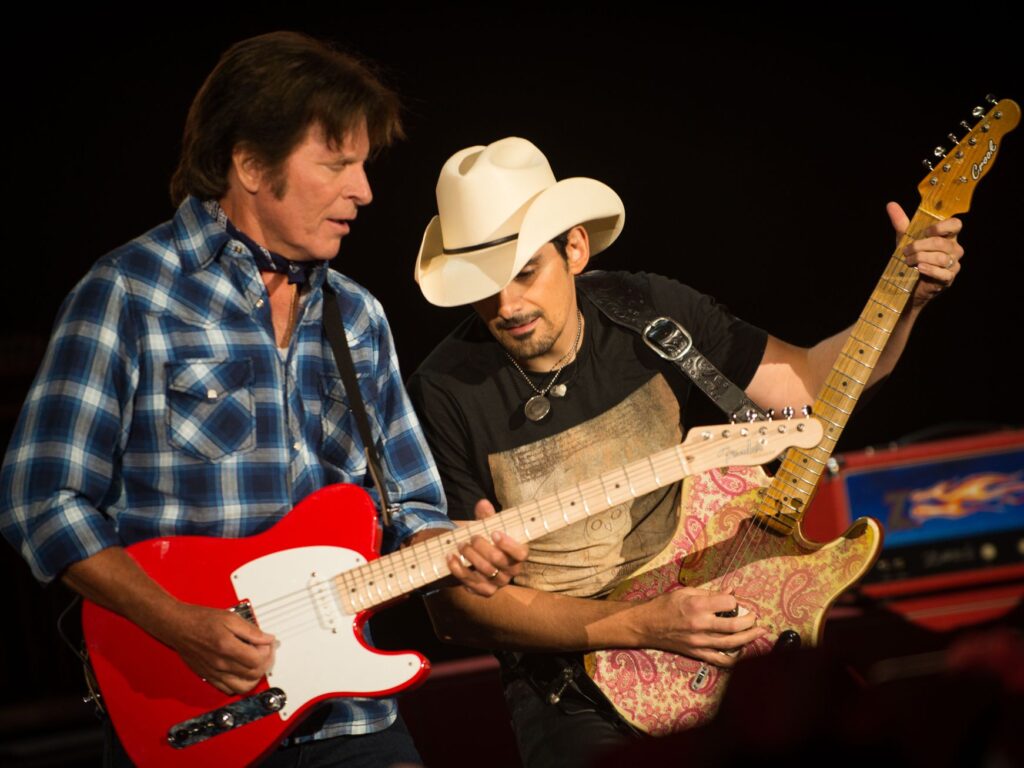
That matters because this duet isn’t simply “a guest spot.” It’s a reunion between two American languages that have always shared the same highway shoulder: roots-rock grit and country guitar conversation. In studio footage and interviews from the album’s rollout, Paisley frames the session like a personal milestone—calling it a dream come true—and describes how they traded ideas and solos back and forth, almost like friendly competition, until it felt like a “garage session.” That detail tells you exactly how to listen: not for polish, but for spark—two players leaning in, grinning, testing each other’s reflexes with respect.
And yet the heart of this performance reaches further back than 2013. “Hot Rod Heart” was first introduced on Blue Moon Swamp (released May 20, 1997), where it sat early in the sequence like a promise that the album would move—dance, snarl, roll its shoulders—without ever losing its human center. That album went on to win Best Rock Album at the 40th Annual GRAMMY Awards, a rare, official stamp on Fogerty’s particular kind of craft: earthy, meticulous, and emotionally direct.
As for “chart position” of the song itself: Fogerty did issue “Hot Rod Heart” as a single in 1997, but it did not register chart placements in the standard territories tracked in his discography—one of those cases where a track becomes beloved through albums, concerts, and personal attachment rather than numeric peaks. In other words, its success has always been a quieter kind—the kind you discover when you put the record on and suddenly the room feels like it has more space in it.
So what is the song actually saying—and why does the Paisley duet sharpen it?
Fogerty’s writing here turns romance into machinery, not because love is cold, but because love—real love—requires maintenance. A “hot rod heart” is not a fragile ornament. It’s a tuned engine: powerful, temperamental, a little too loud for polite company. The image carries a lifetime of American nights inside it: neon reflected on a hood, the low thrum of tires, the private confessions that only seem possible when you’re driving and no one can interrupt. In that world, the road isn’t escape. It’s honesty. The motion gives your feelings permission to move.
Paisley’s presence amplifies that idea. His guitar voice has always been conversational—able to joke, flirt, testify, and sting without ever losing clarity. When he and Fogerty trade phrases, you can hear two eras of the same tradition meeting in the same lane: Fogerty’s chordal bite and swampy insistence beside Paisley’s bright precision and country snap. It’s less “featuring” than “sparring partners who secretly want the other guy to land a great punch.” The result is a performance that feels young in the way experienced musicians can feel young: not naïve, but alive—still curious, still hungry for the next bend in the song.
And beneath the guitars, the meaning holds steady. “Hot Rod Heart” is ultimately about that stubborn part of us that refuses to become purely sensible. Even when life asks us to slow down, to behave, to choose safer routes—something in the chest still wants the long way home, the windows down, the old promises tested again under streetlights. In the 2013 duet, that longing doesn’t sound like regret. It sounds like fuel.