
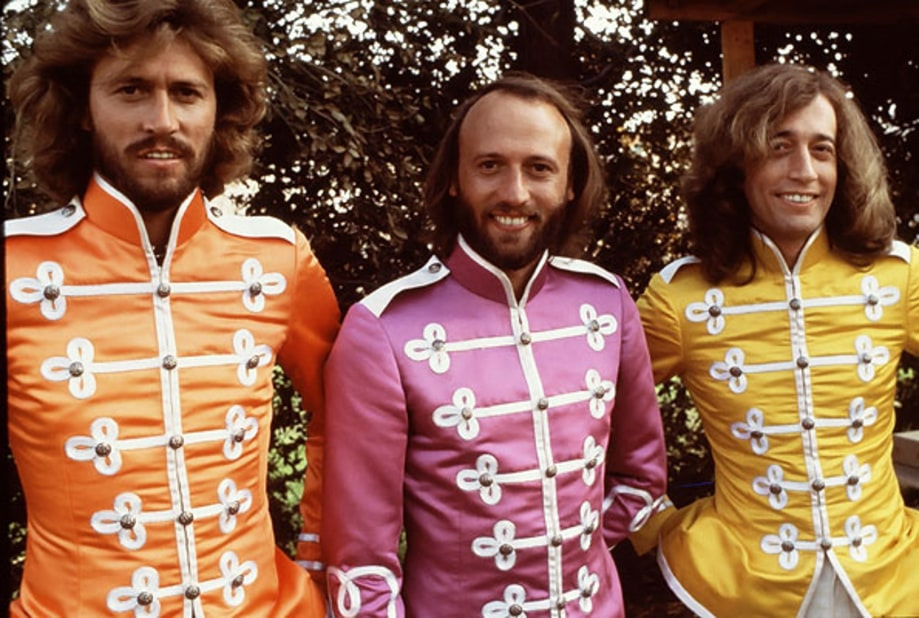
“Down the Road” is the Bee Gees at a crossroads—still carrying the ache of their early balladry, yet already leaning into a tougher groove that points toward the feverish future.
Before the world learned to say Saturday Night Fever as if it were a single breath, the Bee Gees were already quietly experimenting with momentum—music that moves, not just music that mourns. “Down the Road” is one of those telltale tracks: not a blockbuster single, not a radio staple, but a revealing piece of the puzzle. It first appeared on their album Mr. Natural, released May 13, 1974 on RSO Records. On the album’s official track listing, “Down the Road” is credited to Barry Gibb and Robin Gibb, with Barry taking the lead vocal, running 3:35.
That’s the factual spine. Now the heartbeat.
In 1974, the Bee Gees were in the middle of one of the most fascinating reinventions in pop history—leaving behind the ornate chamber-pop melancholy of the late ’60s and early ’70s and inching toward something leaner, earthier, more rhythmic. “Down the Road” doesn’t pretend to be a grand statement; it simply behaves like a band learning how to swing its weight. Critics and deep-track listeners have long heard it as a foreshadowing—an “obvious prelude” to the funkier, dance-driven years ahead, even before disco became their permanent headline. And that is exactly what makes the song so satisfying to revisit: you can hear the future arriving, quietly, in the way the groove locks in.
What’s especially poignant is how “Down the Road” holds two Bee Gees identities in the same frame. There’s still that familiar Gibb emotional gravity—voices that know how to sound like memory, harmony that feels like weather moving across the face of a lake. Yet underneath, the track pushes forward with a confident strut: a rhythmic insistence that says, we’re not standing still anymore. It’s the sound of a band refusing to be preserved in amber.
Because it wasn’t released as a headline single from Mr. Natural, “Down the Road” didn’t have a classic “debut peak” moment on the singles charts to announce itself with fanfare. Instead, it became something arguably more enduring: a song that shows up later like an old friend, unexpectedly, in the footnotes of bigger stories. One of the most striking examples is its second life onstage. The Bee Gees performed it on Here at Last… Bee Gees… Live, an album recorded at the L.A. Forum on December 20, 1976, where the concert set leaned heavily on hits—yet still made room for this “more obscure” gem from 1974.
And then comes the sweetest twist of all: in 1978, at the very height of their pop domination, a live version of “Down the Road” was used as the B-side to their single “Night Fever.” Imagine that for a moment—the global dance-floor phenomenon on one side, and this earlier, road-worn groove tucked on the back like a private message. It’s the Bee Gees reminding you—whether they meant to or not—that superstardom didn’t erase their earlier selves. The past was still riding along.
So what does “Down the Road” mean? It feels like a song about motion as salvation—about leaving before you’re ready, about the uneasy faith that something better waits around the bend. The title alone carries that old, universal promise: that distance might soften regret, that the next town might offer a clean page, that the heart can outrun what it’s dragging. And if you’ve lived long enough to know that running doesn’t always cure anything—well, that knowledge makes the groove hit differently. It becomes less about escape and more about endurance: one foot in front of the other, even when the reasons are complicated.
That’s why “Down the Road” belongs in any honest Bee Gees conversation. Not because it topped a chart, but because it captures the band becoming—a snapshot of transition, grit, and quiet confidence. It’s a reminder that the road to the bright lights is rarely straight… and that sometimes the truest music lives in the tracks that never begged for attention, yet never stopped moving.