
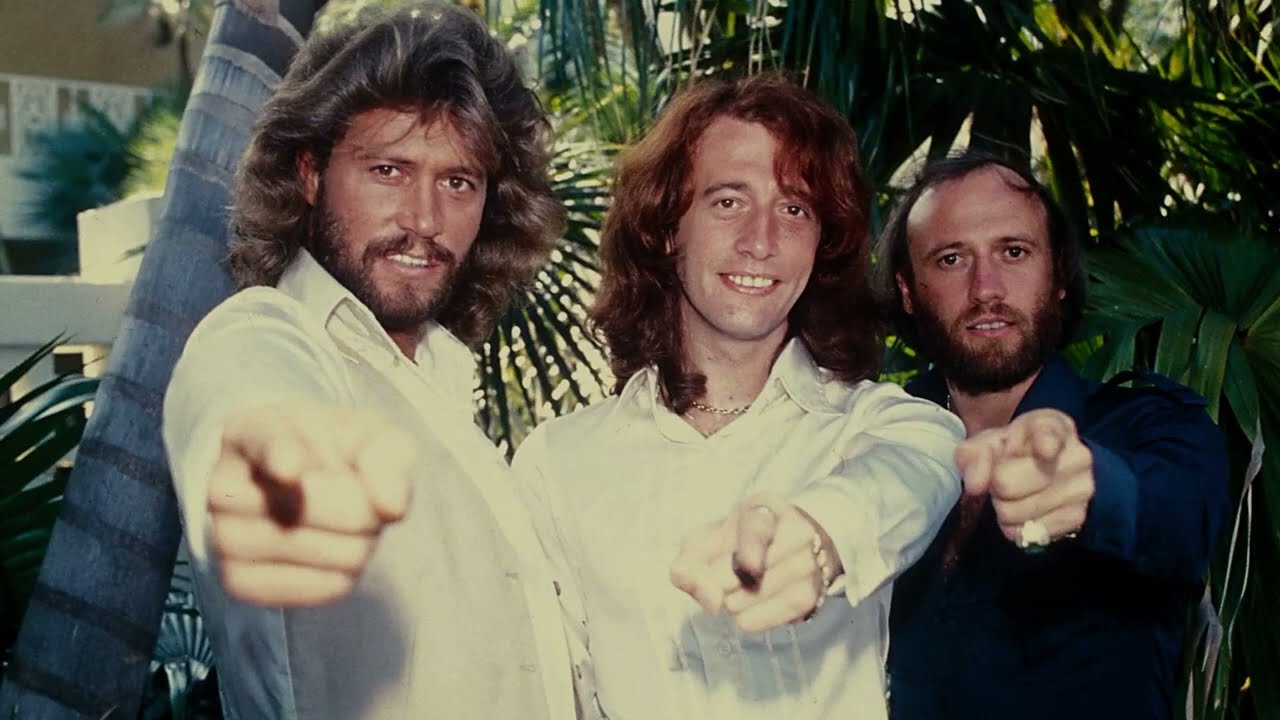
“Paradise” is the Bee Gees’ late-night promise—soft rock wrapped in velvet harmonies, where hope sounds beautiful precisely because it’s fragile.
Released on the Bee Gees’ 1981 album Living Eyes, “Paradise” sits like a candle in a draughty room: steady, tender, and slightly trembling at the edges. It was recorded during February–June 1981, credited to Barry Gibb, Robin Gibb, and Maurice Gibb, and released by RSO in 1981. That matters, because Living Eyes arrived at an awkward crossroads—after the seismic cultural wave of the late ’70s and into a new decade that sometimes treated the Bee Gees like yesterday’s headline. And yet, inside that shifting weather, “Paradise” is quietly defiant: not loud, not desperate, simply determined to keep believing in what a love promise can still mean.
If you’re looking for a big “debut chart position,” “Paradise” doesn’t tell that kind of story. It wasn’t launched as a major international hit single in the way their earlier smashes were. Instead, it gained a smaller, more collector-like life: it was later released as a single in the Netherlands and Japan, backed with “Nothing Could Be Good.” In other words, “Paradise” moved like a whisper rather than a parade—passed hand to hand by listeners who were still paying attention to the album tracks, the ones that don’t fight for daylight but shine best after dark. Its afterlife was honored, too: it was included on the 1983 compilation Gold & Diamonds, a sign that even if it wasn’t a chart headline, it belonged to the era’s emotional core.
Musically, “Paradise” is built from what the Bee Gees always did better than almost anyone: harmony as psychology. The song’s genre is often tagged soft rock / art rock, but labels don’t capture the true sensation—those layered voices arriving like overlapping thoughts you can’t quite silence. Barry and Robin share lead vocals, and the blend feels personal, almost conversational, as if the song is being sung from inside a relationship rather than at an audience. The lyric itself—anchored by the repeated vow, “you promise me paradise”—is both romantic and wary. Because a “promise” isn’t certainty; it’s a request for faith. And the more it’s repeated, the more you sense the fear underneath: don’t go back on your word.
One of the most striking truths about “Paradise” is how serious the musicianship is for such a gentle song. The personnel list reads like a late-night dream of studio excellence: Don Felder (of the Eagles) on electric guitar, Steve Gadd on drums, and keyboards from players including Richard Tee and George Bitzer, with Albhy Galuten adding synthesizer textures. The production credits—Barry Gibb, Robin Gibb, Maurice Gibb alongside Albhy Galuten and Karl Richardson—signal a group still sculpting sound with care, even when fashion had begun to drift away from them. You can hear it: the track doesn’t rush to impress. It glides. It trusts the listener to lean in.
And that’s the deeper meaning of “Paradise.” It isn’t a postcard from a perfect place. It’s a song about the human need to believe in one—especially when life starts to look complicated, when “forever” feels like a word people say too easily. The Bee Gees don’t sell paradise as a destination; they sing it as a promise that has to be kept, renewed, defended. In that sense, the title is almost heartbreaking: paradise is not guaranteed, it’s negotiated—again and again, between two people who don’t want to give in to the world’s noise.
Listening now, “Paradise” feels like a private room inside Living Eyes—a reminder that the Bee Gees’ greatest strength was never only trend-making. It was emotional precision: the ability to make longing sound elegant, to make uncertainty singable, to turn a simple repeated phrase into a small, enduring prayer.