
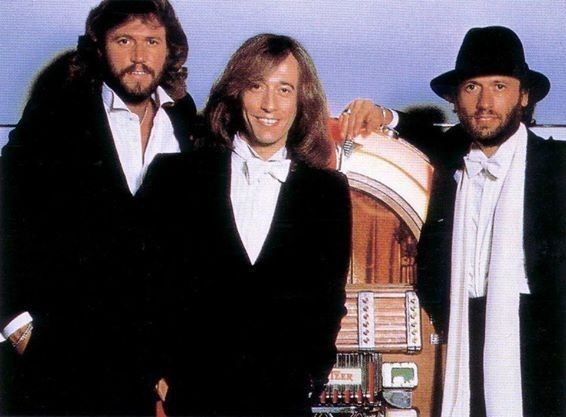
“Tragedy” live at the MGM Grand turns the Bee Gees’ great disco-era cry of heartbreak into something even larger—part memory, part spectacle, part survival, as though a song once born in personal despair has learned to command an arena without losing its wound.
One of the most important facts to place right at the beginning is that “Tragedy – Live At The MGM Grand” comes from One Night Only, the Bee Gees’ celebrated live album and concert film recorded at the MGM Grand Garden Arena in Las Vegas on November 14, 1997 and released in 1998. The live version is not a separate studio remake, but a concert performance drawn from that major comeback-style event, a show widely remembered as the group’s first U.S. concert in nearly a decade. In other words, this version carries two histories at once: the original history of “Tragedy” as a towering 1979 hit, and the later history of three brothers returning before a vast audience to sing their legacy back into the room.
The original “Tragedy” was itself one of the Bee Gees’ defining triumphs. Released in 1979 from Spirits Having Flown, it reached No. 1 on the Billboard Hot 100 and No. 1 on the UK Singles Chart, extending the extraordinary commercial streak the group enjoyed at the peak of their late-1970s dominance. It was one of the songs that confirmed the Bee Gees were not merely attached to the disco moment, but central to it—capable of writing records that combined rhythmic immediacy with emotional drama on a scale few others could match.
But statistics alone cannot explain why “Tragedy” still hits so hard, especially in the MGM Grand performance. The song has always been more than a dance-floor anthem. Its lyric is full of collapse: loneliness, emotional ruin, the sudden emptiness left by love’s disappearance. Even modern commentary on the song still recognizes that central feeling—a breakdown after separation, a cry from someone who has lost control of the emotional world that once held him together. That is why the title lands so strongly. This is not mild sadness. It is catastrophe spoken in the language of pop.
There is also a marvelous story behind the original recording that helps explain the song’s force. In accounts of how the Bee Gees made “Tragedy,” the famous explosive sound effect was created not with actual pyrotechnics, but by combining low-end piano resonance with Barry Gibb blowing into a microphone diaphragm, then processing the result electronically. It was ingenious, slightly mad, and perfectly suited to the theatrical scale of the song. That detail matters because “Tragedy” was always built as an event. Even in the studio, it was meant to sound like emotion detonating.
By the time of One Night Only, that emotional detonation had acquired another layer: memory. The 1997 performance is so moving because the Bee Gees were no longer the young kings of the disco era defending a current hit. They were elder statesmen of pop returning to songs that had outlived fashions, backlash, and time itself. In the live setting, “Tragedy” becomes not only the story of romantic devastation, but a testament to endurance. The falsetto cry is still there, the drama is still there, but now it is carried by artists who know what survival feels like. The song’s old urgency remains, yet it is framed by experience, by history, by the sight of an audience already knowing every rise and fall before it arrives.
That is the deeper meaning of “Tragedy – Live At The MGM Grand.” It is a song about heartbreak, yes, but in live performance it also becomes a song about the persistence of feeling across decades. The Bee Gees always had a genius for making emotional excess sound elegant. They could sing despair without sounding defeated, melodrama without sounding foolish. In “Tragedy,” they take one of the oldest pop themes—losing love—and raise it to near-operatic height. At the MGM Grand, that quality becomes even more striking. The room is huge, the performance grand, yet the emotion at the song’s core is still painfully simple: the feeling’s gone, and you can’t go on. That line remains devastating because it says in plain words what many grander poems fail to say.
There is something especially poignant, too, about hearing Barry, Robin, and Maurice Gibb together on this material in 1997. Later generations would come to hear the Bee Gees with the added ache of loss and retrospect, but even without imposing later sadness onto the performance, the live version already carries the weight of brotherhood, shared history, and artistic durability. One Night Only was, in many ways, a public reaffirmation that the Bee Gees’ catalog had survived every attempt to reduce it to an era. “Tragedy” in Las Vegas proves that point magnificently. It is no relic. It is alive, theatrical, wounded, and strangely triumphant.
So “Tragedy – Live At The MGM Grand” deserves to be heard as more than a concert retread of a famous single. It is a 1997 Las Vegas performance, released in 1998 on One Night Only, reaching back to a 1979 No. 1 classic and giving it new stature in front of a modern audience. What lingers most, though, is not the chronology. It is the feeling of seeing a song once built from private emotional wreckage become a shared communal cry—bigger, older, and perhaps even more human than it was the first time.