
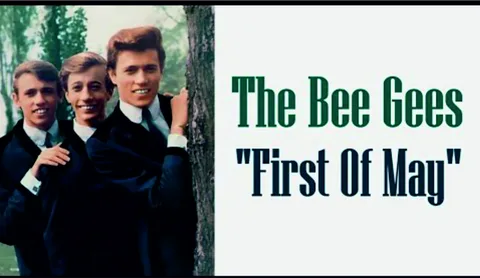
“First of May” has that rare power to summon an entire vanished world almost before the song has truly begun—because the Bee Gees wrote it not like a memory being explained, but like one suddenly returning, whole and aching, in a single breath.
There are songs that become nostalgic over time, and then there are songs like “First of May” that seem to carry nostalgia inside their very bones. Before the listener has even settled into the melody, the feeling is already there: childhood slipping away, seasons changing without permission, love and innocence quietly receding into the distance. That is why the song still feels so overwhelming. It does not slowly build toward remembrance. It begins in remembrance. And in just a few lines, the Bee Gees manage to open a doorway between the present and everything that has already been lost.
Released in January 1969 in the UK and March 1969 in the United States as a single from the double album Odessa, “First of May” became one of the standout Bee Gees songs of their late-1960s period. It reached No. 6 on the UK Singles Chart and No. 37 on the Billboard Hot 100 in the U.S. Those numbers matter, of course, but this is not really a song whose legacy can be measured by chart placement alone. Its real life has always been emotional. People return to it because it touches something deeper than pop success: the unbearable swiftness of time.
That is the first great beauty of “First of May.” It understands that memory does not arrive in careful order. It arrives all at once. A phrase, a smell, a date, a season—and suddenly a whole lifetime seems to rise behind it. The title itself is part of the magic. First of May is not merely a calendar reference. It sounds ceremonial, almost sacred, as though one ordinary spring day has become permanently lit by feeling. In the song, that date becomes a kind of emotional landmark, the place where youth and tenderness are still within reach, even as the singer already knows they cannot be held there forever.
Musically, the record helps that feeling along with extraordinary delicacy. The song opens with piano, then gradually widens with Bill Shepherd’s orchestral arrangement, giving it the sense of memory expanding in real time. Barry Gibb sings the lead, and that matters enormously. His voice here is soft, youthful, and touched with just enough sadness to make every line feel as though it is already looking backward. The performance is not grand in the showy sense. It is grand in the way memory is grand—quietly, almost helplessly, because what it recalls is too precious to speak of roughly.
The story around the song only deepens its poignancy. “First of May” came during one of the most strained chapters in early Bee Gees history. It was chosen as the A-side over “Lamplight,” the Robin Gibb-led song that Robin himself wanted released instead. That disagreement became one of the sparks behind Robin’s temporary departure from the group during the Odessa period. In that sense, the song now carries two kinds of sadness: the wistfulness inside the lyric, and the tension surrounding the band at the moment it emerged. There is something almost painful about that contrast. A song so full of tenderness arrived at a moment of fracture.
And perhaps that is part of why it lasts. The Bee Gees were always masters of emotional layering. Even in their earliest years, they knew how to make melancholy sound elegant rather than heavy-handed. “First of May” is one of their purest examples of that gift. It never overstates the feeling. It simply allows memory to do its work. The lyric moves with the sad wisdom that the first sweetness of life never truly disappears, but neither can it ever be lived again in quite the same way. That is a truth almost everyone recognizes, whether they realize it immediately or not.
There is also something profoundly universal in the song’s economy. It does not need many words to suggest a whole emotional history. That is why your line about “bringing back a whole lifetime in just a few lines” feels exactly right. Great nostalgic songs often succeed by being specific enough to feel real, yet open enough to let the listener enter. “First of May” does both. It feels personal, but never closed. The memories in it become our own almost instantly.
Over the years, the song has only deepened its hold on listeners. It found new life through the 1971 film Melody, and later enjoyed a significant revival in Japan after being used in the 1996 drama Wakaba no Koro, where a reissue reached No. 25 and sold over 100,000 copies. That afterlife says a great deal. Some songs survive because they belong to one era. “First of May” survives because it belongs to the human experience of looking back.
In the end, that may be the deepest reason the song still hurts so beautifully. “First of May” is not really about one date, one moment, or even one love. It is about the fragile miracle of realizing that time has already carried part of your life away while your heart is still reaching toward it. The Bee Gees turned that realization into something graceful, tender, and nearly impossible to outgrow. And that is why, before nostalgia has even had time to settle in, “First of May” already feels like memory singing.