
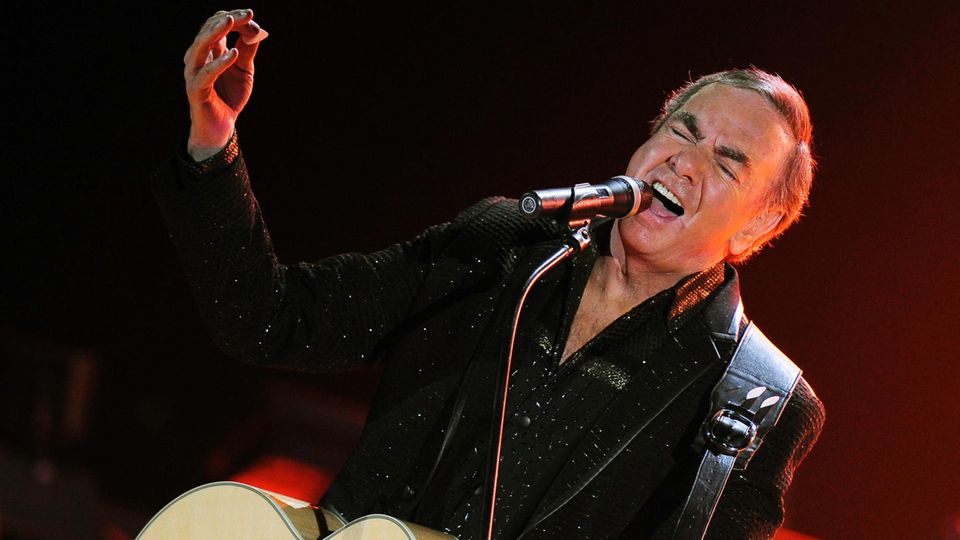
In “Prologue,” Neil Diamond does not begin with a song so much as with an arrival. The music opens a door, widens the air, and prepares the listener for something larger than a single melody—something theatrical, searching, and already in motion.
The opening feels monumental because “Prologue” was built to do more than introduce a tune. It was built to introduce a world.
In Neil Diamond’s catalog, “Prologue” is tied most famously to the live grandeur of Hot August Night, the landmark concert album recorded at the Greek Theatre in Los Angeles and released in December 1972. On that album, “Prologue” does not stand alone as a neatly self-contained pop song. It serves as the sweeping orchestral lead-in to “Crunchy Granola Suite,” opening the evening with scale, anticipation, and ceremony. The official Neil Diamond track listing preserves that pairing clearly as “Prologue / Crunchy Granola Suite.” (neildiamond.com, shop.neildiamond.com)
That placement is the first key to its power. A prologue is not merely a first track. It is a threshold. The title itself announces that what follows belongs to a bigger dramatic shape. It suggests preface, overture, invocation. So before Neil Diamond even begins the fuller body of the concert, the audience is already being asked to enter a larger emotional frame. That is why the piece still sounds like the start of something bigger than a song: it was designed as the beginning of an event.
And Hot August Night truly was an event. The album has long been recognized as one of the defining live records of its era, and official Neil Diamond material still describes it as a performance that “set the bar for live recordings.” In that setting, “Prologue” becomes more than stage dressing. It becomes the dramatic inhale before the night fully begins. (shop.neildiamond.com)
There is another important part of the story. The live “Prologue” did not come out of nowhere. It belongs to the broader artistic world surrounding Tap Root Manuscript, released on October 15, 1970, one of Neil Diamond’s most experimental albums. That record reached No. 13 on the Billboard 200 and included both conventional pop-rock songs and the ambitious second-side suite known as “The African Trilogy,” which Diamond described as “a folk ballet.” In other words, this was a period when he was already thinking beyond the ordinary boundaries of a three-minute hit. He was interested in structure, sequence, atmosphere, and scale. “Prologue” fits naturally into that creative ambition. (en.wikipedia.org)
That is why the piece feels so unusually large. It carries the instincts of an artist who was no longer satisfied with simply delivering songs one by one. He wanted to shape an arc. He wanted the beginning to feel ceremonial. Even commentary on Hot August Night has noted that Neil Diamond organized those Greek Theatre performances almost like a Broadway musical, with a full orchestra, dramatic pacing, and a carefully designed opening in which “Prologue” prepared the ground for “Crunchy Granola Suite.” (newdirectionsinmusic.substack.com)
That orchestral sweep matters because it changes the listener’s relationship to the night. The music does not rush to familiarity. It creates expectation first. It lifts the curtain before the story has fully spoken. This is what makes “Prologue” so memorable even though it is, by nature, an introduction. Most introductions vanish once the main body arrives. “Prologue” does not vanish. It leaves its shape over everything that follows.
Its afterlife proves that. The piece has remained visible not only through Hot August Night, but also through later official releases and retrospectives. It appears in the official Neil Diamond discography and on collections such as In My Lifetime, which helps show that it was not treated as disposable stage filler. It remained part of the architecture of his legacy. (neildiamond.com, neildiamond.com)
So the story of “Prologue” is not really the story of a conventional song. It is the story of Neil Diamond understanding that beginnings matter. That the first sound of a night can change the scale of everything that comes after. That an audience can be invited upward before it is invited in.
That is why the opening still feels monumental. “Prologue” does not merely start the record. It announces intention. It says that this performance will not be casual, and that this music will not stay small. Before the crowd hears the familiar songs, before the full band surges forward, before the voice takes command, “Prologue” has already done its work. It has turned the stage into a horizon.
And that is why it still sounds like the start of something bigger than a song. Because it is the sound of the room widening, the lights rising, and Neil Diamond preparing not just to sing, but to open an entire evening like a curtain.