
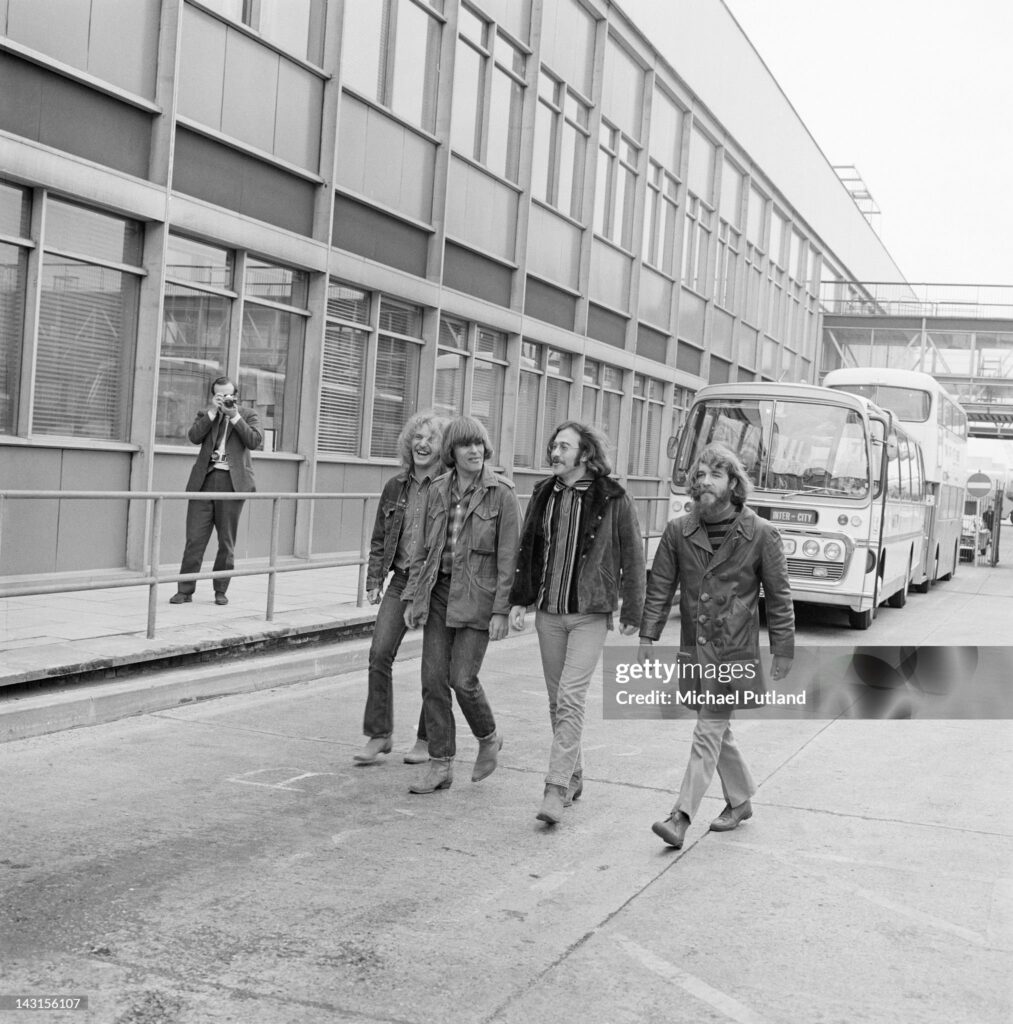
“Ooby Dooby” catches Creedence Clearwater Revival at the threshold of greatness—still rough at the edges, still smiling at rock and roll’s first wild spark, and already sounding like a band that understood where American music came from.
Long before Creedence Clearwater Revival became one of the defining American bands of the late 1960s, they were four California musicians with a deep affection for the music that had shaken jukeboxes, dance halls, and car radios in the decade before. Their version of “Ooby Dooby”, included on the 1968 album Creedence Clearwater Revival, is one of the clearest windows into those early roots. It was never released as a major hit single by the band, so it did not become a chart landmark in the way “Proud Mary”, “Bad Moon Rising”, or “Green River” would soon become. But the album that carried it introduced the group nationally, reaching No. 52 on the Billboard album chart in its original run before the band’s later success gave it an even longer life.
That matters, because “Ooby Dooby” is not just a loose cover tucked into an early LP. It is a statement of lineage. The song itself was first made famous by Roy Orbison in 1956, written by Dick Penner and Wade Moore. In Orbison’s hands, it had the bounce and swagger of early rockabilly—simple, playful, and impossible to sit still through. When Creedence Clearwater Revival took hold of it more than a decade later, they did not treat it like a museum piece. They played it as if the spirit of early rock and roll was still alive in the room, still sweating under the lights, still grinning through the amplifiers.
What makes the performance so enjoyable is how naturally it fits the young CCR identity. By 1968, popular music had become crowded with psychedelia, studio experimentation, and grand statements. Many bands wanted to sound futuristic. Creedence Clearwater Revival, even at this early stage, seemed more interested in sounding eternal. Their gift was not in chasing fashion but in reviving old American forms—blues, country, rockabilly, rhythm and blues—and making them feel urgent again. “Ooby Dooby” may be lighthearted on the surface, but it quietly tells us a great deal about who they were. Before they became chroniclers of bayous, back roads, riverboats, and restless American unease, they were students of the first generation of rock and roll.
John Fogerty brings exactly the right energy to the vocal. He does not imitate Roy Orbison; that would have been pointless. Orbison’s version had its own charm, its own Texas-born snap and youthful cool. Fogerty instead leans into the grain of his own voice—raspy, eager, and slightly weathered even when he was young. That choice gives the track a tougher edge. It sounds less like a teenage romp and more like a bar-band celebration of the music that first made young musicians want to plug in a guitar and turn the volume up.
Instrumentally, the recording is lean and lively. You can hear the band’s instinct for groove already taking shape. Tom Fogerty, Stu Cook, and Doug Clifford keep the performance moving with a clean sense of momentum, never overplaying, never decorating the song beyond what it needs. That restraint would later become one of CCR’s great strengths. Even when the band was at full commercial power, they rarely drowned songs in excess. They understood that conviction, rhythm, and feel could carry more weight than complexity. On “Ooby Dooby”, that philosophy is still in its youth, but it is there.
The backstory of the track also belongs to the larger story of the band’s transformation. Before they were known as Creedence Clearwater Revival, the members had spent years recording in different forms, including as The Golliwogs. They had worked, struggled, changed names, and absorbed the sounds of earlier American music while the industry around them kept shifting. So when they emerged under the CCR name, songs like “Ooby Dooby” served almost like a bridge between eras. Here was a band stepping into the late 1960s while still carrying the heartbeat of the 1950s.
There is also something wonderfully honest about their decision to record a song like this on a debut album. They were not trying to prove sophistication. They were showing taste, instinct, and affection. Sometimes the best early recordings by major artists are the ones that reveal what they loved before they fully revealed who they were. “Ooby Dooby” works that way. It is not the deepest song in the CCR catalog, nor is it meant to be. Its meaning lies in its joy, its motion, and its reminder that great bands are often built on deep listening. Creedence Clearwater Revival did not invent the language of American rock and roll—they learned it fluently, then spoke it back in a voice that became unmistakably their own.
Listening now, the song has the warmth of an old memory and the speed of a first impulse. It reminds us that every legendary band has a moment before the mythology hardens, before the signatures become fixed, before the biggest songs arrive. On “Ooby Dooby”, Creedence Clearwater Revival are still introducing themselves, but the confidence is already there. The swamp-rock kings had not fully arrived yet, but their musical character had. And in that sense, this spirited little cover is more than a footnote—it is an early clue, a grin before the thunder, a loving salute to the old rock and roll flame that would help light their own remarkable run.