
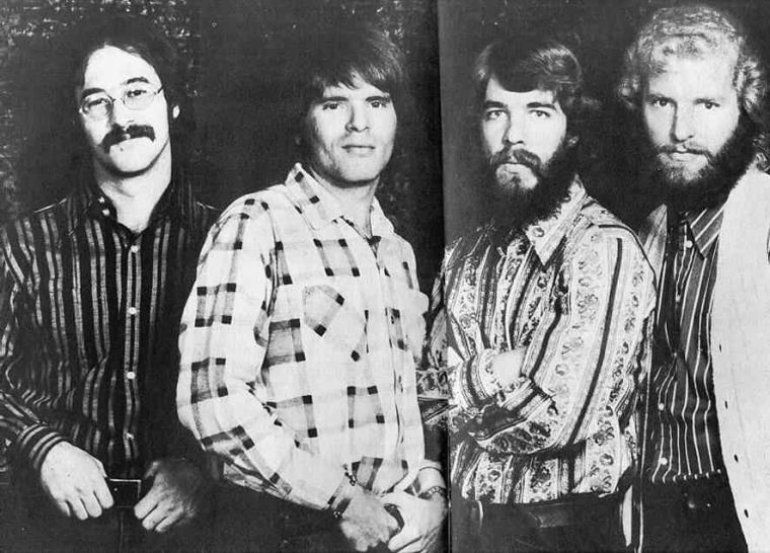
“Take It Like a Friend” is Creedence Clearwater Revival caught in a rare in-between mood—half consolation, half resignation—asking you to swallow disappointment with dignity, even when the band itself was quietly coming apart.
If you place the facts on the table first, they already tell a story. “Take It Like a Friend” appears on CCR’s final studio album, Mardi Gras, released on April 11, 1972 by Fantasy Records. It’s track 2 on Side One, credited to Stu Cook as songwriter, with Cook also taking the lead vocal, and a listed running time of 3:00. And because it was not issued as a standalone single, it doesn’t carry a personal “debut chart position” the way “Sweet Hitch-Hiker” or “Someday Never Comes” do—its reputation has always been earned the slow way: by listeners who kept playing the album, long after the headlines moved on.
That context is impossible to ignore, because Mardi Gras is not just “another CCR record.” It is the sound of an American band reaching the end of its rope. The album was recorded after the departure of guitarist Tom Fogerty, making it CCR’s only studio album as a trio, and—most unusually—featuring songs written, sung, and produced by each of the remaining members, not solely John Fogerty. The sessions, by the band’s own documented history, were marred by personal and creative tensions, and the group would officially disband later in 1972.
That’s the backdrop against which “Take It Like a Friend” lands—and suddenly the title feels less like casual advice and more like a small philosophy for survival. “Take it like a friend” is not the language of victory. It’s the language of someone trying to keep the temperature down in a room that keeps heating up. It suggests a wound that has already happened—something said too sharply, something taken the wrong way, something that can’t be retracted—followed by a plea: don’t turn this into war, don’t turn this into forever.
And there’s a particular poignancy in the fact that Stu Cook sings it. In the CCR myth, the voice is typically Fogerty’s—the prophet of the bayou that never was, the narrator whose authority could make a three-minute single feel like an entire American novel. But on Mardi Gras, the spotlight widens, and “Take It Like a Friend” becomes one of those moments where the band’s internal democracy is audible. You’re hearing not just a different singer, but a different emotional posture: less swagger, more plainspoken appeal.
Musically, it still belongs to CCR’s world—tight, economical, built to move. Yet the feeling is different. Where the classic hits often sound like they’re marching forward, this one feels like it’s standing still long enough to ask for mercy. It’s a song that seems to understand how relationships—romantic, friendly, even bandmates locked inside a shared history—often survive not because everyone is right, but because someone decides to soften the landing. The phrase “like a friend” matters: it implies decency, the kind you offer even when love is tired or pride is loud.
And if you zoom out one more step, the album’s public reception creates an even sharper edge. Mardi Gras still performed strongly on the charts, peaking at No. 12 on the US Billboard 200 and earning RIAA Gold certification in the United States. Success on paper—strain in the room. That contradiction is the late-stage tragedy of many great bands, and “Take It Like a Friend” sits right inside it, like a note written calmly while the house is already shaking.
So the song’s meaning, in the end, isn’t just in its lyric—it’s in its placement in time. “Take It Like a Friend” is the sound of a group at the last bend in the road, still capable of groove, still capable of craft, but singing with the subtle urgency of people who know that not everything can be repaired. It doesn’t beg for applause. It asks for a gentler ending.