
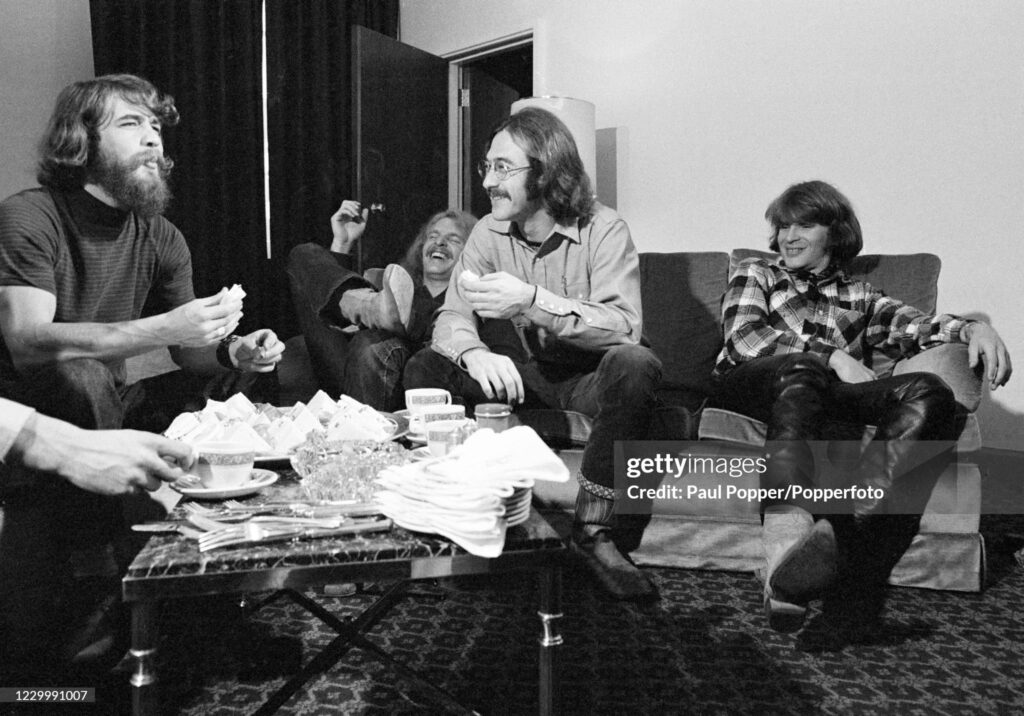
“Don’t Look Now (It Ain’t You or Me)” is one of Creedence Clearwater Revival’s sharpest moral reckonings—a lean, restless song that asks who really carries the weight of the American dream.
There are songs that entertain, songs that comfort, and then there are songs that quietly put a mirror in front of the listener. “Don’t Look Now (It Ain’t You or Me)” belongs to that last category. Released in 1969 on Creedence Clearwater Revival’s remarkable album Willy and the Poor Boys, the song did not arrive as a major hit single in the usual chart sense, yet it remains one of the group’s most penetrating statements. The album itself reached No. 3 on the Billboard album chart, and within that collection this track stood out as something especially bracing: part folk question, part working-class sermon, part John Fogerty thunderbolt.
By 1969, Creedence Clearwater Revival had already built a staggering run of success. The band was moving at a pace few American groups could match, releasing urgent, compact songs that sounded rooted in older traditions while speaking directly to the turbulence of their own time. In that setting, “Don’t Look Now (It Ain’t You or Me)” felt less like a commercial gambit than a moral challenge. It asked a plainspoken question in an age of slogans, protests, privilege, and performance: who is doing the actual work?
That question is the heart of the song. John Fogerty wrote it with the clipped force that made so much of CCR unforgettable. The lyric moves through images of labor, sacrifice, and social imbalance, asking who works the fields, who pays the price, who keeps the world running while others stand aside. Its famous refrain carries both accusation and warning. The title itself—“Don’t Look Now (It Ain’t You or Me)”—lands with a bitter twist. It is not simply cynical, and it is not merely political in a narrow sense. It is about responsibility. It is about the uneasy divide between those who speak and those who carry.
Musically, the track is classic Creedence Clearwater Revival: tight, unadorned, and deceptively simple. There is no wasted motion here. The arrangement moves with a kind of wiry insistence, built on rhythm rather than spectacle. Fogerty’s vocal does not plead for attention; it presses forward, urgent and almost conversational, as if he is trying to cut through noise and get back to first principles. That was one of CCR’s great gifts. They could sound raw without being careless, direct without being shallow. Even when a song lasted only a few minutes, it could leave behind a much larger echo.
Part of what gives the song its lasting power is the historical moment in which it was born. America in 1969 was full of argument about class, war, youth, identity, patriotism, and fairness. Many artists responded with abstraction or idealism. Fogerty, by contrast, often wrote with the plain edge of a man watching the country from the ground up. He had a gift for making songs feel old and immediate at the same time. In “Don’t Look Now (It Ain’t You or Me)”, he channels the voice of ordinary labor—the people whose effort is easy to overlook until a song like this reminds you they were there all along.
That is why the song has endured so well among listeners who value not just melody, but meaning. It does not flatter the audience. It does not offer easy righteousness. It suggests that comfort can blind people, and that public virtue can sometimes rest on someone else’s unrecognized burden. Those are difficult truths, but CCR knew how to deliver difficult truths in unforgettable form. The melody stays with you, yes—but so does the sting.
Within Willy and the Poor Boys, the song also helps reveal the deeper shape of the album. That record balanced exuberance with social awareness, old-time energy with modern disillusionment. It included some of Creedence Clearwater Revival’s most beloved music, but beneath the groove and grit was a serious understanding of American contradiction. “Don’t Look Now (It Ain’t You or Me)” may not always be the first title casual listeners mention, yet longtime admirers know it carries some of John Fogerty’s most pointed writing.
There is something almost timeless in that choice. Decades pass, fashions change, and still the song feels alive because the central issue has not faded. Who labors? Who profits? Who is seen? Who is forgotten? Great protest songs often survive because they are tied not just to one event, but to a permanent tension in public life. This is one of them. Not in the grand, ceremonial manner of an anthem, but in the cutting, unpretentious way CCR did so well.
And perhaps that is why the song still lands with such force. It is not dressed up as a masterpiece. It just is one of those records that keeps telling the truth every time you return to it. In a catalog full of swamp-rock drive, unforgettable riffs, and radio immortals, “Don’t Look Now (It Ain’t You or Me)” remains a special kind of achievement: a song with dirt on its boots, conscience in its bones, and a question that never really stopped being relevant.
For anyone willing to listen closely, it offers more than nostalgia. It offers recognition. It reminds us that Creedence Clearwater Revival were never only about sound or style. At their best, they were chroniclers of the country’s promises and evasions, its pride and its blind spots. And in this hard, compact gem from 1969, they left behind one of their clearest warnings—still humming, still prodding, still impossible to shake.