
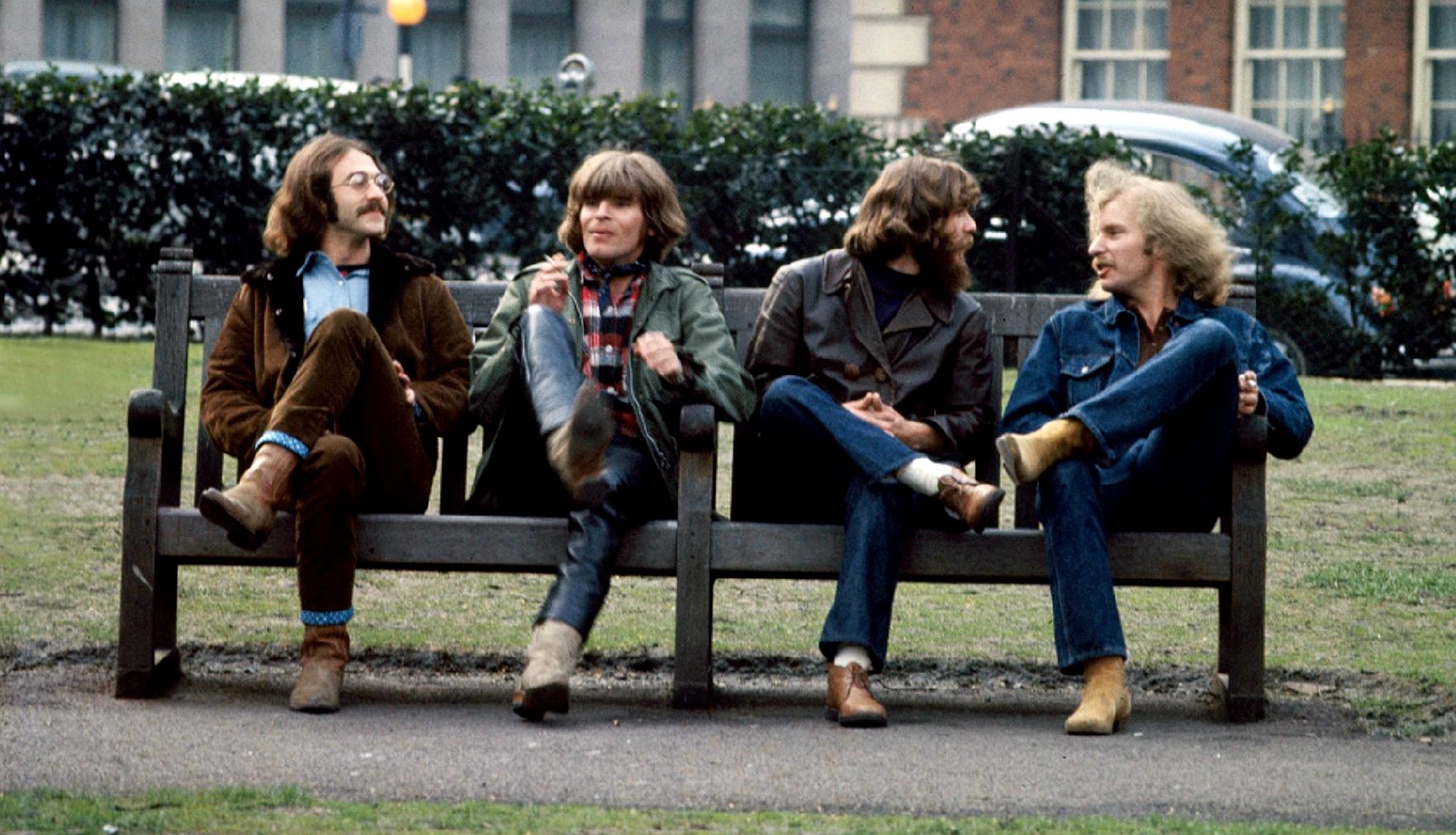
Before You Accuse Me (Take A Look At Yourself) endures because it does more than answer blame; in the hands of Creedence Clearwater Revival, it becomes a timeless reminder that self-honesty is often the hardest truth of all.
When Creedence Clearwater Revival recorded Before You Accuse Me (Take A Look At Yourself) for their 1970 album Cosmo’s Factory, they were doing what they did better than almost anyone of their era: reaching into the deep well of American roots music and pulling out something that felt both reverent and newly alive. The track was not pushed as one of the album’s headline U.S. singles, so it did not carve out a separate pop chart story of its own. But it arrived on a record that certainly did. Cosmo’s Factory went to No. 1 on the Billboard 200 and stayed there for nine weeks, becoming one of the defining albums of that remarkable year. In that company, this song may seem like a side road at first glance. In truth, it is one of the clearest windows into what made CCR so powerful.
The song itself did not begin with CCR. It was written by Bo Diddley, born Ellas McDaniel, and first recorded in the 1950s. Long before rock bands filled arenas, the song already carried the durable logic of the blues: before you point a finger, take a look at your own failings. That idea is as old as human nature, and perhaps that is why it never ages. When John Fogerty and CCR took it on, they did not overdecorate it. They did not try to turn it into a grand statement. They trusted the groove, the tension, the dry snap of the rhythm, and the plainspoken force of the lyric. That restraint is exactly what gives their version its staying power.
There is something especially satisfying about the way Creedence Clearwater Revival approached old rhythm-and-blues material. Even when they were at the height of their fame, they still sounded like a working band that cared more about feel than polish. On Before You Accuse Me, the playing is tight without ever feeling stiff. John Fogerty’s vocal does not plead for sympathy and does not try to charm the listener into agreement. Instead, it carries a firm, almost weathered confidence, as if he is standing his ground in the middle of a hard conversation. Around him, the band lays down a groove that rolls with patience and purpose. There is no wasted motion. Every chord, every beat, every guitar accent serves the mood.
That mood is worth lingering on, because it explains why the song still lands so well decades later. Many songs about troubled love turn toward heartbreak, apology, or dramatic accusation. Before You Accuse Me (Take A Look At Yourself) chooses a different path. It does not deny tension. It does not pretend everything is fine. But its central argument is moral rather than theatrical: fairness begins with self-examination. That is a profound theme for a song that moves with such ease. Beneath the rhythm and the blues phrasing is a message about pride, hypocrisy, and the uncomfortable work of looking inward before judging someone else.
That message fit CCR perfectly. For all their commercial success, their best recordings often had the feel of something older, tougher, and wiser than contemporary pop. They knew how to make a song sound lived-in. On Cosmo’s Factory, that instinct appears again and again, whether the band is leaning into rock and roll, country flavor, swamp atmosphere, or straight blues. In that context, Before You Accuse Me feels less like an album track tucked between bigger radio staples and more like a statement of lineage. It reminds the listener that CCR were not simply hitmakers. They were interpreters of an American musical conversation stretching from the blues to rock and beyond.
And yet the song is not valuable only as a history lesson. Its emotional appeal is immediate. Almost everyone, at some point, has felt the sting of being judged unfairly or the uneasy realization that blame can travel in circles. That is why the lyric remains so effective. It is simple enough to remember after one listen, but layered enough to stay with you. A lesser performance might have reduced it to a clever retort. CCR make it feel like something older and heavier, the kind of truth spoken after a long silence, when tempers cool and only honesty matters.
John Fogerty, in particular, understood how to balance toughness with weariness. He never sang this material as though it belonged behind museum glass. He sang it as though it still belonged to ordinary life. That quality gives the track its warmth. Even at its sharpest, the song does not sound cruel. It sounds human. It knows that people can be unfair, prideful, contradictory, and still recognizable to one another. That emotional maturity is one reason CCR’s catalog has lasted so well. The band could make a three-minute performance feel as though it had years inside it.
In the end, Before You Accuse Me (Take A Look At Yourself) remains a small masterpiece of clarity. It may not be the first title mentioned when people list the biggest CCR songs, but it reveals something essential about them: their respect for songcraft, their grounding in American roots traditions, and their gift for making old truths sound immediate again. On a No. 1 album bursting with famous tracks, this one stands quietly but firmly, like a voice from the corner of the room saying what everyone needs to hear. And perhaps that is why it still feels so fresh. Trends come and go, styles rise and fade, but a song that asks us to look in the mirror before we judge someone else will always find its way back to us.