
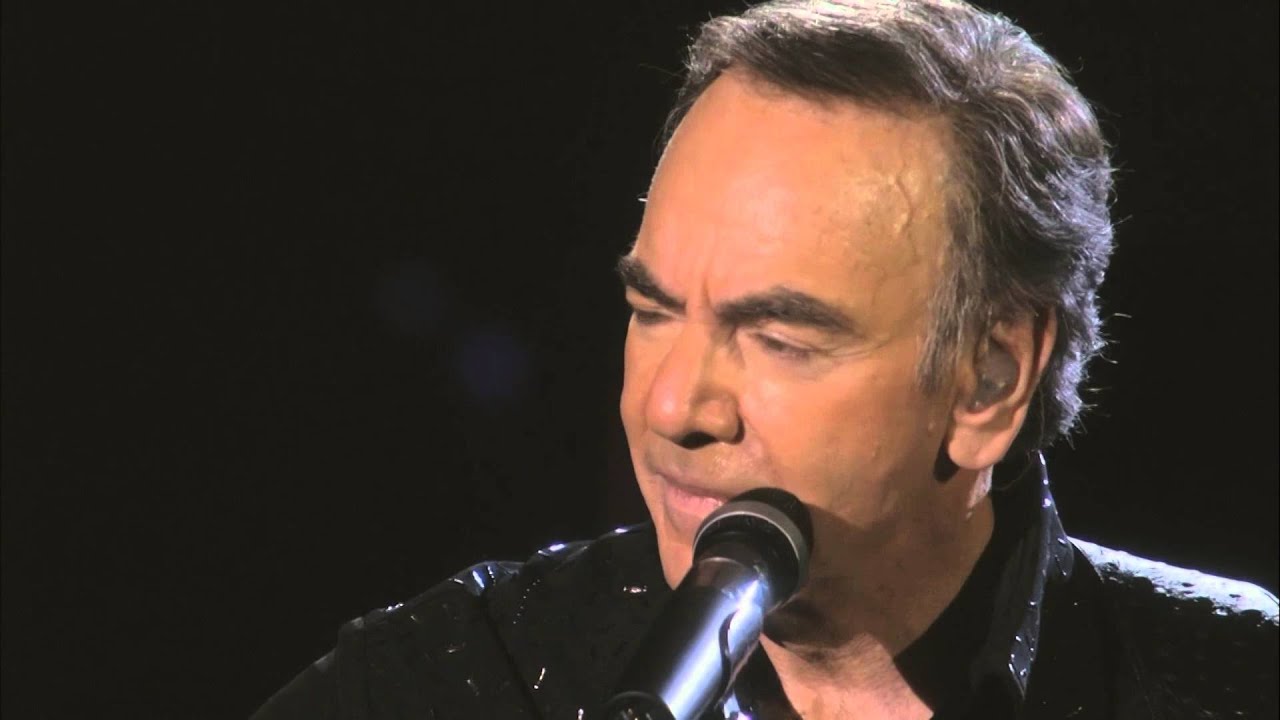
“Love on the Rocks” is Neil Diamond at his most bruised and unguarded—an adult love song where the champagne has gone flat, the laughter has turned sharp, and the heart keeps singing anyway.
“Love on the Rocks” arrived as a single in October 1980, issued on Capitol, with “Acapulco” on the B-side. It was drawn from The Jazz Singer soundtrack—Diamond’s most cinematic era—and it became one of those rare ballads that felt instantly “classic” while still sounding like the present tense of pain. Commercially, it was huge: the song climbed to No. 2 on the Billboard Hot 100, holding that position for three weeks in January 1981, and it also reached No. 3 on Billboard’s Adult Contemporary chart. In the UK it peaked at No. 17.
But the charts only tell you how many heard it—not why it lands. The real force of “Love on the Rocks” is that it sounds like someone who has stopped romanticizing what romance is supposed to be. It’s not a teenage “forever.” It’s the morning-after inventory: the little humiliations, the quiet resentments, the way love can erode while two people are still sharing the same room. Diamond sings it with that signature mix of grit and grandeur—voice pushed forward like a man insisting on dignity even as the story admits defeat.
The song’s behind-the-scenes origin is almost shockingly playful compared to the finished heartbreak. “Love on the Rocks” was one of five collaborations between Neil Diamond and French singer-songwriter Gilbert Bécaud for The Jazz Singer. And it began “as a bit of a lark”: a reggae-tinged number called “Scotch on the Rocks,” named for Bécaud’s drink of choice—before the writers recognized its potential and rewrote it into the serious ballad we know. (A demo of that earlier version later surfaced on Diamond’s 1997 retrospective, a reminder that great songs sometimes start as a joke and end as a confession.)
That transformation—from playful to piercing—mirrors the emotional point of the lyric itself. Sometimes what breaks a relationship isn’t a dramatic catastrophe; it’s the slow realization that the “fun” is gone, and all that’s left is performance. The chorus hits like a headline, but the verses feel like the private evidence. It’s a song about love turning into something brittle—still shiny enough to hurt you, but no longer soft enough to hold.
Because it was written for a film, the song even exists in two emotional “worlds.” In The Jazz Singer, English actor and singer Paul Nicholas performs a punk/new wave version—deliberately abrasive—to the dismay of Diamond’s character, Jess Rubin. That detail is more than a fun footnote. It underlines what the story is doing: old tenderness colliding with new noise, sincerity mocked by style, vulnerability turned into spectacle. Diamond’s own version, by contrast, is all naked feeling—less fashionable, more fatal.
And then there’s the larger frame the soundtrack provided. The Jazz Singer soundtrack itself was a blockbuster, peaking at No. 3 on the Billboard 200 and ultimately earning 5× Platinum certification in the U.S. In that company, “Love on the Rocks” doesn’t merely decorate the album; it helps define its emotional temperature: a grown man’s romance, full of bravado on the surface and damage underneath.
So what does “Love on the Rocks” mean when it endures past its era? It means love can be real and still fail. It means two people can share a history and still run out of mercy. And it means there’s a particular kind of courage in admitting the dream has cracked—then singing anyway, not to “win,” but to tell the truth cleanly. In Diamond’s hands, the song becomes less a breakup and more a reckoning: a hard look at what remains when the glitter is gone—just two hearts, two egos, and the quiet, stubborn ache of wanting it to have been different.