
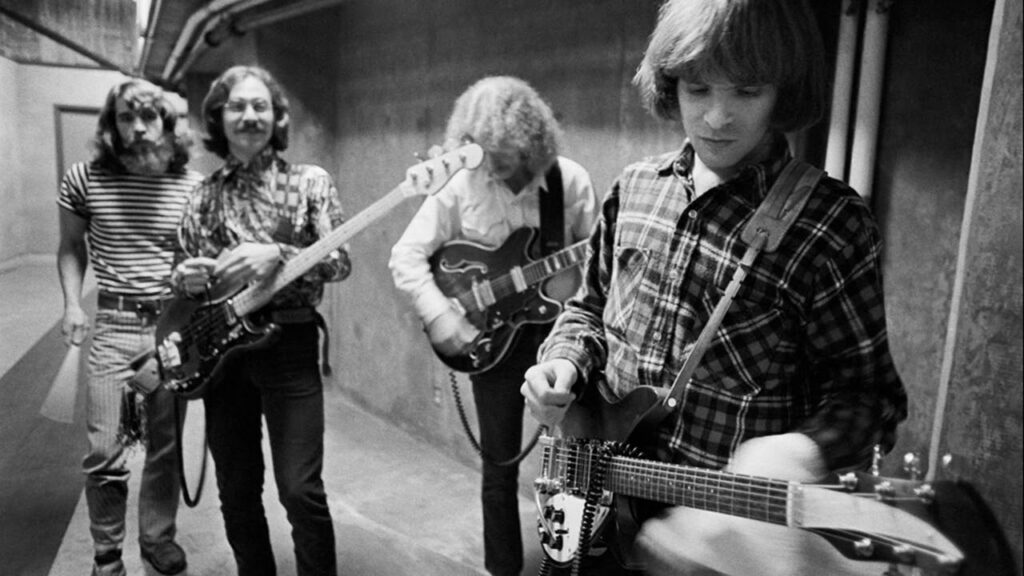
“Green River” is Creedence Clearwater Revival’s great memory-song of summer—bright on the surface, but haunted by the deeper truth that childhood freedom is already becoming the past even as it is being sung.
One of the most important facts to place at the beginning is that “Green River” was released as a single in July 1969, a month before Creedence Clearwater Revival’s album Green River, which came out on August 7, 1969. Written by John Fogerty, the song quickly became one of the band’s signature records, rising to No. 2 on the Billboard Hot 100 in the United States. In the UK, it was also a substantial hit, reaching No. 19 on the Official Singles Chart. So even before later compilations and remasters fixed it permanently in rock memory, “Green River” was already a major success in its own day.
As for the label “Remastered 1985,” it is best understood as a later catalog presentation of the original 1969 recording, not a different performance. That tag commonly appears on digital versions tied to Chronicle: 20 Greatest Hits, where several CCR tracks are labeled as 1985 remasters. In other words, the song itself belongs wholly to the band’s 1969 peak; the “1985” wording reflects reissue and remaster history rather than a new artistic version.
The story behind “Green River” is one of the most evocative in the CCR catalog because it comes from John Fogerty’s own remembered landscape. Fogerty has long said the song was inspired not by some literal Southern swamp, but by his childhood memories of vacationing at Putah Creek near Winters, California, and by a flavored soda syrup called Green River. That combination is pure Fogerty: memory transformed into myth. He took fragments of ordinary American boyhood—water, heat, boredom, freedom, the smell of outdoors in summer—and turned them into something that sounded older, deeper, and almost legendary. Even though CCR were a California band, songs like this helped create their singular world of imagined Americana.
That is why the song’s meaning runs deeper than its easy rhythm first suggests. “Green River” is not just about a place; it is about the feeling of returning to a place that exists as much in memory as in geography. The river becomes a doorway into youth itself: a time of skipping stones, wandering barefoot, escaping adult structure, and living inside afternoons that seemed never-ending. But what makes the song so moving is that it is already sung from a distance. This is not a child’s song. It is an adult’s remembrance of childhood, and that slight backward glance gives the record its ache. Beneath the bright guitar and the rolling beat, there is nostalgia—warm, grateful, and a little sad.
Musically, the song shows Creedence Clearwater Revival at one of their purest moments. It is lean, quick, and unforgettable. John Fogerty always believed in simplicity used powerfully, and even commentary around the Green River album has highlighted how much he cherished this song and this period of the band. There is no wasted motion in the arrangement. The groove feels effortless, but that effortlessness is deceptive. Like so many great CCR singles, “Green River” sounds as if it had always existed, as if the band merely found it waiting in the air. That naturalness is one reason it has lasted so strongly across generations.
Placed in the context of the Green River album, the song also tells us a great deal about where CCR stood in 1969. This was their third studio album and the second of three they would release that astonishing year. The album itself became one of their landmark records, later earning multi-platinum certification and securing a place in major all-time album lists. So the title track was not an isolated spark. It came from the center of a remarkable burst of creativity when Creedence Clearwater Revival seemed able to turn every instinct into something direct, durable, and deeply American.
So “Green River (Remastered 1985)” should be heard as a later sonic presentation of one of CCR’s essential 1969 masterpieces: a July 1969 single, a No. 2 U.S. hit, a Top 20 UK success, and one of John Fogerty’s most vivid acts of musical remembrance. But beyond the dates and chart positions, what remains is the song’s emotional truth. It captures that vanished season when the world felt wider, water felt colder, and freedom seemed as close as the next riverbank. That is why “Green River” still runs so deeply in memory. It is not only about where we were. It is about the part of us that still longs to go back.