
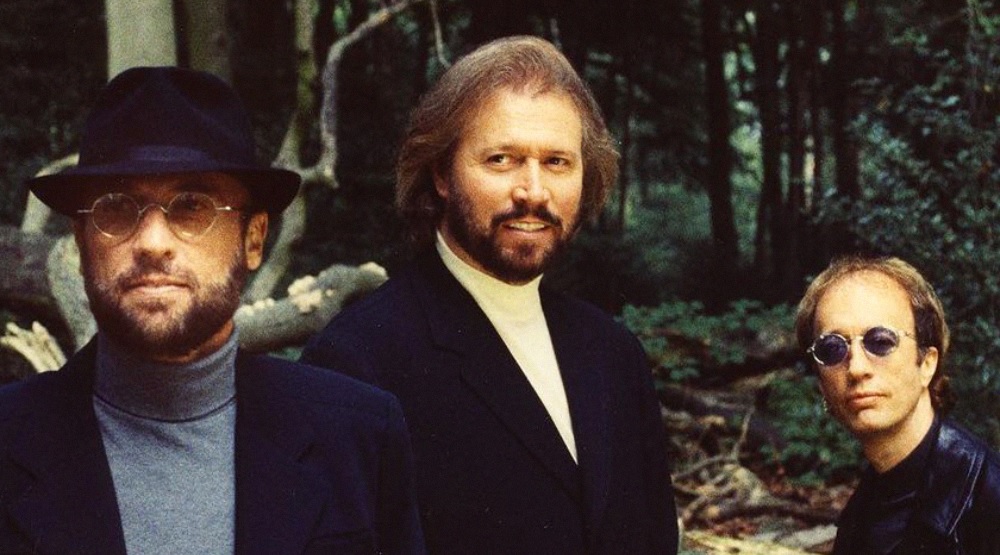
“How Deep Is Your Love” is the Bee Gees’ soft miracle—proof that, even in the brightest disco era, the most lasting light can come from a whisper.
Released as a single in September 1977, “How Deep Is Your Love” (RSO; B-side “Can’t Keep a Good Man Down”) became one of the defining emotional centers of Saturday Night Fever—and one of the Bee Gees’ most enduring recordings. Written by Barry Gibb, Robin Gibb, and Maurice Gibb, it rose to No. 1 on the Billboard Hot 100 for three weeks, topped Billboard’s Adult Contemporary chart for six weeks, and reached No. 3 on the UK singles chart (also No. 3 in Australia). It went on to win the GRAMMY Award for Best Pop Vocal Performance by a Group at the 20th Annual GRAMMY Awards. And, hovering behind it like a neon skyline, the Saturday Night Fever soundtrack itself became a phenomenon—holding No. 1 on the Billboard 200 for 24 consecutive weeks—so the song’s tenderness was amplified inside an era that often moved fast and glittered louder than it spoke.
Yet the song’s real ranking has never been only numeric. It’s emotional. It’s the moment, in the middle of a dance-driven cultural earthquake, when the room suddenly slows—when even the most restless heart admits it wants something steadier than the night.
The backstory begins with a film that needed more than disco. Producer Robert Stigwood asked the Bee Gees for songs, and famously they were creating without the full comfort of knowing every scene in advance—writing, instead, toward a mood: urban longing, weekend escape, the ache of wanting a life larger than your weekdays. Amid the propulsion of “Stayin’ Alive” and “Night Fever,” “How Deep Is Your Love” becomes the necessary counterweight: the breath between steps, the private confession behind the public swagger. Recorded in 1977 during sessions that included work at Château d’Hérouville in France and Criteria Studios in Miami, and produced by the Bee Gees along with Albhy Galuten and Karl Richardson, the track is polished without being cold—carefully built so the warmth survives the spotlight.
Musically, it’s a masterclass in restraint. The chords feel like they’re chosen not for surprise, but for safety—like a hand offered in the dark. The arrangement doesn’t chase the dancefloor; it hovers beside it, letting the harmonies do the heavy lifting. Barry’s lead vocal—tender, airy, intimate—sits right on the edge of vulnerability, while the group’s harmonies wrap around him like reassurance you can’t quite explain. The beat is present, but it never elbows the lyric out of the way. Everything serves a single emotional purpose: to make devotion sound believable.
And that’s the song’s meaning, really: devotion as a question you’re almost afraid to ask. “How deep is your love?” isn’t a line of conquest. It’s a test of reality. It’s what you ask when you’ve been disappointed enough times to know that sweet words aren’t the same thing as staying. The lyric doesn’t shout for passion; it asks for proof. Not proof through drama—proof through depth. Through the kind of love that endures after the music fades and the streetlights look different.
Part of why the song still lands so hard, decades later, is that it refuses cynicism. Plenty of late-’70s pop is thrilling, but some of it feels like it belongs to a specific room, a specific outfit, a specific Saturday night. “How Deep Is Your Love” belongs to something broader: the human need to be chosen in a way that lasts. It’s romantic without being naïve, polished without being insincere—an adult tenderness that doesn’t apologize for wanting stability.
If disco was often painted as surface—sequins, mirrors, motion—this song is the reminder that the era’s best work had a beating heart. The Bee Gees didn’t just soundtrack a dance craze; they wrote a standard of modern pop intimacy. “How Deep Is Your Love” endures because it understands what time does to people: it doesn’t simply change faces, it changes expectations. And still, the song dares to ask its gentle question—quietly, faithfully—like a promise that the deepest loves don’t need to shout to be heard.