
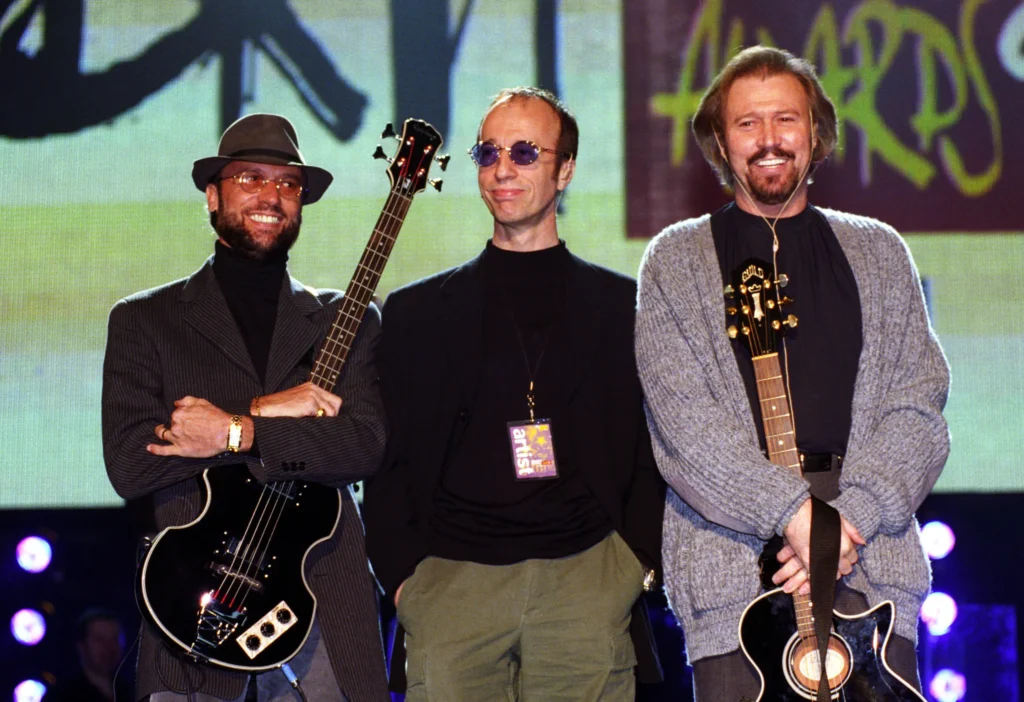
“You Stepped Into My Life” is the Bee Gees’ soft-glow testimony that one person’s arrival can rearrange the whole inner world—turning old hurt into rhythm and hope.
There’s a particular kind of romance that doesn’t sound like fireworks. It sounds like relief. “You Stepped Into My Life” lives in that emotional key: not the drama of chasing love, but the stunned gratitude of finally being found. The song comes from Bee Gees’ 1976 album Children of the World, released September 13, 1976—the record where their future, sleek and dance-ready, begins to show its face in full light. And while the Bee Gees’ biggest 1976-77 chart headlines belonged to singles like “You Should Be Dancing” and “Love So Right,” this track has always been something more intimate: a deep cut that feels like a hand resting gently on the shoulder, saying, Yes, it was real. Yes, it changed me.
For accuracy, it’s important to separate the song’s life from its chart identity. In the U.S., “You Stepped Into My Life” was released in September 1976 as the B-side to the single “Love So Right.” That means it didn’t receive its own Billboard Hot 100 “debut position” as an A-side. The chart story at launch belongs to “Love So Right”: it debuted at No. 70 on the Hot 100 dated September 18, 1976, and later peaked at No. 3. In the UK, “Love’s So Right” peaked at No. 41 on the Official Singles Chart, first charting in November 1976. Meanwhile, the Bee Gees’ own documentation notes that in Canada the pairing was flipped (with “You Stepped Into My Life” used as the A-side), and in Scandinavia and the UK it appeared as a double A-side.
But if charts measure volume, “You Stepped Into My Life” measures something quieter: the moment the heart stops bracing.
Musically, you can hear why it matters historically. Children of the World was recorded largely at Criteria Studios in Miami with additional work at Le Studio in Quebec, and it marked the dawn of the Gibb–Galuten–Richardson production team that would soon help define the Bee Gees’ late-’70s dominance. The song itself was recorded on February 3, 1976 and May 7, 1976, and the personnel list reads like a band learning how to glide: Barry Gibb on lead vocal and acoustic guitar, Maurice Gibb on bass, Alan Kendall on electric guitar, Dennis Bryon on drums, and Blue Weaver painting the edges with keyboards and synth textures.
The meaning is beautifully direct. The lyric doesn’t pretend love is complicated; it insists love is transformative. Before her, there was pain. After her, there is “ecstasy”—a word that can sound extravagant until you remember how ordinary it feels when your life finally stops hurting in the same old places. That’s what the Bee Gees capture: the shock of happiness after endurance. The chorus repeats like a heartbeat because the speaker is trying to believe his own luck—trying to say it enough times that it becomes permanent.
And there’s a deeper, almost bittersweet subtext when you place the song in the Bee Gees’ timeline. By 1976, they had already lived through reinvention, critical skepticism, shifting fashions, and the uneasy work of starting again. “You Stepped Into My Life” can be heard as romance, absolutely—but it can also be heard as the sound of a group stepping into a new era, sensing that something bright is returning, and daring to trust it.
Some songs are great because they explode. “You Stepped Into My Life” is great because it settles. It doesn’t argue with sadness; it simply replaces it—gently, patiently—until the room feels different. And years later, that’s the kind of song you don’t just remember. You return to it, the way you return to the memory of the moment everything quietly turned around.