
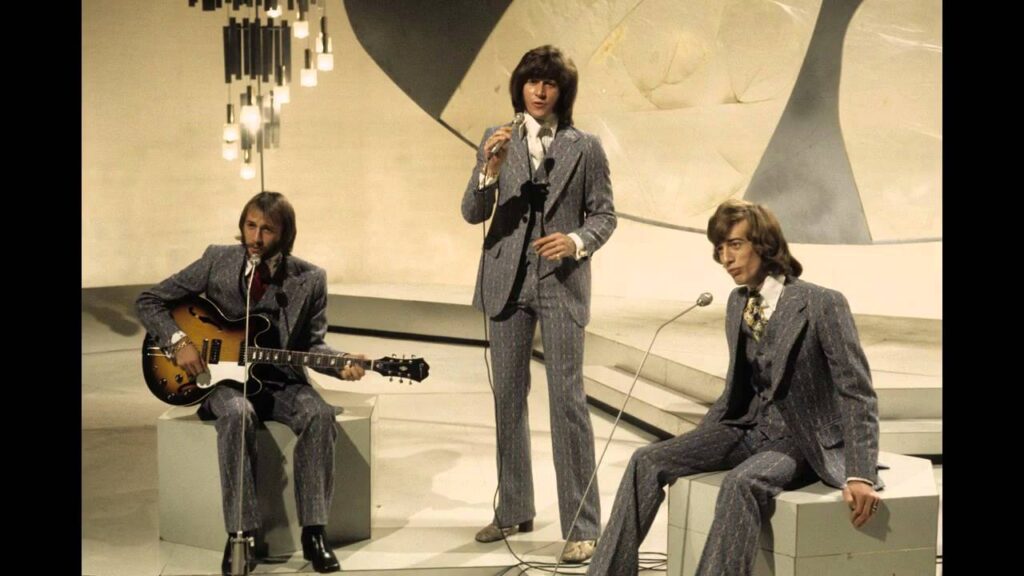
“I Can’t See Nobody” is the Bee Gees’ early portrait of emotional blindness—love so consuming it turns the outside world into a blur.
Long before the Bee Gees became the architects of glittering disco perfection, they were already experts in something quieter and, in its own way, more daring: melancholy with manners. “I Can’t See Nobody” belongs to that first international flowering—recorded at IBC Studios in London on March 7 and March 13, 1967, and released initially not as a headline, but as the B-side to “New York Mining Disaster 1941.” In the UK, the single came out in April 1967, followed by May 1967 in the US. A small but telling chart detail often gets missed: the song itself did not enter the main Billboard Hot 100, but it charted for one week at No. 128 on Billboard’s “Bubbling Under the Hot 100” in July 1967—a modest footprint that quietly confirms it was heard, even if it didn’t yet have a “hit” story of its own.
And yet the track’s real arrival is inseparable from the album that carried it into people’s homes. “I Can’t See Nobody” appears on Bee Gees’ 1st, released July 14, 1967—their first full-length international album after the Australia-only beginnings, produced by Robert Stigwood and Ossie Byrne. It was the kind of record that didn’t simply introduce a band; it introduced a sensibility: ornate pop, orchestral shading, and a near-theatrical intensity in the vocals.
The “behind the song” story carries a gentle irony. According to accounts collected around the track, Barry and Robin Gibb wrote it during the family’s final stretch in Australia (with Robin recalling it being written in Brisbane), before they had the chance to record it properly—so the song itself feels like something carried across an ocean and finally allowed to speak. When they did record it in London, the performance landed in a particularly Bee Gees way: Robin Gibb leads the verses, then the voices gather in the chorus like a sudden tide of harmony.
If you listen closely, the song’s meaning is as emotional as it is literal. “I can’t see nobody” isn’t merely a romantic slogan—it’s the confession of a mind caught in fixation, a heart so filled with one presence that everything else fades into irrelevance. This is love as tunnel vision: tender, frightening, and strangely lonely. The narrator isn’t celebrating devotion so much as describing its cost. When you can’t “see” anyone else, the world narrows. Friends become distant shapes. Time loses its ordinary rhythm. Even joy can feel like a kind of fever, because it depends on one person’s nearness.
That’s why Robin’s vocal is crucial. Even decades later, critics and fans often point to this track as an early showcase of his extraordinary, fragile-sounding intensity—an almost teary edge that makes the lyric feel less like performance and more like exposure. The Guardian, ranking the group’s songs years afterward, highlighted “I Can’t See Nobody” as a key early moment and noted it would later be covered by Nina Simone, a sign that its ache travelled far beyond the Bee Gees’ own catalogue.
There’s also something historically revealing in the way the song was released. As a B-side, it lived in the shadow of “New York Mining Disaster 1941”—the track that helped introduce the Bee Gees internationally. But in some countries, it effectively stepped out of the shadow: it was issued as a double A-side in Germany and Japan, suggesting that in certain places the industry already sensed what devoted listeners would later discover—that the Bee Gees’ “hidden” songs often carried the deepest spell.
What stays with you, finally, is the song’s emotional honesty. In 1967, pop music was full of declarations and bright promises, but “I Can’t See Nobody” is different: it admits how love can isolate even while it warms you. It’s the sound of a young band already understanding a grown-up truth—that longing can be as claustrophobic as it is beautiful. And maybe that’s why, long after the charts have forgotten the number 128, the song still finds people: it doesn’t sell romance. It tells the truth about it—softly, intensely, and with the kind of harmonies that feel like memories you didn’t know you still had.