
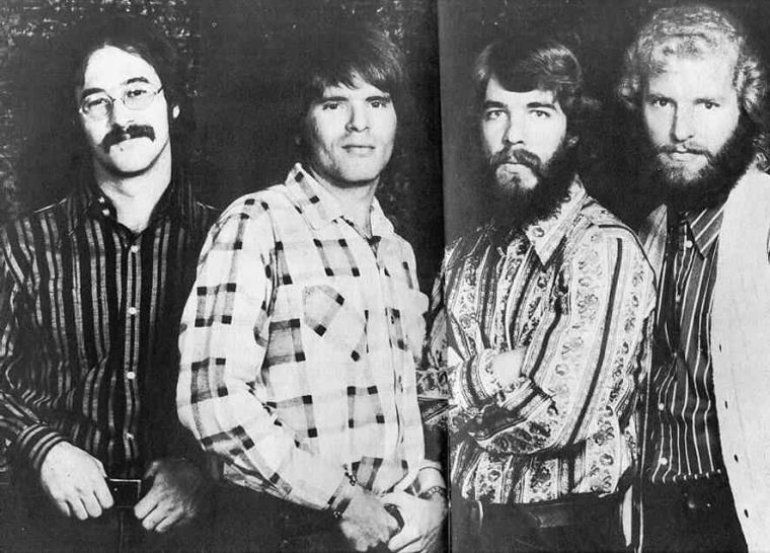
“Fight Fire” is not yet the full Creedence legend — it is the spark before the blaze, a fierce little prelude where you can hear the young band straining toward the harder, leaner sound that would soon change everything.
When people come across “Creedence Clearwater Revival – ‘Fight Fire’”, the first thing worth saying clearly is that the song belongs to the band’s pre-CCR chapter. “Fight Fire” was recorded and released under the name The Golliwogs, not under the later Creedence Clearwater Revival banner that made John Fogerty, Tom Fogerty, Stu Cook, and Doug Clifford famous around the world. It appears on the 2001 Creedence Clearwater Revival: Box Set among the pre-Creedence material, where it is listed as one of the Golliwogs recordings, and discographies tie it to a 1966 single release with “Fragile Child” on the flip side. So this is not a lost hit from the classic 1968–1972 CCR run. It is something more historically revealing: a glimpse of the band just before the real transformation.
That distinction matters because “Fight Fire” does not sound like “Proud Mary,” “Bad Moon Rising,” or “Green River.” Not yet. The swamp groove is not fully formed, the ruthless economy of the later Creedence records has not quite snapped into place, and the whole thing still belongs more to the rough, transitional world of mid-1960s garage rock and beat-group energy than to the unmistakable roots-rock identity that would come soon after. But that is exactly why the song is so interesting. You are not hearing the finished monument. You are hearing the pressure building inside it.
There is something especially exciting about “Fight Fire” because even the title feels prophetic. It suggests urgency, danger, instinct, and confrontation — all qualities that would later fit John Fogerty’s writing and singing almost perfectly. In this earlier setting, though, the song feels more like a young band trying to break through the walls around them. It has that restless, hungry sound common to groups who know they are capable of more than the world has yet noticed. That gives the track its charge. It is not polished legend. It is ambition with a pulse.
The historical place of the song only deepens that feeling. By 1966, the musicians who would become Creedence Clearwater Revival had already spent years struggling under different names, from Tommy Fogerty & the Blue Velvets to the Golliwogs, cutting singles and trying to find a musical identity strong enough to survive the changing tides of the decade. The 2001 box set and later archival collections preserve “Fight Fire” precisely because it belongs to that long apprenticeship. It is one of the records that lets listeners hear the band before the breakthrough, before the myth hardened, before the classic albums made everything seem inevitable in retrospect.
And nothing about it was inevitable.
That may be the most moving thing about “Fight Fire.” Listening now, with the entire Creedence story already known, it is tempting to search the song for direct signs of the future. Some of that is fair enough. You can hear toughness, forward drive, and a refusal to drift. But the song also reminds you how uncertain the road still was. This was a band not yet speaking in the voice history would remember. They were still trying things, still working through forms, still sounding like young musicians who knew they had force but had not yet found the exact language for it. In that sense, “Fight Fire” is valuable not because it already sounds fully like Creedence, but because it shows how much had to happen before Creedence truly arrived.
There is also a particular pleasure in the track’s compactness. At around 2 minutes 34 seconds on the box set listing, “Fight Fire” belongs to that old single-era tradition where songs hit fast and got out quickly. That brevity suits it. The record does not linger to explain itself. It rushes forward, says its piece, and leaves behind an impression of grit rather than grandeur. Later Creedence would become masters of exactly that kind of compression — songs that sounded huge without needing to be long. Here, the instinct is already flickering.
So the real beauty of “Fight Fire” lies in hearing a major American band before it became major. It is not among the canonical Creedence masterpieces, and it was not a chart landmark. But as part of the group’s Golliwogs period, it carries real fascination. It captures the band in motion, still unfinished, still reaching, still trying to force its way toward the sound that would later feel so natural no one could imagine it ever being otherwise. That makes the song more than a curiosity. It makes it a spark from the years when the fire had not yet fully taken hold — but was very clearly beginning to burn.