
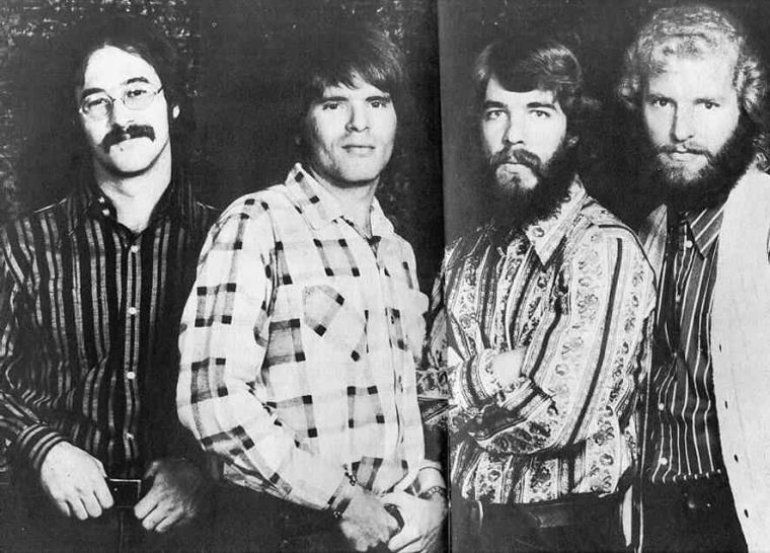
“Before You Accuse Me” is a back-porch courtroom in three minutes—where blame is returned, calmly and decisively, to the one who throws it first.
When people talk about Creedence Clearwater Revival, the conversation usually rushes toward the big, urgent originals—songs that seemed to walk straight out of the American dirt and onto the radio. But “Before You Accuse Me” reminds you that part of CCR’s greatness was their taste: their ability to pick up an old blues-and-rock ’n’ roll grievance, tighten the bolts, and make it feel like it had always belonged in 1970. CCR’s version appears on Cosmo’s Factory, which entered the Billboard 200 on the chart dated July 25, 1970, and went on to reach No. 1 (with August 22, 1970 noted as its peak chart date on Billboard’s listing).
That chart context matters—even if “Before You Accuse Me” itself wasn’t issued as a U.S. hit single. On an album that did spin off major radio staples, this track sits like a knowing nod to the roots: a reminder that CCR could outsprint the era’s noise by running backward into tradition. The track listing—placing “Before You Accuse Me” right up front—signals that this isn’t filler or nostalgia for its own sake. It’s part of the album’s backbone, alongside other reverent covers that tip the hat to early rock and blues lineage.
The deeper story begins with Bo Diddley—born Ellas McDaniel—whose name is stamped onto the song as writer. In 1957, Bo Diddley released “Before You Accuse Me” as a single on Checker Records (paired with “Say! Boss Man”), a slice of mid-century rhythm-and-blues that carries the unmistakable Diddley attitude: the street-corner logic, the half-sung warning, the moral mirror turned back on the accuser. When CCR revive it, they don’t try to out-clever the original. They do something smarter: they respect the shape of the song, then deliver it with that trademark Fogerty snap—clean guitar, clipped rhythm, and a vocal that sounds like it’s leaning forward across the table.
What makes “Before You Accuse Me” so satisfying—especially in CCR’s hands—is its grown-up kind of confrontation. The lyric isn’t a plea. It isn’t a long confession. It’s a simple standard of fairness: look at yourself first. That’s the sting. It suggests a world where accusations are often just disguises for guilt, and where the loudest finger-pointing sometimes comes from the person most afraid of being seen clearly. There’s no melodrama, no ornate poetry—just the plainspoken dignity of someone tired of being tried in a court that never applies the law equally.
Musically, CCR give the song a kind of forward momentum that feels like tires on a two-lane road—steady, unsentimental, almost cheerful in its refusal to be cornered. The groove doesn’t sulk. It walks. And that walking rhythm is the secret to why the message lands without bitterness: the band treats the moment like a fact of life, not a tragedy. In the CCR universe, heartbreak and hypocrisy aren’t reasons to collapse; they’re reasons to keep moving—eyes open, spine straight, voice steady.
Placed on Cosmo’s Factory, the track also plays a role in the album’s larger emotional architecture. This record is often remembered as CCR at peak efficiency—hits, swagger, discipline, and a certain unvarnished confidence that didn’t need psychedelic decoration or studio trickery to feel huge. Critics looking back have noted how the album blends smashes with extended performances and rootsy covers, with “Before You Accuse Me” among those spirited nods to earlier rock ’n’ roll. In that sense, the song is more than a cover: it’s CCR paying rent to the house that raised them.
And maybe that’s why it still feels good to hear today. “Before You Accuse Me” isn’t just an old argument preserved on tape—it’s a small piece of hard-won wisdom. In a world that loves quick judgments and louder judgments, CCR offer a calmer, sharper weapon: perspective. The song doesn’t ask you to win the fight. It asks you to recognize the truth—before the first stone is thrown.
Always a pleasure to listen to CCR.I am born 1955,and CCR helped me a lot through my somewhat rough childhood.