
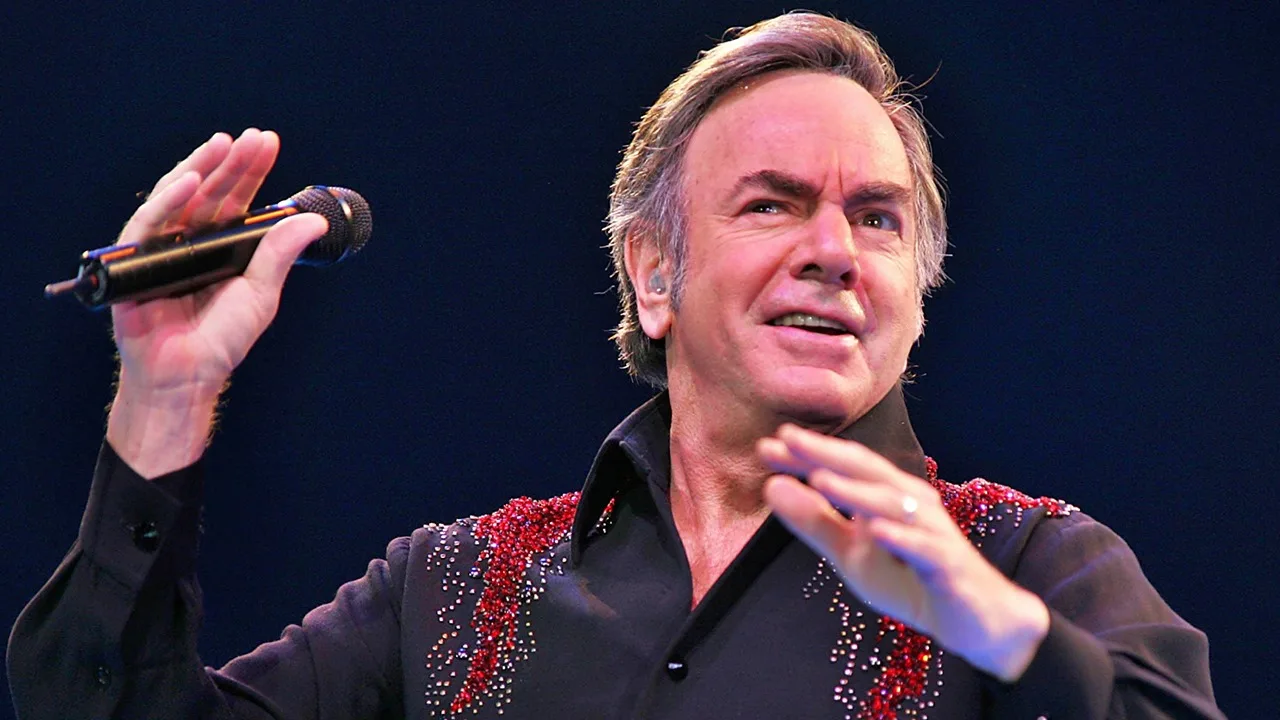
“If You Know What I Mean” is a song about the hush between two people who once shared everything—where the past returns in flashes of music, smoke, and half-spoken memories that don’t need explaining.
Released in June 1976 as the lead single from Neil Diamond’s album Beautiful Noise, “If You Know What I Mean” arrived like a familiar voice calling from the far end of a hallway. On the Billboard Hot 100, it debuted at No. 55 (June 19, 1976) and ultimately peaked at No. 11 (August 7, 1976)—a climb that felt steady rather than sensational, as if the song was simply finding the listeners who already had a place for it in their lives. And on Billboard’s Easy Listening (now Adult Contemporary) chart, it reached No. 1 for two nonconsecutive weeks, with July 17, 1976 and August 14, 1976 marked as its weeks at the summit.
That chart story sits inside a bigger one: Beautiful Noise was produced by Robbie Robertson (of The Band), and it was widely seen as a stylistic pivot—richer in texture, broader in arrangement, and more “cinematic” in its emotional lighting than much of Diamond’s immediate earlier work. Even Cash Box, reviewing the single in June 1976, called it “somewhat of a departure,” praising its shifting musical moods and the way the string-backed chorus rises to “an emotional peak”—and they singled out Robertson’s production as a major asset.
But the real hook of “If You Know What I Mean” isn’t the chart math. It’s the way the song speaks in shared shorthand—as if the listener has been invited into a private conversation where the most important details are understood, not declared. The title itself is a wink that can carry tenderness, regret, mischief, and longing all at once. It’s the phrase you use when words are too clumsy for what you’re trying to confess.
There’s also an unusually personal undertow in Diamond’s own description of the song. He has described it as a “tender recollection” of a relationship from his teenage years, involving an affair with a significantly older woman—a memory told not with scandalous heat, but with the softened focus of time. That context doesn’t reduce the song to autobiography, but it does explain its particular emotional temperature: this isn’t a young man pleading to be loved; it’s an older narrator looking back at the moment love first felt dangerous, secretive, and irreversible.
Listen closely to how the song is built. It doesn’t march in a straight line. It drifts, it gathers itself, it returns—like memory does. The verses feel like someone turning over old photographs in dim light, pausing not on the obvious smiles but on the background details: the room, the music, the atmosphere. Then, when the chorus blooms, the arrangement lifts the way the heart lifts when it recognizes a name it hasn’t said in years. That rise-and-fall is exactly what Cash Box heard when they praised the track’s “diverse” moods and that climactic chorus.
And that’s the song’s deeper meaning: nostalgia as a double-edged gift. In Diamond’s hands, remembering isn’t only sweetness—it’s the ache of realizing you can’t step back into those moments without also touching what you lost. The phrase “if you know what I mean” becomes a small refuge: a way to keep the memory intact without exposing it to daylight, judgment, or explanation. It’s not just suggestive—it’s protective.
Maybe that’s why “If You Know What I Mean” has endured beyond its 1976 run. It doesn’t demand attention; it earns intimacy. It’s the kind of song that waits patiently until you’ve lived enough to understand it—until you, too, have a few names and nights that return without permission, carried back on the smallest things: a melody, a scent, a line you haven’t thought about in decades… and suddenly you do. If you know what I mean.